Decide between roof repair vs replacement with our guide. Use our four-step framework to evaluate age, damage, and costs to save money on your roof.
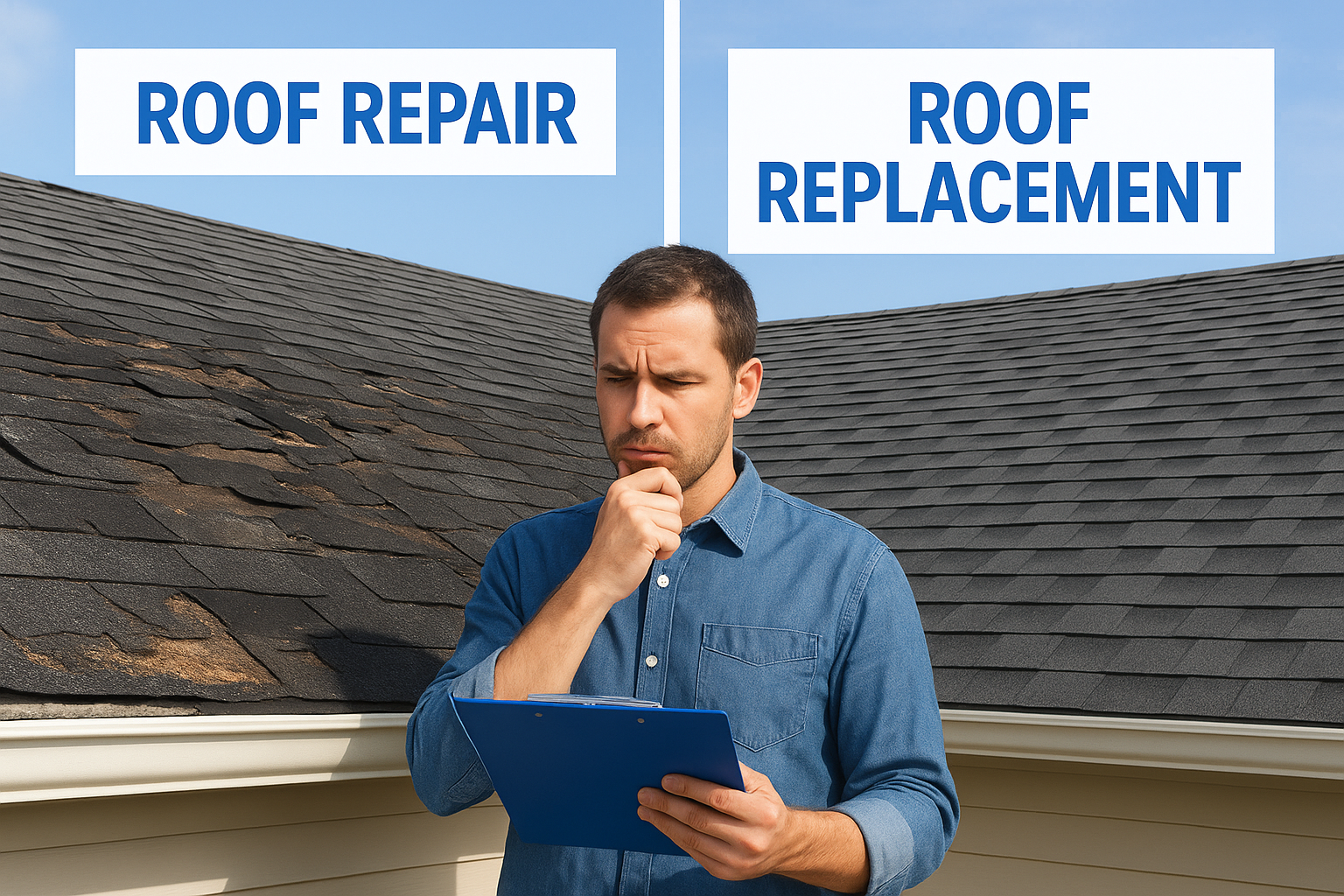
You've got a leak, missing shingles, or maybe a neighbor just got a whole new roof after the last hailstorm, and now you're wondering whether your roof needs a patch or a complete do-over. The decision between roof repair vs replacement isn't always obvious, and getting it wrong can cost you thousands. A premature replacement wastes money you didn't need to spend. But sinking cash into repairs on a roof that's past its useful life? That's money down the drain, too.
At Defend Roofing, we walk Central Texas homeowners through this exact decision every week. As a father-and-son team with three generations of roofing experience, we've seen plenty of roofers push full replacements when a targeted repair would've handled the problem, and we've seen homeowners patch a roof six times when they needed to replace it after the first failure. We don't benefit from steering you the wrong way, and our 100+ photo Precision Roof Assessment gives you the documented evidence to see exactly what's going on up there.
This guide breaks down the factors that actually matter when deciding between repair and replacement, including roof age, damage extent, cost comparisons, and the industry rules of thumb (like the 25% and 50% thresholds) that help frame the decision. By the end, you'll have a clear framework to make the right call for your home and your budget.
Most homeowners jump straight to cost when they face roof repair vs replacement, but cost alone won't give you a clear answer. The right decision comes from looking at a combination of factors that interact with each other. A targeted repair can be the smart move on a structurally sound roof. On a roof that's already declining from age or widespread damage, that same repair is money you'll spend twice when the next failure shows up six months later.
Getting this decision right means working through four specific factors in order: roof age and material lifespan, the source and spread of damage, the math behind repair vs replacement costs, and any code or insurance constraints tied to your home.
Each of the four factors below acts as a filter. Work through them in sequence, and by the time you reach the last one, the right path becomes much clearer. Skipping any factor leaves a gap in your analysis that often leads to a decision you'll want to undo.
| Factor | What you're evaluating | Why it matters |
|---|---|---|
| Roof age and material | How much usable life remains | An old roof may not justify repair costs |
| Damage source and spread | Whether damage is localized or systemic | Widespread deterioration typically points to replacement |
| Cost comparison | The 25% and 50% repair-cost thresholds | Shows when repairs stop making financial sense |
| Codes, insurance, and timeline | Local requirements and your personal plans | These can override the math entirely |
You don't need to climb on your roof to begin this process. Start with your paper trail: pull your original home inspection report, any previous roofing invoices, and your current homeowner's insurance policy. These documents tell you the roof's approximate age, what work has already been done, and what your coverage limits and deductible look like before an adjuster arrives.
After gathering your records, get a professional roof assessment that includes photographic documentation of every identified issue. This step matters more than most homeowners realize. Damage that appears minor from the street, a few lifted shingles, soft decking, or granule buildup in the gutters, can point to something much more serious underneath. Photos also give you a clear record if you need to file an insurance claim or get a second opinion.
Armed with your records and a documented inspection, you have everything you need to work through the four factors without relying on a salesperson's word for it. The steps below walk you through each one, so you can apply them to your specific roof.
Roof age is the first filter because it tells you how much useful life remains in your current system. If you don't know your roof's installation date, start with your home inspection report or closing documents from when you purchased the house. Previous roofing invoices, permit records from your local municipality, or even a call to the previous owner can fill in the gap if those documents are missing.
Every roofing material carries a manufacturer-rated lifespan, and knowing yours tells you how many years you have left to work with. A roof with 10 or more years of life remaining is generally a strong candidate for repair. One sitting at or past its rated lifespan is not, regardless of how minor the visible damage looks from the ground.
Here are the standard lifespans by material type:
| Roofing material | Expected lifespan |
|---|---|
| 3-tab asphalt shingles | 15-20 years |
| Architectural asphalt shingles | 25-30 years |
| Metal roofing (standing seam) | 40-70 years |
| Tile (clay or concrete) | 50+ years |
| Wood shake | 20-30 years |
If your roof is within 5 years of the end of its rated lifespan, any repair you make is likely a short-term fix that delays an inevitable replacement by only a season or two.
An aging roof doesn't fail in one spot. It fails systemically, meaning granule loss, shingle brittleness, and dried-out flashing appear across the entire surface, not just where you see the active leak. When your roof is in its final quarter of expected life, a repair addresses the symptom but not the underlying decline. Spending money on repeated patches at that stage rarely pays off and often delays a replacement you'll need within a year or two anyway.
Knowing where the damage starts tells you whether you're dealing with an isolated problem or a roof that's failing across the board. A single cracked shingle after a hailstorm is very different from granule loss across multiple slopes, waterlogged decking, or flashing that has pulled away from a chimney along its entire length. Before you can make a sound roof repair vs replacement decision, you need to know both the source of the damage and how far it has spread.
Localized damage is confined to a specific area, typically one slope, one flashing point, or a small cluster of shingles. Systemic damage spreads across multiple sections and usually points to underlying deterioration rather than a single weather event. Use the checklist below to identify which category your roof falls into:
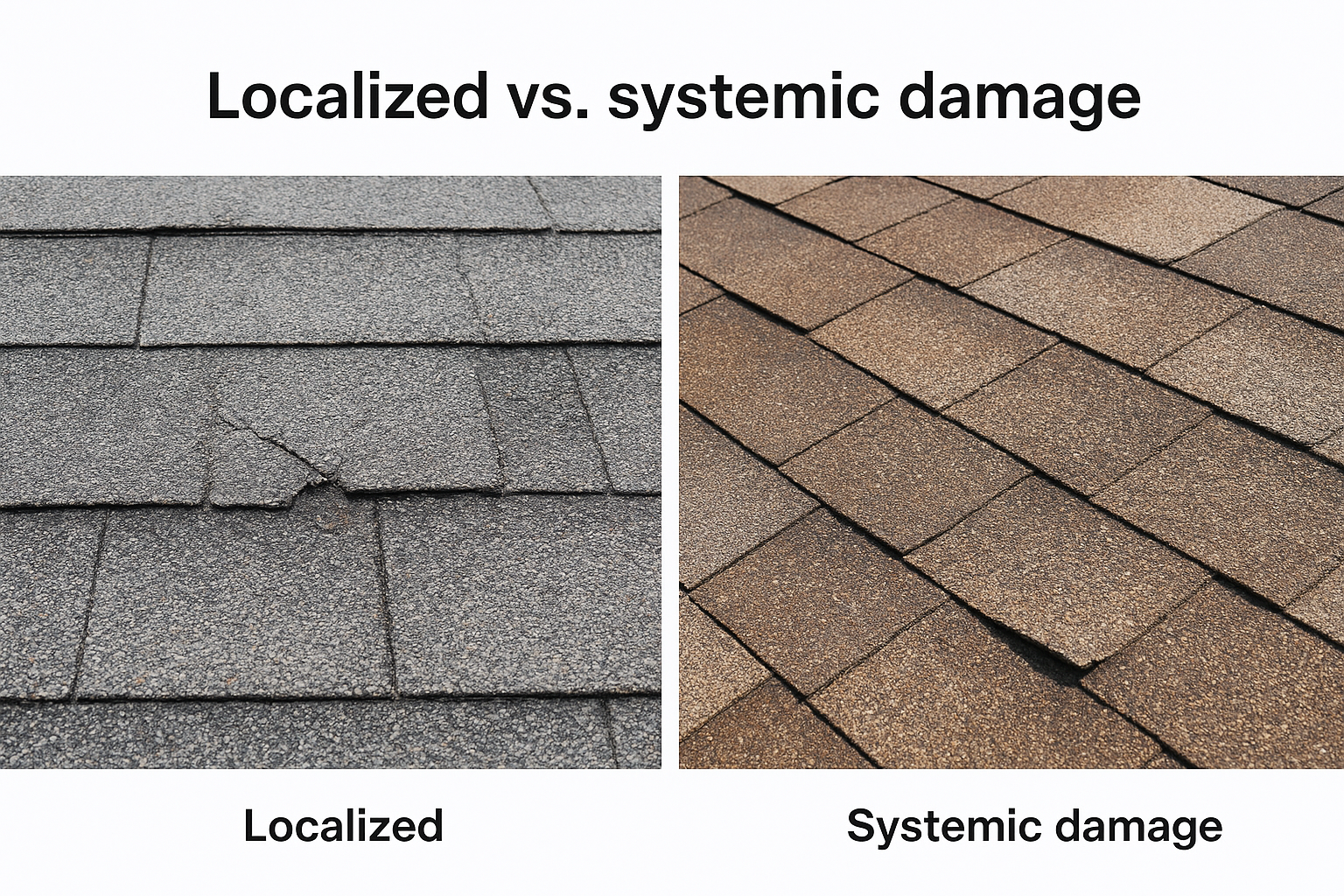
If you find soft decking beneath more than one section of the roof, that structural compromise almost always points toward replacement rather than repair.
Walk your attic first. Water stains, mold streaks, and daylight coming through the decking tell you where moisture has already entered and how far it has traveled. Photograph every stain with a date stamp so you have a documented timeline of damage progression you can show to an insurance adjuster.
From the ground, use binoculars to check each slope for shingle uniformity and granule coverage. Note any areas where the color shifts or where shingles appear raised, which signals wind or moisture intrusion beneath the surface.
Once you know your roof's age and the spread of damage, cost math gives you a third filter that cuts through a lot of uncertainty. Two widely used industry thresholds, the 25% rule and the 50% rule, help you compare what you'll spend on repairs against what a full replacement would cost. Neither rule is a guarantee, but together they give you a clear financial framework for the roof repair vs replacement decision.
The 25% rule says that if your repair cost lands below 25% of the total replacement cost, repair is almost always the smarter financial move, provided your roof still has meaningful life remaining. Start by getting a written estimate for a full replacement from a licensed contractor, then compare your repair quote against that number.
Here is a simple template you can fill in:
| Item | Your number |
|---|---|
| Full replacement estimate | $____________ |
| 25% threshold (multiply by 0.25) | $____________ |
| Repair estimate | $____________ |
| Is repair below the 25% threshold? | Yes / No |
If your repair estimate falls below that 25% line and your roof has more than 5 years of rated life remaining, a targeted repair will almost always deliver a better return than a full replacement.
When your repair estimate exceeds 50% of the replacement cost, the math tilts decisively toward replacement. At that spending level, you are paying a significant portion of a new roof's price without actually getting one. You also miss out on the manufacturer warranty and workmanship guarantee that come with a full installation.
Apply the same template above, but this time check whether your repair quote clears the 50% line. If it does, put that money toward a replacement instead and avoid paying twice.
Even when the math strongly favors repair, local building codes and your insurance policy can override that conclusion entirely. Check these two external factors alongside your personal timeline before you sign any contract.
Many Texas municipalities follow the International Residential Code (IRC), which requires a full replacement when more than 25% of a roof surface is damaged or removed within a 12-month period. If your repair scope crosses that threshold, a permit-pulling contractor is legally required to bring the entire roof up to current code standards, which often makes full replacement the only compliant option. Call your local building department or check your city's permitting portal to confirm the exact threshold in your jurisdiction before committing to a repair scope.
Your homeowner's insurance policy type changes what you actually pay out of pocket. Actual Cash Value (ACV) policies pay the depreciated value of your damaged roof, while Replacement Cost Value (RCV) policies cover the full cost of a new roof after you meet your deductible. Knowing which type you hold changes whether repair or replacement makes more financial sense after a storm event.
If your adjuster's damage assessment already covers 50% or more of a new roof's cost, your out-of-pocket exposure for a full replacement may be smaller than the cost of a repair you fund entirely on your own.
Plans to sell within 18 months push the decision toward replacement, since a new roof delivers stronger resale value and buyer confidence than a documented history of patchwork repairs. Staying for another decade means prioritizing long-term performance, which loops back to the roof repair vs replacement framework you've worked through in steps one through three. Either way, your timeline acts as the final filter that locks in your decision.
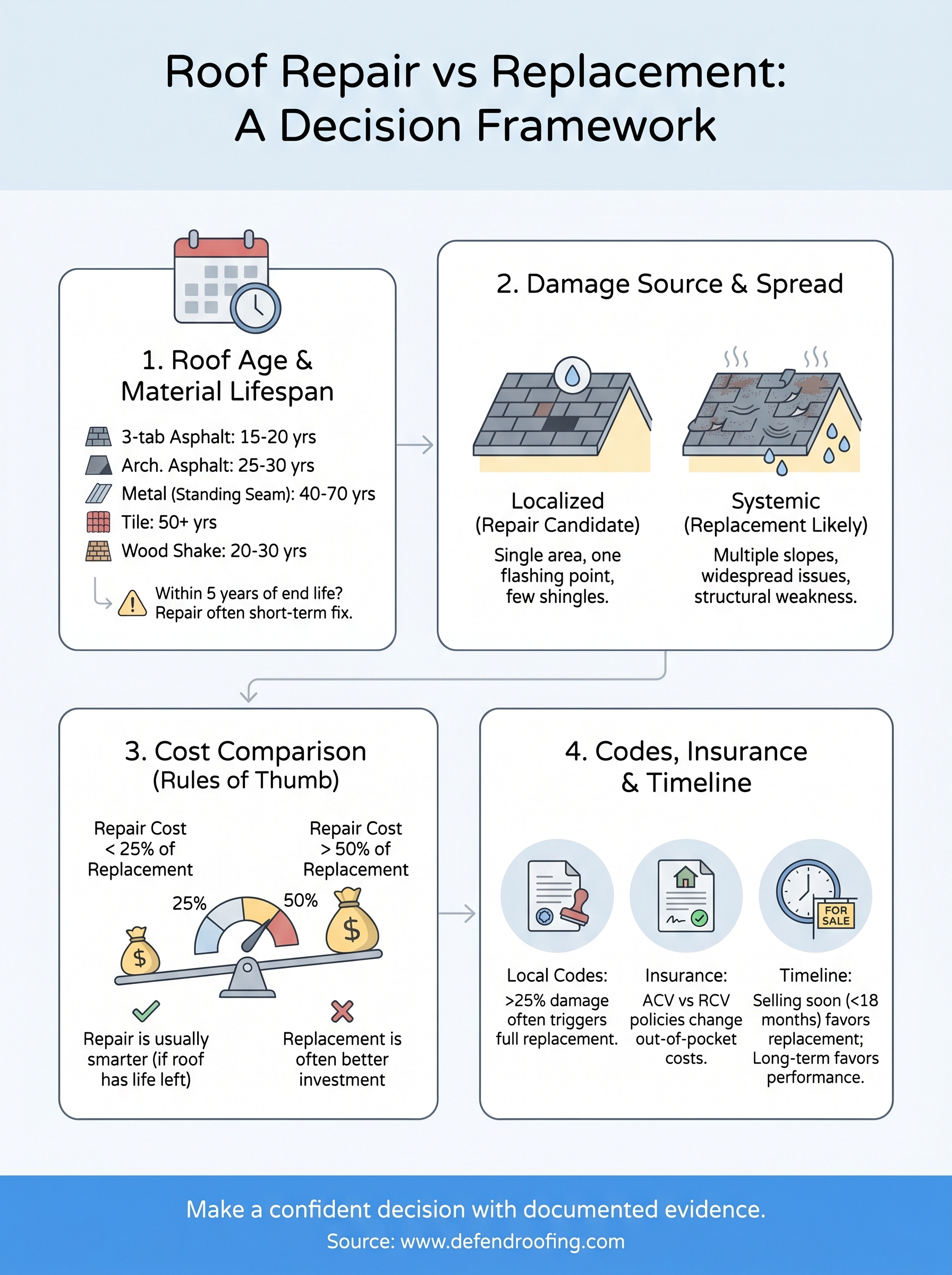
You now have a four-step framework that cuts through the noise on roof repair vs replacement: check your roof's age against its material lifespan, document the source and spread of damage, run the 25% and 50% cost thresholds, and factor in codes, insurance, and your personal timeline. Working through those steps in order gives you a decision grounded in evidence, not a contractor's sales pitch.
The next practical step is getting a documented roof assessment from someone who will show you exactly what is up there. At Defend Roofing, every assessment includes 100+ photos and a straight recommendation based on what your roof actually needs, not what generates the largest invoice. If you are in the Austin area and want a clear answer on your roof, schedule your Precision Roof Assessment today and get the documented evidence you need to make a confident decision.