Compare 12 ways to pay for your roof replacement. Learn how to finance a new roof using insurance, loans, or equity, and weigh the pros and cons of each.

A roof replacement in Central Texas typically costs between $8,000 and $25,000 depending on materials, size, and complexity. That's not a number most homeowners can pull from a checking account on short notice. If you're wondering how to finance a new roof, you're not alone, and you have more options than you might think.
At Defend Roofing, we're a father-and-son team (Chris and Greyson Buster) with three generations of roofing experience serving Austin and the surrounding communities. We walk homeowners through every part of the roof replacement process, including the financial side. We've seen people overpay for bad financing terms because they didn't know what was available to them. We've also helped homeowners save thousands by navigating insurance claims before financing a single dollar out of pocket.
The truth is, the right financing path depends entirely on your situation, your credit, your equity, your timeline, and whether insurance covers part of the cost. A HELOC makes sense for one homeowner. A contractor financing plan works better for another. Government assistance programs exist but come with specific qualifications.
This guide breaks down 12 ways to pay for a new roof, including personal loans, home equity options, credit cards, contractor financing, insurance claims, and government programs. For each one, we cover how it works, the real pros and cons, and who it's best suited for, so you can make a decision based on facts, not a sales pitch.
If you're searching for how to finance a new roof without dealing with banks or lenders on your own, contractor financing is often the most convenient starting point. At Defend Roofing, we offer financing options for qualified homeowners directly through our company, so you can move forward with your roof replacement without waiting weeks for a separate loan approval or gathering stacks of paperwork at a bank branch.
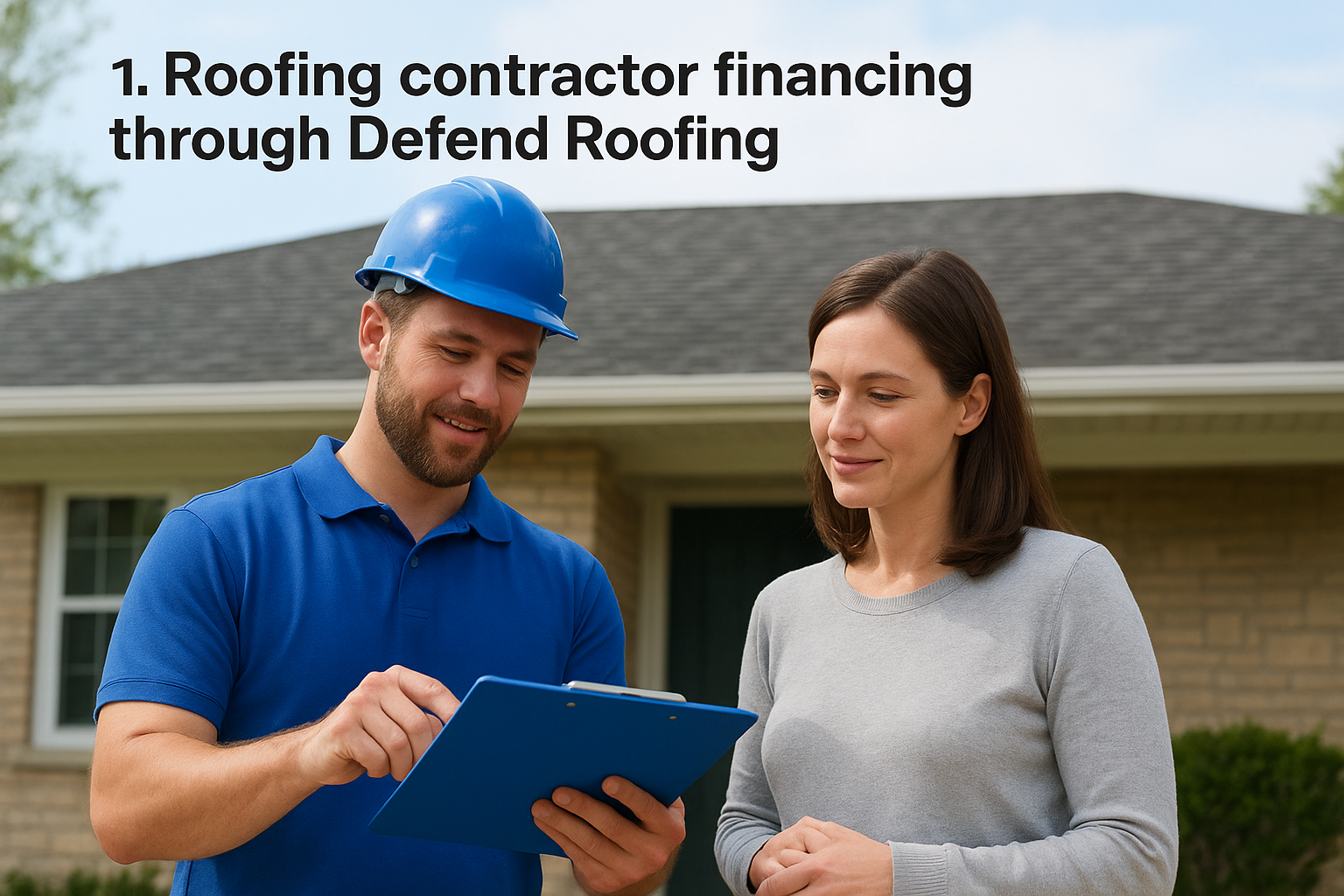
Defend Roofing partners with third-party lenders to offer financing at the point of sale. After your Precision Roof Assessment and final project quote, you apply through our financing partner. Approval decisions typically come back quickly, often within minutes, and you review all terms before committing to anything. The lender pays Defend Roofing for your project, and you repay the lender in structured monthly installments over your chosen term.
Contractor financing works best for homeowners who need a new roof now but don't have cash on hand or enough equity to use a home equity product. It's also a strong fit if you want a single, streamlined process without separately coordinating with a bank or credit union. If your credit score is in decent shape, you'll likely qualify for competitive terms through our lending partner.
Rates through contractor financing programs vary based on your credit profile, but they typically range from 6.99% to 24.99% APR depending on the lender and your qualifications. Funding is fast, usually within one to two business days after approval, which makes this one of the quickest paths to getting a project started compared to most bank-based alternatives.
If your roof has active leaks or recent storm damage, the fast funding timeline of contractor financing makes it worth serious consideration before the damage compounds further.
Before you accept any financing offer, get clear answers to these specific questions:
Clear answers to each of these protect you from unexpected costs once the project is complete.
Before you start figuring out how to finance a new roof, check whether your homeowners insurance will cover part or all of the cost. In Central Texas, hail and wind events regularly damage roofs enough to qualify for a full insurance-covered replacement, which means you may not need to finance much at all.

You file a claim with your insurance carrier after a qualifying storm event. An adjuster inspects your roof and documents the damage. If approved, your insurer pays out based on your policy terms, either actual cash value (ACV) or replacement cost value (RCV), minus your deductible. At Defend Roofing, we provide 100+ photo documentation with every Precision Roof Assessment, which gives adjusters clear evidence and helps prevent lowball settlements.
Getting a thorough roof assessment before the adjuster visits can significantly impact the size of your approved claim.
This option works best for homeowners who experienced recent storm damage from hail, wind, or fallen debris. If your roof is showing signs of granule loss, dented vents, or broken shingles after a storm, an insurance claim is the first call to make.
Your only out-of-pocket cost is your deductible, typically $1,000 to $2,500 for most Texas policies. Claim payouts usually arrive within two to four weeks after adjuster approval.
Paying for a roof replacement with money you already have is the simplest and lowest-cost path available. No applications, no interest charges, no lender approval. If you're thinking about how to finance a new roof without taking on any debt, building or tapping into dedicated savings is the cleanest option on this entire list.
You pay your roofing contractor directly from savings at the time of the project. Some homeowners plan ahead by setting up a dedicated "sinking fund," which is a savings account where you deposit a fixed monthly amount specifically for large home expenses like a roof. Over two to three years, even modest contributions add up enough to cover a significant portion of replacement costs.
A dedicated roof sinking fund works best when you start it the day after your last roof installation, giving you 15 to 20 years to build the balance before the next replacement is due.
This option is best for homeowners with existing savings, those who can delay their project a few months while saving more, or anyone who wants to avoid taking on debt and has the flexibility to wait.
Your total cost equals exactly what you pay the contractor, nothing more. Funding is immediate if the money is already saved.
A personal loan is one of the most straightforward ways to cover a roof replacement when you don't have equity to borrow against or savings to tap. Banks, credit unions, and online lenders all offer personal loans, which means competition keeps the process accessible for a wide range of credit profiles.
You apply with a lender, get approved based on your creditworthiness and income, and receive a lump sum deposited directly to your bank account. You then pay your contractor as you would with cash. Repayment happens in fixed monthly installments over a set term, typically two to seven years, with a fixed interest rate locked in at the time of approval.
Personal loans work well for homeowners with good to excellent credit who don't have meaningful home equity built up yet. If you're figuring out how to finance a new roof and you've been in your home only a few years, a personal loan may be the most realistic unsecured option available to you.
APRs generally range from 7% to 36% depending on your credit score and the lender. Funding usually arrives within one to three business days after approval.
Borrowers with credit scores above 720 tend to qualify for the most competitive personal loan rates, so checking your score before applying helps you set realistic expectations.
A home equity line of credit (HELOC) lets you borrow against the equity you've built in your home, and it's one of the most flexible tools available when you're figuring out how to finance a new roof. Instead of receiving a lump sum, you get access to a revolving credit line you draw from as needed, similar to how a credit card works but secured by your home.

Your lender establishes a credit limit based on your home's appraised value minus what you still owe on your mortgage. During the draw period, typically 5 to 10 years, you borrow what you need, repay it, and borrow again. You pay interest only on the amount you actually draw, not the full credit line. After the draw period closes, you enter the repayment phase and make principal-plus-interest payments until the balance is cleared.
A HELOC works particularly well if your roof project has multiple phases or if you want to keep a financial cushion available for other home repairs.
This option suits homeowners with substantial equity who want flexibility and don't mind a variable interest rate. It's a strong fit if you're also planning other home improvements beyond just the roof.
Current HELOC rates typically fall between 8% and 12% APR, though your exact rate depends on your credit profile and current prime rate. Approval and funding usually take two to six weeks.
A home equity loan gives you a lump sum upfront, secured by the equity in your home, and you repay it in fixed monthly installments at a fixed interest rate. Unlike a HELOC, there's no revolving credit line here. You borrow once, you repay on a set schedule, and the rate never changes. If you're deciding how to finance a new roof and want predictable payments without the uncertainty of a variable rate, a home equity loan is worth a close look.
Your lender calculates your available equity by subtracting your remaining mortgage balance from your home's current appraised value. You can typically borrow up to 80% to 85% of that equity. Funds arrive as a single lump sum after closing, and repayment starts immediately on a fixed schedule over 5 to 30 years.
Because the rate is fixed from day one, a home equity loan protects you from payment increases if market interest rates climb during your repayment period.
This option works best for homeowners with significant equity who prefer the certainty of a fixed rate over the flexibility of a revolving credit line. It's also a strong fit if you're financing a single, well-defined project with a clear total cost, like a full roof replacement.
Rates typically range from 7% to 11% APR depending on your credit and equity. Funding usually takes two to five weeks after application due to the appraisal and closing process.
A cash-out refinance replaces your existing mortgage with a new, larger loan and gives you the difference in cash at closing. If you're exploring how to finance a new roof and you've built up solid home equity, this option lets you tap that equity while potentially resetting your mortgage rate at the same time. It's one of the larger financial moves on this list, so it makes the most sense when the numbers work on both sides of the transaction.
You refinance your current mortgage for more than your remaining balance, and the lender sends you the gap as a lump sum. For example, if you owe $200,000 on a home worth $350,000, you might refinance for $225,000 and receive $25,000 in cash to apply toward your roof. Your new monthly payment then reflects the larger loan balance and updated interest rate.
Cash-out refinancing works best for homeowners with substantial equity and a current mortgage rate that's at or above today's market rates. If refinancing lowers your rate while also freeing up cash, the combined benefit can offset the closing costs over time.
Rates typically range from 6% to 9% APR depending on your credit profile and current market conditions. Funding takes four to six weeks because the process requires full mortgage underwriting, an appraisal, and a closing.
A cash-out refinance only makes financial sense if the new rate does not significantly increase your total interest paid across the remaining life of the loan.
The FHA 203k loan is a government-backed mortgage that wraps a home purchase or refinance together with funds for renovation, including roof replacement. If you're looking at how to finance a new roof while also tackling other repairs, this loan bundles everything into one monthly payment instead of stacking separate financing products.
The FHA 203k program lets you borrow based on the projected value of your home after repairs, not its current condition. A HUD-approved consultant inspects your home, scopes the work, and submits the project details to your lender. Funds are held in an escrow account and released to contractors as work is completed and verified, which adds a layer of accountability to the process.
The 203k loan is administered through FHA-approved lenders, not directly through the government, so you apply at a bank or credit union that participates in the program.
This option works best for homeowners purchasing a fixer-upper or refinancing a home that needs significant repairs beyond just the roof. It's also worth considering if your credit score sits in the 580 to 620 range, where conventional renovation loans become harder to qualify for.
Rates typically land between 6.5% and 9% APR. Funding takes 45 to 90 days because of the consultant requirement and extended underwriting process.
The Fannie Mae HomeStyle loan is a conventional renovation mortgage that combines your home financing with project funds, similar in concept to the FHA 203k but with fewer restrictions and broader eligibility. If you're researching how to finance a new roof alongside other home improvements, the HomeStyle loan bundles everything into a single mortgage product backed by a conventional lender.
You apply for a HomeStyle loan through a Fannie Mae-approved lender, and the total loan amount is based on your home's projected value after the renovation is complete. Your contractor submits a detailed project scope and cost estimate upfront. Renovation funds are held in escrow and released as work reaches verified completion milestones, which keeps the project on track and protects your investment throughout the process.
The HomeStyle loan covers a wide range of improvements beyond roofing, so it can be especially useful if your home needs multiple repairs addressed at once.
This loan suits homeowners with good credit scores (typically 620 or higher) who want conventional loan terms rather than FHA requirements. It's also a strong fit if you're purchasing a home that needs a new roof before move-in.
Rates typically fall between 6.5% and 9% APR depending on your credit and equity. Funding generally takes 45 to 75 days from application to close.
If you're low-income or a senior homeowner trying to figure out how to finance a new roof, government and nonprofit programs may cover some or all of your costs without requiring repayment. These programs exist at the federal, state, and local levels, and they often go unclaimed simply because homeowners don't know they qualify.

Programs like the USDA Section 504 Home Repair program provide grants and low-interest loans to qualifying rural homeowners for essential repairs, including roofing. At the local level, many counties and cities run their own housing rehabilitation programs funded through HUD's Community Development Block Grant (CDBG) initiative. Nonprofits like Habitat for Humanity also run home repair programs in select markets. Eligibility typically depends on your income level, age, homeownership status, and location.
Contacting your local housing authority directly is the fastest way to find out which programs are active in your area.
This option is best for low-income homeowners, seniors on fixed incomes, or households that have experienced a disaster event and cannot afford out-of-pocket roof costs.
Grant programs have no repayment cost if you qualify. Subsidized loan rates can be as low as 1% APR. Funding timelines range from 30 to 180 days depending on the program.
A 0% intro APR credit card is a viable short-term option when you're figuring out how to finance a new roof, especially if you can pay off the balance before the promotional period ends. Used correctly, it functions as an interest-free loan for 12 to 21 months depending on the card.
You charge the roofing project to a card offering a 0% introductory APR, then pay down the balance in full before the promotional period expires. Once the intro period ends, the remaining balance converts to the card's standard variable APR, which can climb steeply. The strategy only works if you're disciplined about making consistent monthly payments throughout the promotional window.
If your roof replacement costs $10,000 and your intro period runs 18 months, you need to pay roughly $556 per month to clear the balance before interest kicks in.
This option works best for homeowners with strong credit scores who qualify for cards with long promotional periods and can realistically pay off the balance before the rate resets. It suits smaller roof repair jobs more reliably than full replacements.
Your cost is $0 in interest if you pay within the promo window. After that, standard APRs typically range from 20% to 30%. Funding is immediate once the card is open and active.
Borrowing from your retirement account is technically an option when you're trying to figure out how to finance a new roof, but it comes with trade-offs that make it the last resort on this list. A 401k loan lets you borrow from your own balance and repay yourself with interest, which sounds appealing until you account for what you're giving up in long-term investment growth.
Most 401k plans allow you to borrow up to 50% of your vested balance or $50,000, whichever is lower. You repay the loan through payroll deductions over a set term, typically five years, with interest that goes back into your own account. If you leave your job before repaying the balance, the remaining amount becomes a taxable distribution and may trigger a 10% early withdrawal penalty if you're under 59.5.
If you lose your job while carrying a 401k loan, the full remaining balance may become due within a matter of months.
This option suits homeowners with no other viable financing options who have a stable job and can repay the loan before any employment disruption occurs. It is a last-resort tool, not a primary strategy.
Interest rates are typically prime rate plus 1%, currently around 9%. Funds arrive within one to two weeks of approval.

You now have a complete picture of how to finance a new roof, from contractor financing and insurance claims to home equity products and government assistance. The right choice depends on your credit, your equity, your timeline, and whether storm damage puts an insurance payout on the table before you borrow a single dollar.
Before you commit to any financing path, start with an honest assessment of your roof's actual condition. At Defend Roofing, every Precision Roof Assessment includes 100+ photos and a straightforward repair-versus-replace recommendation with no pressure attached. You get the facts, and you make the decision.
If you're ready to understand exactly what your roof needs and explore your financing options with a team that's been doing this for three generations, reach out today. Schedule your free roof assessment and we'll walk you through everything from the first inspection to the final payment.