Learn what size gutters do I need for your home. Compare 5-inch and 6-inch gutters based on your roof’s pitch, drainage area, and local rainfall intensity.
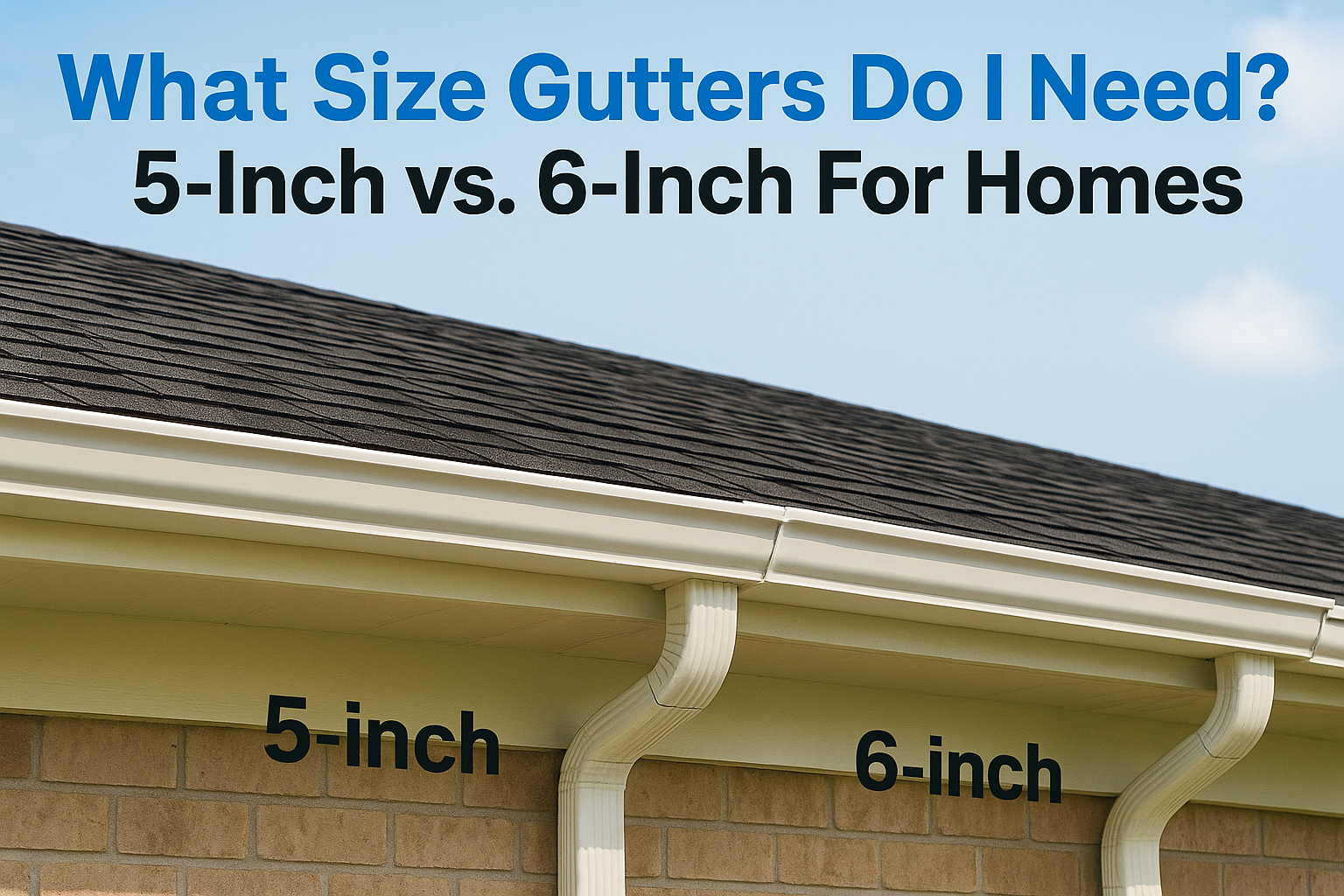
If you're asking what size gutters do I need, the answer depends on a few measurable factors, not guesswork. Your roof's square footage, pitch, and the rainfall intensity here in Central Texas all play a role in whether 5-inch or 6-inch gutters are the right call for your home.
Undersized gutters overflow. That overflow leads to fascia rot, foundation erosion, and landscaping damage, problems that cost far more than the gutters themselves. Oversized gutters waste money upfront and can look disproportionate on smaller homes. Getting the size right matters, and it's more straightforward than most homeowners expect.
At Defend Roofing, we assess gutters alongside every roof we inspect as part of our 100+ photo Precision Roof Assessment. Chris and Greyson Buster have seen firsthand how the wrong gutter size creates recurring issues for Austin-area homeowners. This guide walks you through the exact factors that determine your gutter size, gives you a simple way to calculate it yourself, and explains when each option makes the most sense.
Three variables drive every gutter sizing decision: roof drainage area, roof pitch, and local rainfall intensity. Most homeowners focus on linear footage when shopping for gutters, but that number tells you how much material to buy, not what size to buy. Answering the question of what size gutters do I need starts with understanding how these three inputs interact to set your minimum required gutter capacity.
Your roof's drainage area is the horizontal square footage each gutter run must handle, not the actual sloped surface area. You measure the footprint of each roof section that drains into a single gutter, not the pitch. A larger drainage area funnels a higher volume of water per hour, and that volume directly sets the minimum capacity your gutters must carry. When a single gutter run handles more than roughly 5,500 square feet of adjusted drainage area, 5-inch gutters will fall short and 6-inch gutters become the practical choice.
One of the most common sizing mistakes is calculating total roof area instead of breaking the roof into individual drainage sections per gutter run.
Pitch affects how fast water leaves your roof surface. A steeper pitch accelerates runoff, so water arrives at your gutters faster and in larger surges than the same rain event would produce on a low-slope roof. The industry uses a pitch correction factor to adjust your base drainage area upward for steeper roofs before sizing:
| Roof Pitch | Correction Factor |
|---|---|
| Up to 6:12 | 1.0 (no adjustment) |
| 7:12 to 8:12 | 1.1 |
| 9:12 to 11:12 | 1.2 |
| 12:12 and above | 1.3 |
Multiply your measured drainage area by the applicable factor before you size any gutter run. Skipping this step is one of the most common reasons gutters overflow even when they appear correctly sized at first glance.
Rainfall intensity is measured in inches per hour during a peak storm event, not average annual totals. Central Texas and the Austin Hill Country regularly see intense, short-duration storm cells that can produce over 3 inches of rain per hour at peak intensity. That figure multiplies your corrected drainage area to produce a peak flow rate in gallons per minute, which is the number that gutter capacity tables are built around. Sizing gutters based on average rainfall instead of peak intensity leads directly to overflow during the summer storm season, when it matters most.
Your roof is divided into multiple sections, and each section drains into its own gutter run. You need the horizontal footprint of each individual section, not the total sloped surface area of your entire roof. This distinction is the starting point for answering what size gutters do I need correctly.
Stand outside and look at your home from above, or pull up your property address on a satellite view tool. Identify each distinct roof plane and the gutter run it feeds. For a standard rectangular section, you measure the length times the width of the ground-level footprint directly beneath that section, ignoring the slope entirely.

If one gutter run collects water from multiple roof planes, such as a main roof and an adjoining dormer, add both footprint areas together before moving forward.
Here is a straightforward calculation for a common single-story section:
| Measurement | Value |
|---|---|
| Section length (horizontal) | 40 ft |
| Section width (horizontal) | 20 ft |
| Base drainage area | 800 sq ft |
For a two-story home, the same method applies. You still measure the horizontal projection at ground level, not the actual sloped roof length. Write down the base drainage area for each individual gutter run separately, because every run gets sized on its own load, not the roof total. Once you have those numbers, carry each one into the pitch correction in Step 2.
Now that you have your base drainage area for each gutter run, you apply two adjustments before picking a gutter size: pitch correction and a layout check for complex roofs. Both adjustments change the effective load your gutters must carry without changing your home's footprint.
Multiply your base drainage area by the correction factor that matches your roof's pitch. A steeper roof sends water to your gutters faster, which raises the effective hydraulic load even if the footprint stays the same. Use the table below to find your multiplier:
| Roof Pitch | Correction Factor |
|---|---|
| Up to 6:12 | 1.0 |
| 7:12 to 8:12 | 1.1 |
| 9:12 to 11:12 | 1.2 |
| 12:12 and above | 1.3 |
So an 800 sq ft drainage section on a 9:12 roof becomes 960 sq ft adjusted (800 × 1.2). Carry that adjusted number forward into Step 3.
Some roof layouts funnel two or more planes into a single gutter run. If a dormer, valley, or secondary roof section deposits water into the same gutter as your main roof plane, add both adjusted areas together before answering what size gutters do I need for that specific run.
Missing a shared drainage point is the fastest way to undersize a gutter run on a complex roof.
A hip roof is the most common example where homeowners underestimate load. Each hip section drains toward a corner, so the gutter at each corner receives runoff from two planes simultaneously. Calculate each corner run as a combined load before moving to the next step.
Your adjusted drainage area from Step 2 is only half the equation. You also need your local peak rainfall intensity in inches per hour to calculate the actual flow rate your gutters must handle. That flow rate is what separates a 5-inch from a 6-inch decision.
Central Texas homeowners in the Austin area should plan for a design rainfall intensity of 7 to 8 inches per hour during a 5-minute peak storm event. That figure comes from NOAA's precipitation frequency data for the region. If you live in a lower-rainfall area, your number may be closer to 4 or 5 inches per hour, which changes your sizing outcome significantly.
Using average annual rainfall instead of peak hourly intensity is the single most common mistake that leads to overflowing gutters.
Multiply your adjusted drainage area by your peak rainfall rate, then divide by 96. That gives you the required flow capacity in gallons per minute for that gutter run. Use the table below to match your result to the right gutter size:

| Required Flow (GPM) | Gutter Size |
|---|---|
| Up to 31 GPM | 5-inch K-style |
| 31 to 47 GPM | 6-inch K-style |
| Above 47 GPM | 6-inch + additional downspouts |
For example, a 960 sq ft adjusted area at 7 inches per hour equals 70 GPM (960 × 7 ÷ 96). That result clearly points to 6-inch gutters for that run, and it gives you a concrete, numbers-based answer to what size gutters do i need for each section of your roof.
Your gutters only perform as well as your downspouts allow. A correctly sized gutter run that drains through an undersized or too-infrequent downspout will still back up and overflow. Once you know what size gutters do i need for each run, you also need to confirm that your downspouts can clear water fast enough to keep pace with peak flow.
A standard 3-inch by 4-inch rectangular downspout handles roughly 20 GPM under normal conditions. A round 4-inch downspout handles a similar volume. Use the flow rate you calculated in Step 3 to determine how many downspouts each run requires.
| Required Flow (GPM) | Downspouts Needed per Run |
|---|---|
| Up to 20 GPM | 1 downspout |
| 21 to 40 GPM | 2 downspouts |
| Above 40 GPM | 3 or more downspouts |
Space your downspouts no more than 40 feet apart along any single gutter run. Placing them at natural low points or corners improves drainage efficiency.
Gutters need a consistent downward pitch toward each downspout so water moves instead of pooling. The standard slope is ¼ inch of drop for every 10 feet of horizontal gutter run.
Gutters that run level or pitch away from the downspout trap standing water, which accelerates corrosion and creates mosquito breeding conditions.
For runs longer than 40 feet, pitch the gutter from the center downward toward a downspout at each end. That keeps water moving and prevents overflow at the midpoint during heavy rain.
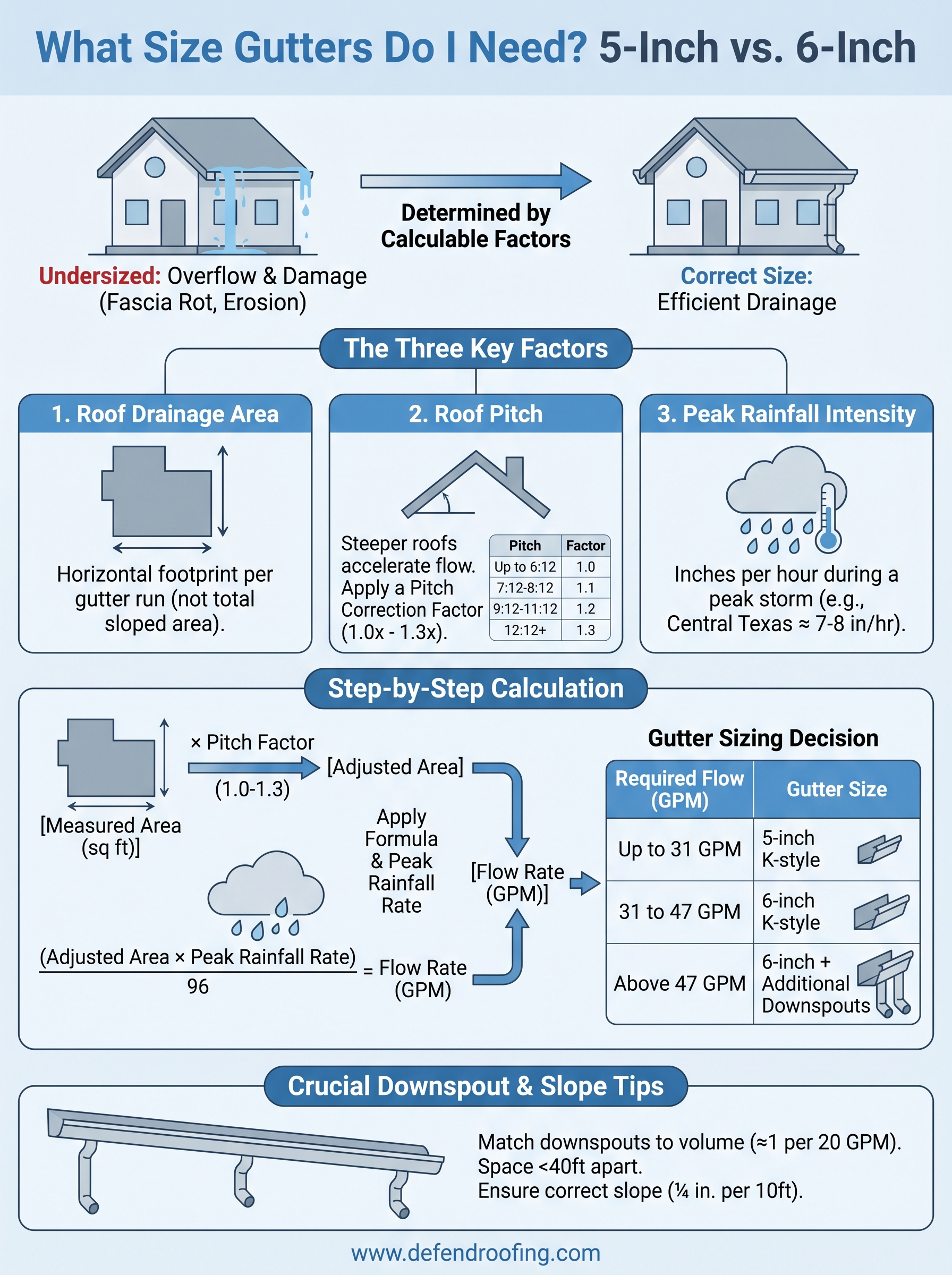
You now have a repeatable process for answering what size gutters do i need on any section of your roof. Measure your horizontal drainage area, apply the pitch correction, run the flow calculation against your local peak rainfall rate, and match your result to the right gutter size and downspout count. For most Austin-area homes, that process points to 6-inch gutters given Central Texas storm intensity.
If any step of this process feels unclear, or if your roof has complex valleys, multiple draining planes, or storm damage affecting your fascia and soffit, a professional assessment removes the guesswork entirely. Defend Roofing's Precision Roof Assessment documents your entire roof and exterior drainage system with 100+ photos so you get an honest picture of what your home actually needs. Schedule your roof and gutter assessment with Chris and Greyson today and get straightforward answers without any sales pressure.