Compare 2026 contractor bids accurately. Learn the current roof replacement cost per square foot for different materials and how to spot a fair estimate.
If you're planning a roof replacement in 2026, the first question on your mind is probably: how much is this going to cost? The answer depends on several factors, but understanding roof replacement cost per square foot gives you the clearest way to compare materials, get realistic estimates, and avoid overpaying for the job. The problem is that pricing varies widely depending on where you live, what material you choose, and who you hire to do the work.
Here at Defend Roofing, we walk Central Texas homeowners through these numbers every week. As a family-owned roofing contractor with three generations of experience, we've seen how confusing and inconsistent pricing information can be, especially when you're trying to budget for one of your home's biggest investments. That's why we put together this breakdown: honest numbers and clear explanations, no fluff.
In this article, we'll cover current per-square-foot pricing for the most common roofing materials, what drives costs up or down, how labor rates factor in, and what Central Texas homeowners specifically should expect to pay. By the end, you'll have the information you need to set a realistic budget and ask the right questions when reviewing estimates from contractors.
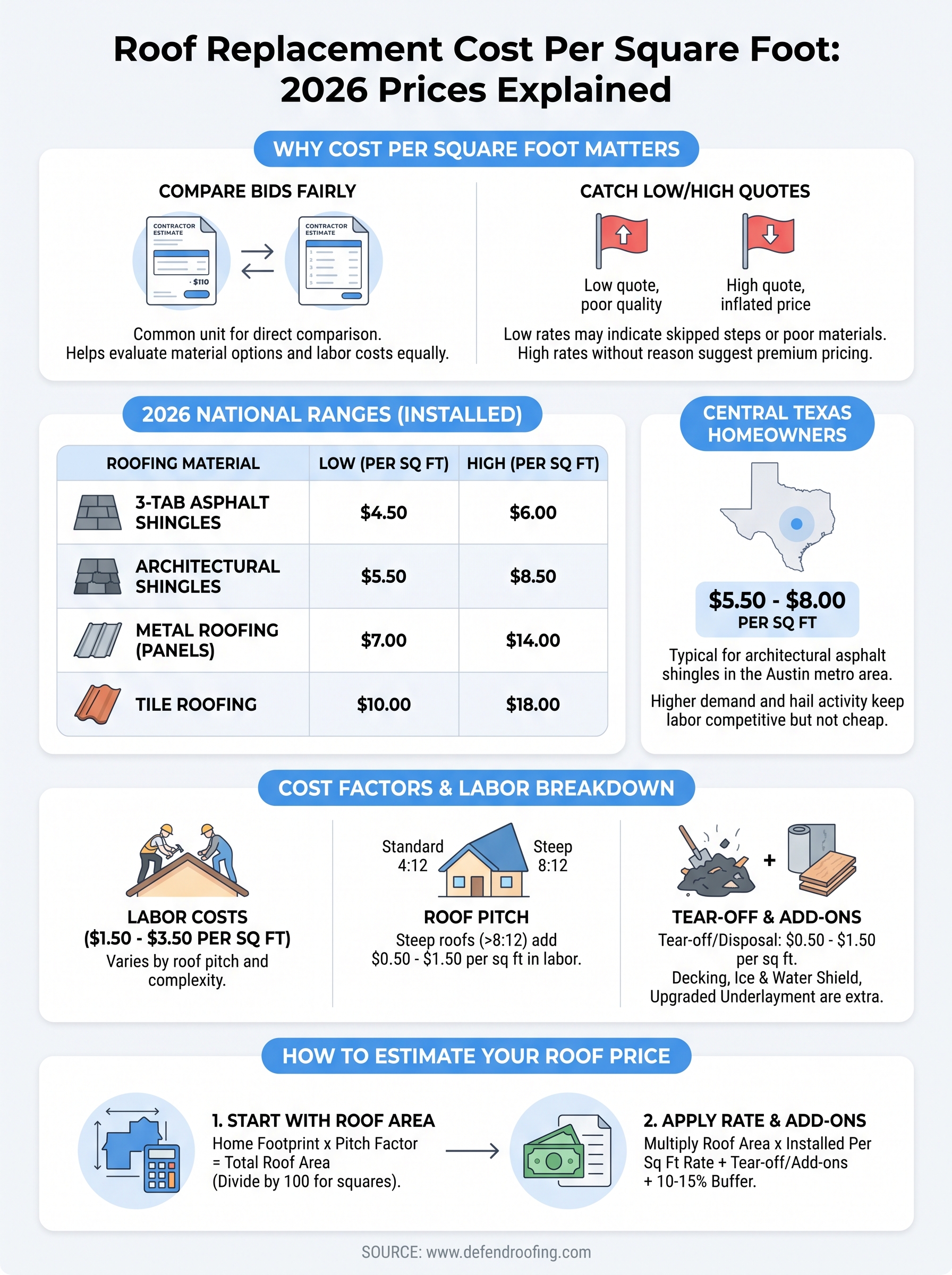
When contractors hand you a roof replacement estimate, they typically quote a total lump sum that's hard to evaluate on its own. A number like $18,500 might sound high or low depending on your roof size and the material involved. Breaking that figure down to a cost per square foot gives you a unit rate you can actually compare, whether you're reviewing multiple bids, researching material options, or trying to understand what's pushing the price up. It's the clearest lens for making sense of roofing numbers.
Not all roofing estimates are structured the same way. One contractor might give you a flat price that bundles materials, labor, and disposal together without separating them. Another might itemize everything line by line. When you convert both quotes into a cost per square foot, you create a common unit that makes comparison straightforward. A bid of $6.50 per square foot versus one at $9.00 per square foot for the same material and scope tells you something meaningful, while $14,200 versus $19,800 in total tells you very little without context.
Knowing your per-square-foot rate is the most effective way to evaluate whether a roofing bid is competitive or inflated for your specific market and material.
To make fair comparisons between contractors, ask each one for the following details in writing:
If a contractor quotes you well below the going market rate per square foot, that's a warning sign rather than a deal. Low bids often come with thinner materials, skipped steps like proper underlayment installation, or workmanship that won't hold up after the first major storm. On the other end, an unusually high per-square-foot price without a clear breakdown of what's included suggests you're being charged premium rates for standard work.
Understanding the typical range for your chosen material and region puts you in a position to ask the right questions. In Central Texas, heat cycles, high humidity, and frequent hail events directly affect both material selection and labor costs. A homeowner who knows that standard asphalt shingles typically run between $4.50 and $7.00 per square foot installed in this market can challenge a number that falls outside that range. One who sees the lump sum for the first time has no reference point and is far more likely to accept a price without question. That's why understanding roof replacement cost per square foot before you call a contractor gives you real leverage.
In 2026, the national average for roof replacement cost per square foot runs between $4.50 and $12.00 installed, depending on the roofing material, roof complexity, and your location. That's a wide range, and it reflects the real variation in what homeowners across the country pay. The lower end typically applies to basic three-tab asphalt shingles on a simple single-story home, while the upper end reflects premium materials like metal or slate on steeper or more complex rooflines.
Across most U.S. markets, standard asphalt shingle roofs land between $4.50 and $7.50 per square foot installed. Mid-range architectural shingles, which make up the majority of residential replacements, tend to fall between $5.50 and $8.50 per square foot when labor and basic materials are included. These figures reflect all-in pricing, meaning material, labor, and standard disposal costs are bundled together.
The figures contractors quote you in a lump sum almost always break down to a per-square-foot rate that sits within a predictable range for your chosen material.
| Roofing Material | Low (per sq ft) | High (per sq ft) |
|---|---|---|
| 3-tab asphalt shingles | $4.50 | $6.00 |
| Architectural shingles | $5.50 | $8.50 |
| Metal roofing (panels) | $7.00 | $14.00 |
| Tile roofing | $10.00 | $18.00 |
In the Austin metro and surrounding areas, including Cedar Park, Leander, and Steiner Ranch, roofing prices tend to run slightly above national averages. Demand stays high year-round because of frequent hail activity and an active housing market, which keeps labor rates competitive but not cheap. Most Central Texas homeowners with standard asphalt shingle roofs pay between $5.50 and $8.00 per square foot installed in 2026, with steeper roofs or larger homes pushing that number higher.
Material supply costs have stabilized compared to the spikes of earlier years, but labor in the Austin area commands a premium over smaller rural markets. Understanding these regional baselines puts you in a position to evaluate any estimate you receive with real context.
The material you choose has the single biggest impact on your overall roof replacement cost per square foot. Each roofing product comes with different raw material costs, installation complexity, and expected lifespan, all of which roll into the per-square-foot price you'll see on an estimate. Knowing the typical range for each material before you speak with a contractor helps you verify that what you're being quoted is reasonable.
Asphalt shingles remain the most common residential roofing material in Central Texas and across the country, largely because they balance cost and durability well. Three-tab shingles sit at the low end, typically running $4.50 to $6.00 per square foot installed, but most homeowners today opt for architectural (dimensional) shingles, which offer better wind and impact resistance and run between $5.50 and $8.50 per square foot. In hail-prone markets like Austin, Class 4 impact-resistant shingles are worth considering, and they typically add $0.50 to $1.50 per square foot over standard architectural options.
If you're in Central Texas, the small premium for impact-resistant shingles can pay off quickly through reduced insurance costs and fewer repair calls after hail season.
Metal roofing covers a wider price range depending on the product type. Standing seam metal panels typically run between $9.00 and $14.00 per square foot installed, while metal shingles designed to mimic slate or tile land closer to $7.00 to $10.00 per square foot. Both options carry significantly longer lifespans than asphalt, often 40 to 70 years with proper installation, which changes how you think about the total cost over time.
Tile roofing, including both clay and concrete options, runs $10.00 to $18.00 per square foot installed and requires a reinforced roof structure in many cases, which adds to the total project cost. Slate typically falls between $15.00 and $25.00 per square foot installed and represents the highest end of residential roofing costs. These premium materials make the most sense when you plan to stay in the home long-term and want to minimize replacement cycles.
Material pricing gets most of the attention, but labor, tear-off, and project add-ons often account for 40% to 60% of your total bill. Understanding these line items on a per-square-foot basis helps you verify that a contractor's estimate reflects real work, not padding. When you evaluate your roof replacement cost per square foot, separating these components from raw material costs gives you a complete picture.
Labor rates in the Austin metro area typically run between $1.50 and $3.50 per square foot for standard asphalt shingle installation. That range reflects differences in roof pitch, crew experience, and project complexity. A low-slope single-story roof takes less time and carries lower labor costs per square foot than a steep multi-gable roof where workers need additional safety equipment and slower footing.
Steeper roofs add meaningful labor costs, so always ask your contractor to specify the pitch adjustment included in their per-square-foot rate before you sign anything.
Roof pitch directly affects how much labor time a job requires. A roof with a 4:12 pitch sits in the standard range, while anything above 8:12 qualifies as steep and typically adds $0.50 to $1.50 per square foot in labor alone. Complex rooflines with multiple valleys, hips, and penetrations add further time and therefore push labor rates higher.
Tear-off, which covers removing your existing shingles and disposing of the debris, typically adds $0.50 to $1.50 per square foot to your project. Some contractors bundle this into their installed price, while others list it as a separate line item. Ask upfront so you know what you're comparing between bids.
Common add-ons that carry their own per-square-foot rates include:
These costs add up fast on larger roofs, so confirm exactly which add-ons apply to your project before you approve a final number.
Estimating your own roof replacement cost per square foot before you call a contractor takes less effort than most homeowners expect. You need two inputs: a reasonable measure of your roof area and a per-square-foot rate that matches your chosen material and region. Once you have both numbers, the math is straightforward and gives you a realistic budget figure before any contractor walks through your door.
Your roof area is not the same as your home's footprint. Roof pitch and overhang add meaningful square footage above what you'd measure on the ground. A practical way to estimate: measure your home's footprint in square feet, then multiply by a pitch factor based on your roof slope. For a standard 4:12 pitch, that factor is roughly 1.06. For a steep 8:12 pitch, it's closer to 1.20. A 2,000 square-foot footprint on a 6:12 roof produces approximately 2,240 square feet of actual roof surface.
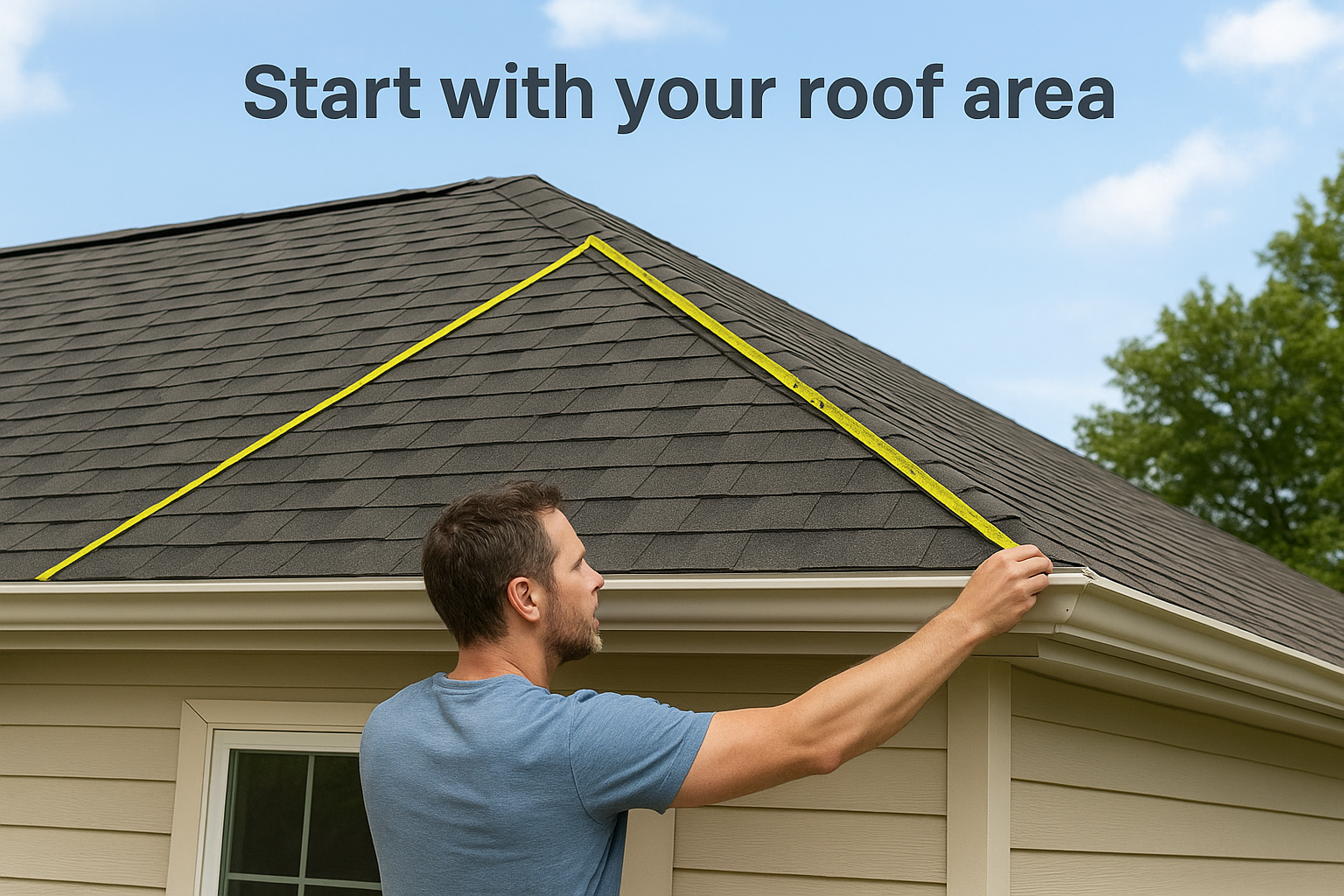
Roofing contractors price by the "square," which equals 100 square feet, so divide your total roof area by 100 to get the number of squares your project requires.
Contractors can give you a more precise measurement using aerial software, but your own estimate gets you within 10% to 15% of the actual number, which is close enough to sanity-check any bid you receive.
Once you have your square footage, multiply by the installed per-square-foot rate for your chosen material. For standard architectural asphalt shingles in Central Texas, use a rate between $5.50 and $8.50 per square foot. A 2,240 square-foot roof at $7.00 per square foot produces a working estimate of $15,680 before add-ons. Then layer in the extras that apply to your specific roof:
Build a 10% to 15% buffer on top of your base number to cover these variables before comparing contractor bids.
You now have the core numbers you need to approach a roof replacement with confidence. Roof replacement cost per square foot gives you a reliable way to compare bids, evaluate materials, and set a realistic budget before any contractor sets foot on your property. Use the ranges in this article as your baseline, then measure your roof area, apply the rate for your chosen material, and add a buffer for tear-off and any likely add-ons.
The next step is getting an accurate, documented assessment of your actual roof condition. Knowing the going rate per square foot means nothing if you don't know the true scope of work your roof requires. At Defend Roofing, every assessment includes 100+ photos and an honest repair-versus-replace recommendation, with no pressure to spend more than your roof actually needs. If you're ready to get a clear picture of what your project will cost, request a free roof assessment and we'll walk you through every number.