See the 2026 asphalt shingle roof replacement cost for Central Texas. This guide covers local pricing, material grades, and how to spot hidden estimate fees.
Replacing your roof is one of the biggest investments you'll make as a homeowner, and the asphalt shingle roof replacement cost catches most people off guard. National averages are helpful as a starting point, but what you'll actually pay depends on your roof's size, pitch, material grade, and where you live, especially here in Central Texas, where heat and storm exposure push material and labor demands in ways other regions don't deal with.
At Defend Roofing, we're a father-and-son operation with three generations of roofing experience across the Austin area. We've seen firsthand how unclear pricing leads to bad decisions, homeowners either overpay because they didn't know what to expect, or they go with the cheapest bid and end up paying twice. That's why we document everything, explain our pricing line by line, and give honest repair-vs-replace recommendations even when replacement would mean a bigger job for us.
This guide breaks down real 2026 pricing for asphalt shingle roof replacements, by square footage, house size, shingle type, and region. We'll walk you through what drives costs up, what doesn't matter as much as you'd think, and how to read a roofing estimate so you can budget with confidence before signing anything.
No two roofs cost the same to replace, and that's not a contractor making excuses. The asphalt shingle roof replacement cost shifts based on a handful of concrete factors: your roof's square footage, its pitch, the shingle grade you choose, and the condition of what's underneath. Knowing which factors are in your control and which aren't puts you in a much stronger position when you're comparing bids.
The biggest driver of your final cost is simply how much roof surface needs to be covered. Contractors measure roofs in "squares," where one square equals 100 square feet of surface area. A standard 1,800 square foot house doesn't have an 1,800 square foot roof because the pitch adds surface area. The steeper your roof, the larger the actual surface your crew has to cover and work on safely.
Steep roofs also slow down installation. Crews need to use safety equipment, move more carefully, and carry materials at angles that take more time and physical effort. Most contractors add a pitch surcharge for roofs above a 6:12 slope, which is common in older Central Texas neighborhoods where steeper aesthetics were built in by design.
Asphalt shingles fall into three general categories: 3-tab shingles (the thinnest and cheapest), architectural shingles (also called dimensional or laminate shingles), and premium designer shingles. In 2026, 3-tab shingles are becoming harder to find as manufacturers phase them out in favor of architectural products, which means even entry-level replacements are shifting in cost.
Architectural shingles are the standard choice for most Texas homeowners because they handle heat, UV exposure, and hail impact better than 3-tab options. Premium shingles with Class 4 impact resistance ratings can qualify you for homeowner's insurance discounts in Texas, which sometimes offsets a portion of the higher upfront material cost. That's worth asking your insurance provider about before you lock in a shingle grade.
If you're replacing your roof after storm damage, choosing a Class 4 impact-resistant shingle may reduce your future insurance premiums enough to make the upgrade cost-neutral over time.
Central Texas has seen steady labor cost increases over the past few years, driven by housing growth across the Austin metro area and sustained demand from storm seasons. The same shingle job that cost one amount in 2022 costs more today because skilled roofing labor is in tighter supply and fuel, equipment, and overhead costs have risen across the board.
Location within the Austin area also matters. Jobs in Lakeway, Steiner Ranch, or Jonestown often involve longer drive times and occasionally more complex access situations than work inside the city limits. Contractors factor that into pricing, sometimes explicitly and sometimes not, so it's worth asking how travel affects your estimate.
Before any new shingles go down, the old layer comes off, and that tear-off process adds time and a disposal fee. Most municipalities in Central Texas prohibit layering new shingles over old ones past a certain number of layers, so this cost is usually unavoidable. What can push costs higher is what's underneath.
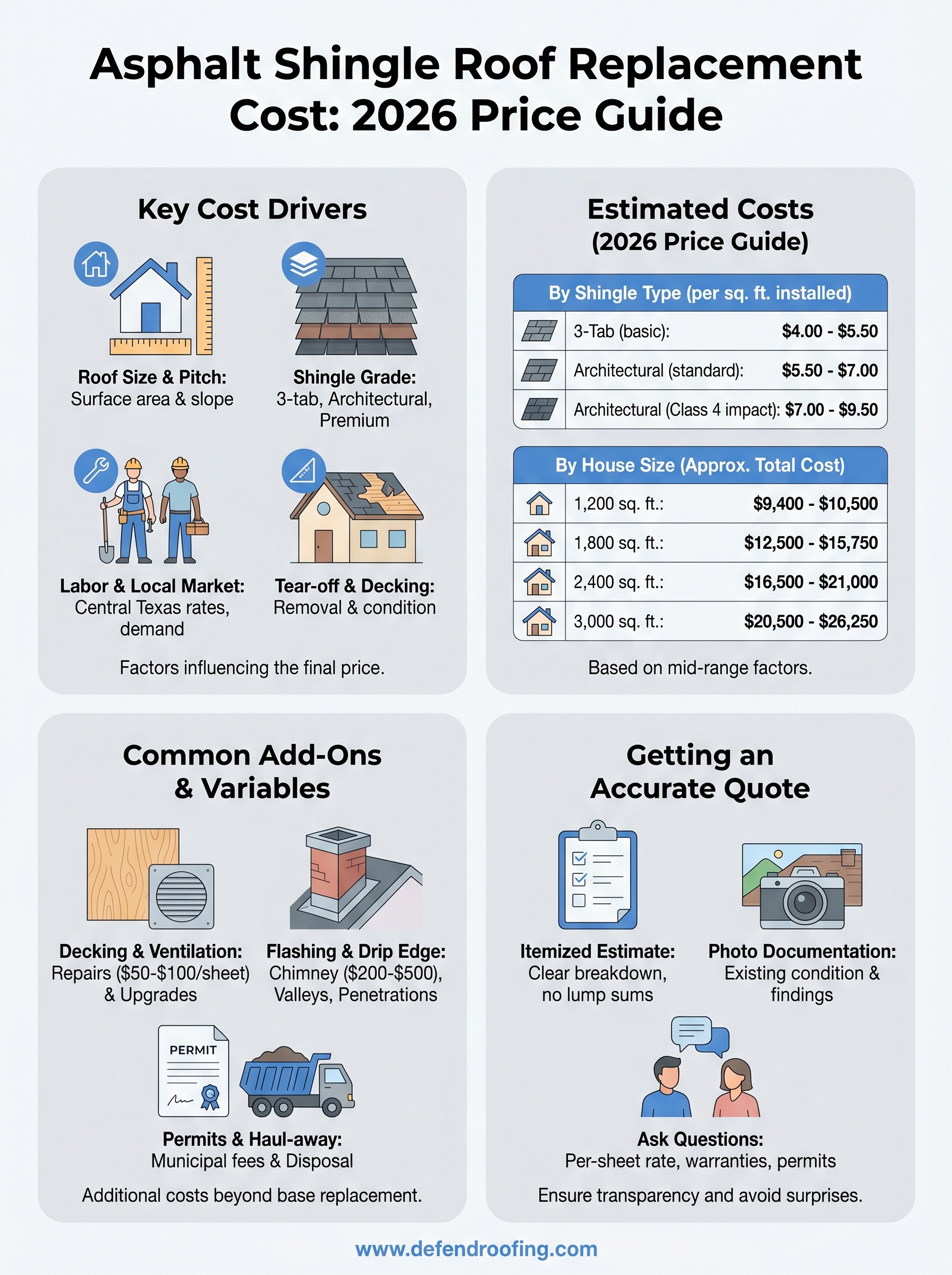
If your decking (the plywood layer beneath the shingles) has rotted sections from moisture intrusion or improper ventilation, those areas need to be replaced before installation. Decking repairs are priced per sheet and typically run $50 to $100 per sheet in the Austin market, so a roof with significant moisture damage can add several hundred dollars to your final invoice.
Getting a rough estimate before you call a contractor gives you a realistic baseline and helps you spot bids that are too low or inflated. The asphalt shingle roof replacement cost for your specific home comes down to three things: your roof's total surface area, the shingle grade you choose, and the scope of any additional work like decking repairs or ventilation upgrades. You don't need a precise number to start planning, but you do need a working framework so you're not walking into quotes blind.
Your roof's surface area is the foundation of any estimate. A simple way to get a working number is to measure your home's footprint (length multiplied by width) and then multiply by a pitch factor. For a low-slope roof, that factor is around 1.1. For a moderately steep roof, it's closer to 1.3 to 1.4. For a steep roof, it can reach 1.5 or higher.
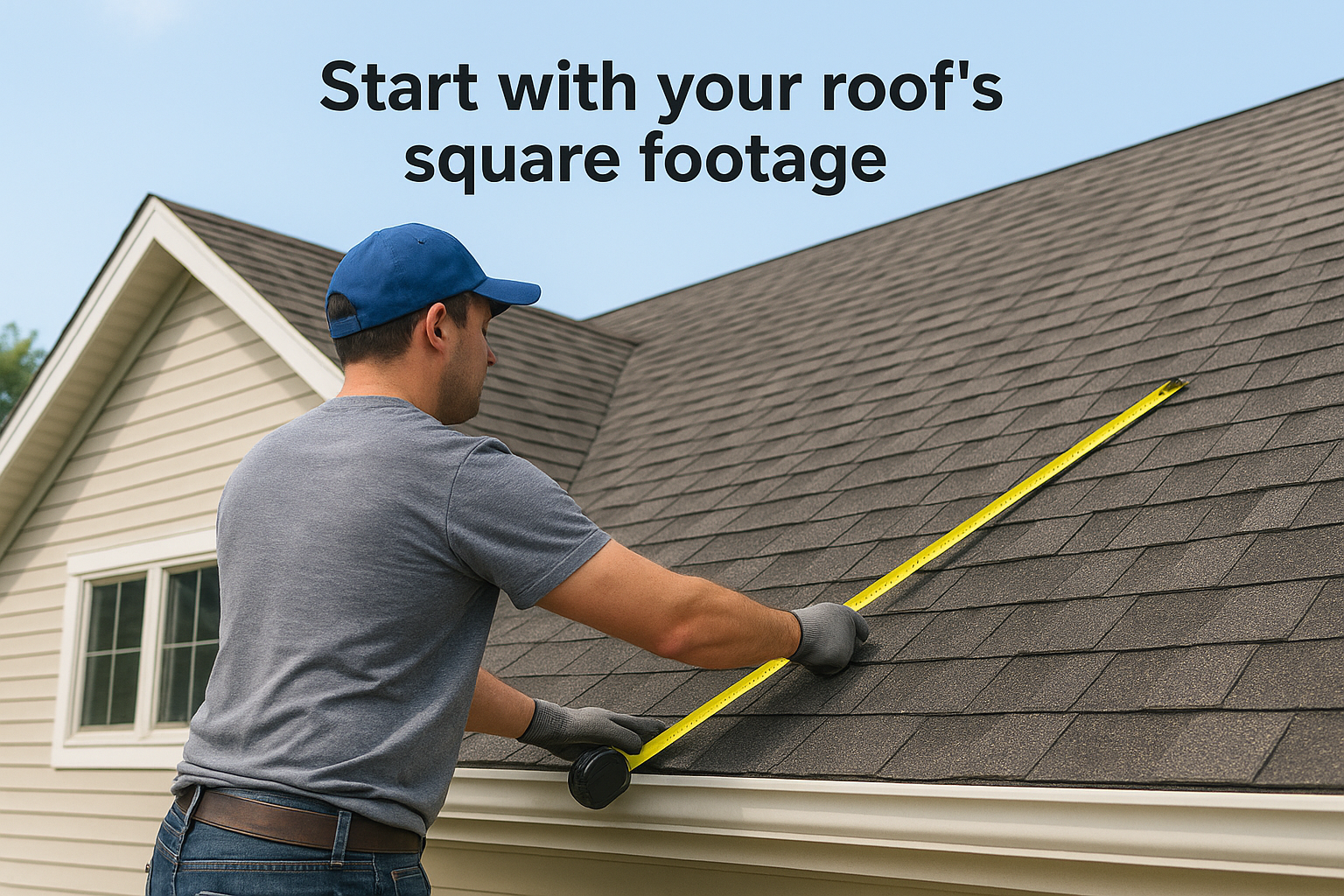
For example, a 1,800 square foot home with a moderate pitch might have roughly 2,340 square feet of actual roof surface, which is about 23 to 24 squares. At a mid-range installed price of $4.50 to $6.50 per square foot, that puts a rough estimate between $10,500 and $15,200 before any add-ons.
This calculation gives you a planning number, not a contract price. Your actual quote will include the contractor's inspection findings, local labor rates, and material costs specific to your job.
Once you have a rough surface area, layer in the other cost drivers. Shingle grade is the biggest material variable: architectural shingles typically run about $1.00 to $2.00 more per square foot installed than 3-tab options, and premium impact-resistant products can add another $1.50 to $3.00 on top of that. On a 23-square roof, those differences add up to real money fast.
Decking condition and ventilation work are the wildcards that most initial estimates don't fully capture. A contractor can't know how many plywood sheets need replacing until the old shingles come off. Reputable roofing companies will tell you their per-sheet replacement rate before the job starts so you're not hit with unexpected charges partway through the project.
Understanding the asphalt shingle roof replacement cost on a per-square-foot basis gives you a concrete number to plug into your planning before any contractor sets foot on your property. In Central Texas, installed prices in 2026 typically range from $4.00 to $9.50 per square foot, depending on shingle grade, labor rates, and job complexity. That range looks wide, but once you know your roof size and shingle type, it narrows quickly.
Your shingle choice is the fastest way to move the needle on your final price. 3-tab shingles sit at the low end and are increasingly hard to source, while architectural shingles represent the practical midpoint that most Texas homeowners land on. Premium impact-resistant shingles cost more upfront but can pay back through insurance premium reductions in hail-prone areas like the Austin metro.
If your neighborhood has experienced hail damage in the past five years, upgrading to a Class 4 impact-resistant shingle is worth running past your insurance provider before you commit to a shingle grade.
| Shingle Type | Installed Cost per Sq. Ft. | Typical Total for 2,000 Sq. Ft. Roof |
|---|---|---|
| 3-Tab (basic) | $4.00 - $5.50 | $8,000 - $11,000 |
| Architectural (standard) | $5.50 - $7.00 | $11,000 - $14,000 |
| Architectural (Class 4 impact) | $7.00 - $9.50 | $14,000 - $19,000 |
These figures reflect installed costs including labor, materials, tear-off, and basic disposal for a single-layer roof in good decking condition. Jobs with steep pitches, multiple penetrations, or decking repairs will land toward the higher end of each range.
Your home's footprint combined with its pitch determines how many squares your contractor will actually price. The table below uses a moderate pitch factor of 1.25, which is common across Central Texas suburban builds, and mid-range architectural shingle pricing of $6.25 per square foot installed.
| Home Size (Sq. Ft.) | Estimated Roof Surface | Estimated Replacement Cost |
|---|---|---|
| 1,200 | ~1,500 sq. ft. | $9,400 - $10,500 |
| 1,800 | ~2,250 sq. ft. | $12,500 - $15,750 |
| 2,400 | ~3,000 sq. ft. | $16,500 - $21,000 |
| 3,000 | ~3,750 sq. ft. | $20,500 - $26,250 |
Treat these figures as planning benchmarks, not contract prices. Your actual quote accounts for your roof's specific pitch, condition, and any additional work your contractor identifies during the inspection.
The base asphalt shingle roof replacement cost covers materials, labor, tear-off, and basic disposal, but most final invoices include at least one add-on that wasn't fully visible during the initial walkthrough. Knowing these common cost additions in advance helps you budget accurately and reduces the chance of surprises when your contractor calls mid-job with a change order.
Your roof deck is the plywood layer that the shingles attach to. Moisture damage from old leaks, poor ventilation, or years of temperature swings in Texas heat can soften or rot sections of the deck, which have to be replaced before new shingles go down. In the Austin area, decking repairs typically run $50 to $100 per sheet of plywood, and a moderately damaged roof might need five to fifteen sheets replaced. Ask your contractor for their per-sheet rate upfront so you have a ceiling on that variable before work starts.
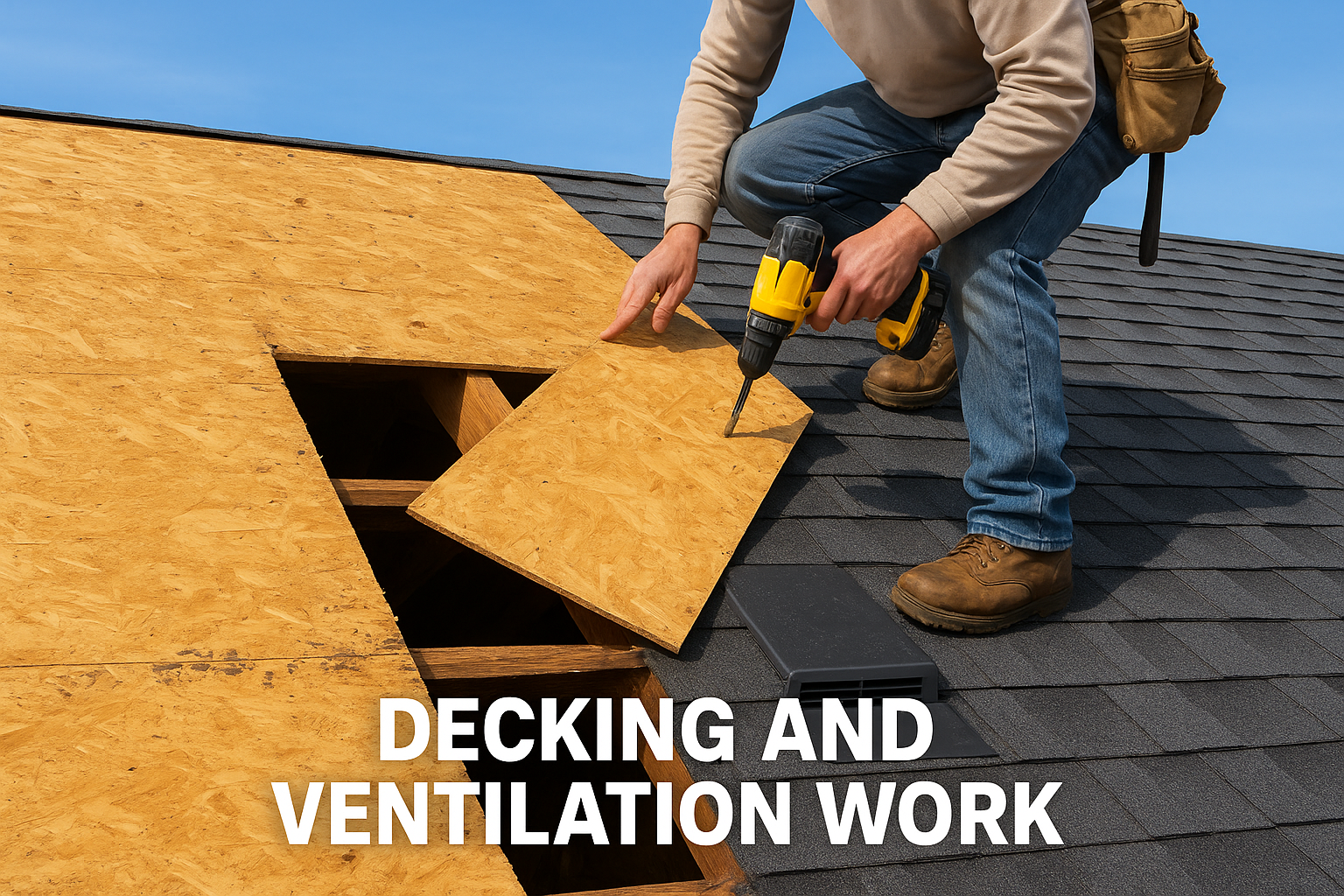
Ventilation upgrades often show up alongside decking work. Improper attic airflow accelerates shingle degradation and can void manufacturer warranties, so contractors who find inadequate ridge vents or blocked soffits will flag those for correction. Adding or repositioning vents typically adds $200 to $600 to the total depending on your attic layout.
Ask your contractor to document any decking or ventilation issues with photos before repairs begin so you can see exactly what was found and why the additional work was necessary.
Flashing is the metal material that seals the joints around chimneys, skylights, walls, and roof valleys. Old flashing often gets replaced during a full roof job because reusing compromised flashing under new shingles creates a future leak point. Replacing flashing around a chimney runs $200 to $500 depending on its size and complexity, while full valley and drip edge replacement adds $150 to $400 for a typical Central Texas home.
Every penetration, meaning every pipe vent, exhaust stack, or skylight on your roof, requires its own flashing seal. Roofs with five or more penetrations can add $500 to $1,000 in flashing and boot replacement costs versus a clean roofline with minimal protrusions.
Most Texas municipalities require a permit for full roof replacements, and fees range from $75 to $300 depending on your city or county. Dumpster rental and debris hauling add another $150 to $400 for a standard residential job. These costs are sometimes bundled into a contractor's base quote and sometimes listed as separate line items, so confirm which approach your bid uses before you sign.
Getting an accurate asphalt shingle roof replacement cost estimate in the Austin market means knowing what a solid quote looks like before you receive one. Central Texas contractors vary widely in how they document and present their pricing, and a lower number on paper doesn't always mean a lower final bill. Asking the right questions upfront separates contractors who price honestly from those who use low estimates to win the job and tack on costs once work has already started.
A well-structured roofing quote breaks the job into clear line items: material costs by shingle type and quantity, labor separated from materials, tear-off and disposal fees, and a stated per-sheet decking repair rate. If a bid shows one lump sum without itemization, that's a problem. You have no way to compare it accurately against other bids or verify what you're actually paying for once the invoice arrives.
Reputable contractors in the Austin area also document what they found on your roof during the initial assessment. Photo documentation of your existing roof condition, including decking damage, flashing concerns, and ventilation issues, gives you a record that supports both the scope of work and any insurance claim you may need to file. Without that documentation, you're trusting verbal descriptions that can change after the job starts.
A written, itemized estimate with photo documentation is the baseline standard you should expect from any contractor you're seriously considering.
Before you sign anything, ask your contractor to walk you through a few specific points. How they respond tells you as much as the estimate itself.
None of these are difficult questions. Any experienced, legitimate contractor will answer them without hesitation, and hesitation itself tells you something worth knowing before you hand over a deposit.
You now have a solid framework for understanding what drives asphalt shingle roof replacement cost in 2026, from shingle grades and roof pitch to decking repairs and permitting fees. That knowledge puts you in a much stronger position when you're ready to start collecting bids and comparing what contractors are actually offering you.
At Defend Roofing, every assessment starts with a 100+ photo Precision Roof Assessment so you see exactly what we find before we recommend anything. We give you a straight answer on whether your roof needs repair or full replacement, and we back every installation with a Limited Lifetime Workmanship Warranty. No pressure, no unnecessary upselling, just honest documentation and clear pricing from a family that's been doing this work for three generations.
When you're ready to get a real number for your home, request your free roof assessment in Austin and we'll get you scheduled.