See the 2026 ridge vent installation cost per linear foot. Compare $3-$8 pricing and learn how bundling with a roof replacement saves Austin homeowners.
If you're pricing out a new ridge vent, whether as a standalone project or part of a full roof replacement, you've probably noticed that ridge vent installation cost varies wildly depending on who you ask. Some contractors quote by the linear foot, others lump it into the total roof price, and a few don't break it out at all. That makes it hard to know if you're getting a fair deal or overpaying for a relatively straightforward component.
Here at Defend Roofing, we install ridge vents on homes across Central Texas every week. As a family-owned roofing contractor with three generations of experience, we believe you deserve to see exactly what you're paying for, which is why we document every project with 100+ photos and transparent, scope-based pricing. We've put together this guide with the same approach.
Below, you'll find current 2026 pricing per linear foot, what drives costs up or down, and how ridge vent installation fits into a larger roof replacement budget. We'll also cover the difference between material and labor costs so you can compare quotes with confidence and spot red flags before signing anything.
Ridge vents sit at the peak of your roof and allow hot, humid air to escape from your attic continuously. Without them working correctly, attic temperatures can spike above 150°F in Texas summers, and that trapped heat shortens the life of your shingles, drives up your energy bills, and can cause moisture damage to your roof deck. Understanding ridge vent installation cost isn't just about budgeting for one line item; it's about making a smart call on one of the most important components of your roofing system.
Your attic depends on a balanced ventilation system to function properly. Ridge vents work in combination with soffit vents to create a continuous airflow path: cool outside air enters through the soffits at the eaves, travels up through the attic, and exits through the ridge at the top. When this intake-to-exhaust cycle works as designed, your attic stays within a reasonable temperature range year-round.

In Central Texas, where summer heat is relentless, a properly ventilated attic can reduce cooling loads by allowing stored heat to escape rather than radiate down into your living spaces. Roofing manufacturers also require adequate ventilation to honor their shingle warranties. If your ridge vent is missing, blocked, or undersized, you could void your material warranty entirely, which is a costly outcome for a component that costs a fraction of the roof itself.
Knowing the actual cost of a ridge vent installation puts you in a much better position when you're evaluating quotes or deciding whether to act now or hold off. If a contractor tells you the ridge vent is "included" in a roof replacement without breaking out the cost as a separate line item, you can't tell whether they've priced the material correctly or cut corners with a cheaper product.
Cheaper ridge vent products exist, and some contractors use them to win bids. The difference between a standard aluminum ridge vent and a high-performance external baffle vent can be $1 to $3 per linear foot in materials alone. Over a 40-foot ridge, that gap adds up fast, and the performance difference is even more significant over the life of the roof.
Transparent, itemized pricing is the clearest sign that a contractor is being honest with you about what you're actually buying.
Some homeowners skip ridge vent installation during a roof replacement to cut the upfront cost. Others inherit a roof where the previous contractor sealed the old vents or installed the wrong type entirely. Both situations lead to the same outcome: trapped attic heat, accelerated shingle deterioration, and potential moisture buildup that rots your decking from the inside out.
Correcting a poorly ventilated roof after the fact costs significantly more than doing it right the first time. You're looking at reopening the ridge, installing proper venting, and potentially replacing damaged decking if moisture has already set in. Getting the cost right upfront and understanding exactly what you're paying for protects you from a much larger bill later.
Estimating ridge vent installation cost starts with two numbers: your ridge length in linear feet and the type of vent you plan to install. Once you have both, you can build a working budget that separates materials from labor and gives you a real baseline for comparing contractor quotes before you commit to anything.
The ridge is the horizontal peak that runs along the top of your roof. Most residential roofs in Central Texas have a main ridge that runs 20 to 50 linear feet, though homes with complex rooflines can have multiple ridges at different lengths and elevations. You can get a rough estimate from the ground by measuring the exterior length of your home at the peak, but the most accurate number comes from a contractor who measures directly on the roof. If you've already had a roofing assessment completed, that measurement should appear in your project documentation along with photos.
Once you know the ridge length, split your estimate into two distinct parts. Material costs cover the physical vent product itself, which ranges from basic aluminum strip vents to higher-performance shingle-over ridge vents with external baffles that allow airflow even under wind-driven rain. Labor costs cover cutting the ridge opening if one doesn't already exist, fastening the vent correctly, and sealing it against weather intrusion.
Never let a contractor give you only an all-in total without breaking out what you're paying for materials versus what you're paying for labor.
Labor typically accounts for 40 to 60 percent of the total cost on a standalone ridge vent project, because the crew has to set up roof access, make precise cuts, and weatherproof the installation from scratch. On a full roof replacement, labor costs drop considerably since the crew is already up there and the ridge is fully exposed during tear-off. Understanding that split helps you spot bids that pad labor rates on replacement jobs or inflate material costs to boost margins.
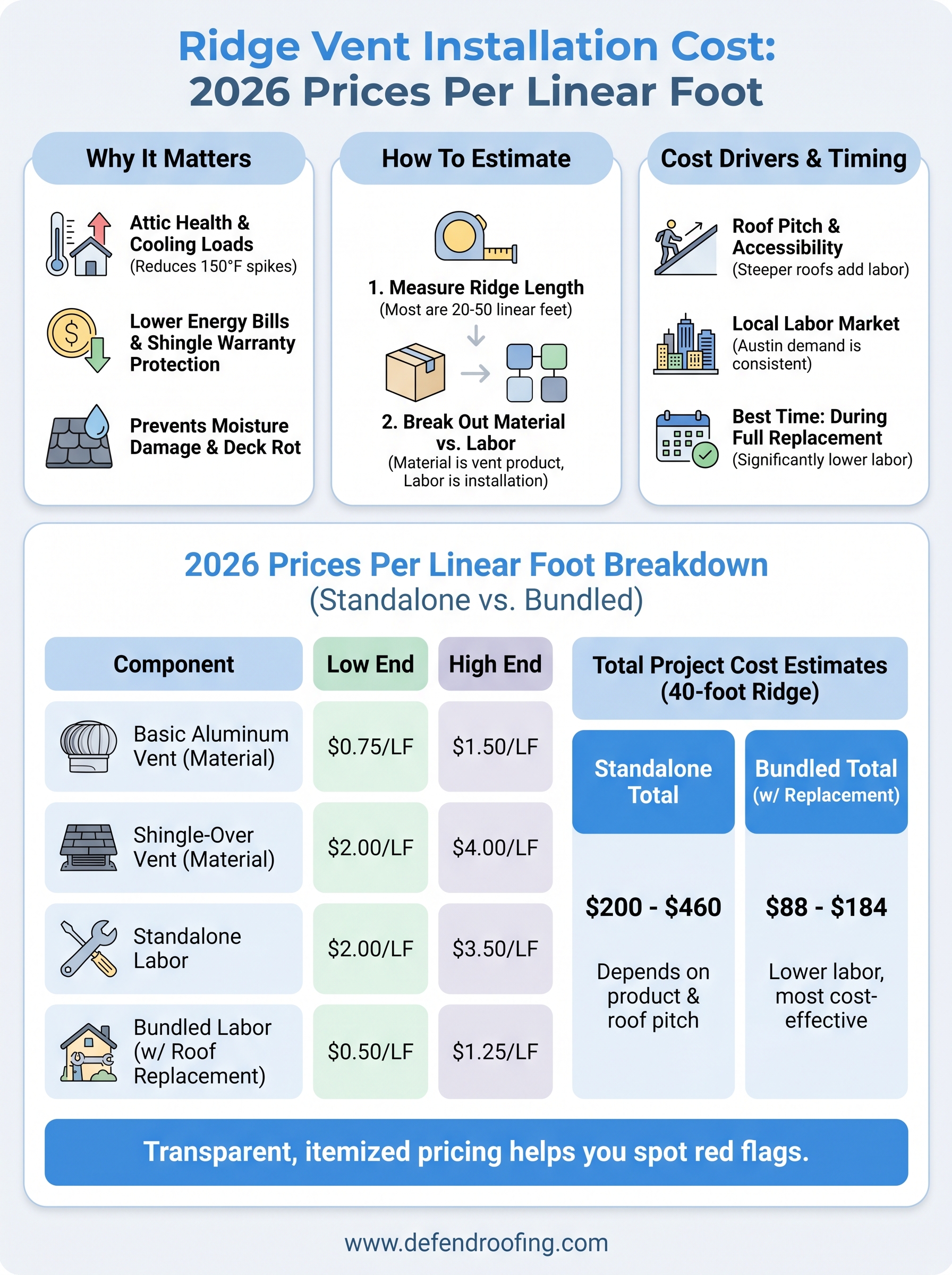
Current ridge vent installation cost in 2026 runs between $3 and $8 per linear foot for materials and labor combined on a standalone project. That range reflects the difference between basic aluminum strip vents on simple rooflines and higher-performance shingle-over ridge vents installed on steeper pitches that require more crew time to access safely. Your total will depend on the product tier you choose and whether the crew needs to cut a new ridge opening or simply replace an existing vent.
The table below gives you a realistic look at what each component costs on its own so you can read a contractor's quote clearly and know whether the numbers add up.
| Component | Low End | High End |
|---|---|---|
| Basic aluminum strip vent (material) | $0.75/LF | $1.50/LF |
| Shingle-over ridge vent (material) | $2.00/LF | $4.00/LF |
| Labor (standalone project) | $2.00/LF | $3.50/LF |
| Labor (during roof replacement) | $0.50/LF | $1.25/LF |
Labor costs drop significantly when ridge vent work is bundled into a full roof replacement, because the crew is already on the roof and the ridge is fully exposed during tear-off.
For a standalone ridge vent installation on a 40-foot ridge, expect to pay between $120 and $320 in materials plus $80 to $140 in labor, putting your all-in total in the $200 to $460 range depending on product choice and roof accessibility. Steeper roofs or second-story installations push that figure toward the higher end because crews need additional safety equipment and more time per linear foot.
When ridge vent work is part of a full roof replacement, the material cost stays the same but labor drops to a fraction of the standalone rate. On a typical Central Texas home with a 35-foot ridge, you might pay $70 to $140 in material and $18 to $44 in bundled labor, for a total ridge vent line item of roughly $88 to $184 within the larger replacement contract.
Central Texas pricing for ridge vent installation cost doesn't always match national averages you'll find in generic cost guides. The Austin area has its own labor market, its own building code requirements, and its own climate demands that shape what contractors charge. Understanding the local factors that push your quote up or down gives you real leverage when you're comparing bids.
Your roof's pitch is one of the biggest cost drivers on any Central Texas job. Steeper roofs require crews to use additional safety equipment and move more slowly along the ridge, which adds time and therefore labor cost to the project. A standard 4:12 pitch is straightforward for most crews, but anything above 8:12 adds a meaningful premium because the work area becomes more physically demanding and slower to navigate safely.
A roof that looks simple from the ground can require significantly more labor when a crew actually gets up there and works along the full ridge length.
Single-story homes in areas like Cedar Park or Leander are generally easier to access than two-story builds in Steiner Ranch or Avery Ranch, where the height alone adds setup time and equipment requirements. If your home has a complex roofline with multiple ridges at different elevations, each section needs its own access setup, which compounds the labor cost quickly.
Central Texas is a high-growth region, and contractor demand in the Austin market stays consistently strong throughout the year rather than spiking only after storm events. That sustained demand keeps local labor rates moderately higher than rural Texas markets, and it also means scheduling can affect your price if you need work done quickly versus waiting for a slower period.
Material costs in Central Texas reflect distribution logistics from major suppliers, and premium ridge vent products from manufacturers like GAF and Owens Corning are widely stocked locally. You won't typically pay a regional surcharge for quality materials here, but budget-tier products that show up in low bids often come from less reliable supply chains and carry no meaningful performance warranty.
Deciding when to address your ridge vent matters almost as much as the ridge vent installation cost itself. Bundling the work with a full roof replacement is almost always the smarter financial move, but there are specific situations where a standalone installation makes sense and timing it correctly will save you from reopening a freshly completed roof.
When your contractor tears off your old shingles, the ridge is fully exposed and easy to work on without any extra setup. That's the lowest-friction moment to install or upgrade your ridge vent because the crew is already on the roof, the material is staged, and no additional access equipment is needed. Skipping the ridge vent upgrade at that point and addressing it separately later means paying for a second mobilization, new safety setup, and additional labor hours to reopen work that was just completed.
Bundling ridge vent installation into your roof replacement is the most cost-effective window you'll ever have for this upgrade.
If your current home has no ridge vent at all, or has an older aluminum strip vent that doesn't meet current ventilation requirements, your replacement contractor should flag that during the assessment. A complete ventilation upgrade during tear-off costs a fraction of what a standalone installation costs later, and it protects your new shingle warranty from day one.
Some situations don't involve a full roof replacement. If your shingles are in solid condition but your ridge vent is damaged, blocked, or the wrong type, a standalone installation is the right call. Storm debris, improper installation by a previous contractor, or a ridge vent that was sealed shut during painting are all legitimate reasons to address the vent on its own without waiting for a full tear-off.
Standalone projects cost more per linear foot, but they're worth doing promptly if your attic temperatures are running high, energy bills are climbing, or you've noticed moisture buildup in the attic space. Waiting on a ventilation problem rarely saves money and usually accelerates damage to your decking and insulation.
You now have a complete picture of ridge vent installation cost: what drives it, how to read a quote, and when to bundle the work with a full roof replacement. The next step is straightforward. Get an assessment from a contractor who documents everything and gives you itemized pricing you can actually verify, not a vague all-in number that hides what you're paying for.
At Defend Roofing, every assessment includes 100+ photos and a clear written scope so you know exactly what your roof needs and why. We serve homeowners across Central Texas including Cedar Park, Leander, Steiner Ranch, and the greater Austin area. Whether you need a standalone ridge vent replacement or you're planning a full roof replacement and want to address ventilation at the same time, we'll give you honest guidance and fair pricing. Request your free roof assessment today and get answers without the sales pressure.