Plan your 2026 project. Learn how much does a new roof cost based on materials, size, and labor to build an accurate budget and compare contractor bids.
A roof replacement is one of the biggest investments you'll make as a homeowner, and the first question on your mind is almost always the same: how much does a new roof cost? The honest answer is that it depends, on your materials, your home's size, roof complexity, and where you live. But that doesn't mean you should be left guessing. You deserve a clear picture before you commit to anything.
Nationally, most homeowners spend somewhere between $8,500 and $30,000+ on a full roof replacement in 2026, with the average landing around $12,000 to $15,000 for a standard asphalt shingle roof. That's a wide range, and the variables behind it matter more than most contractors bother explaining.
At Defend Roofing, we work with Central Texas homeowners every day who want straight answers, not vague estimates followed by a hard sell. Our family has been roofing for three generations, and we believe pricing should be transparent from the first conversation. That's why every project starts with our 100+ photo Precision Roof Assessment, so you see exactly what we see.
This guide breaks down the real costs behind a new roof, material by material, factor by factor, so you can budget with confidence and spot inflated quotes before you sign anything.
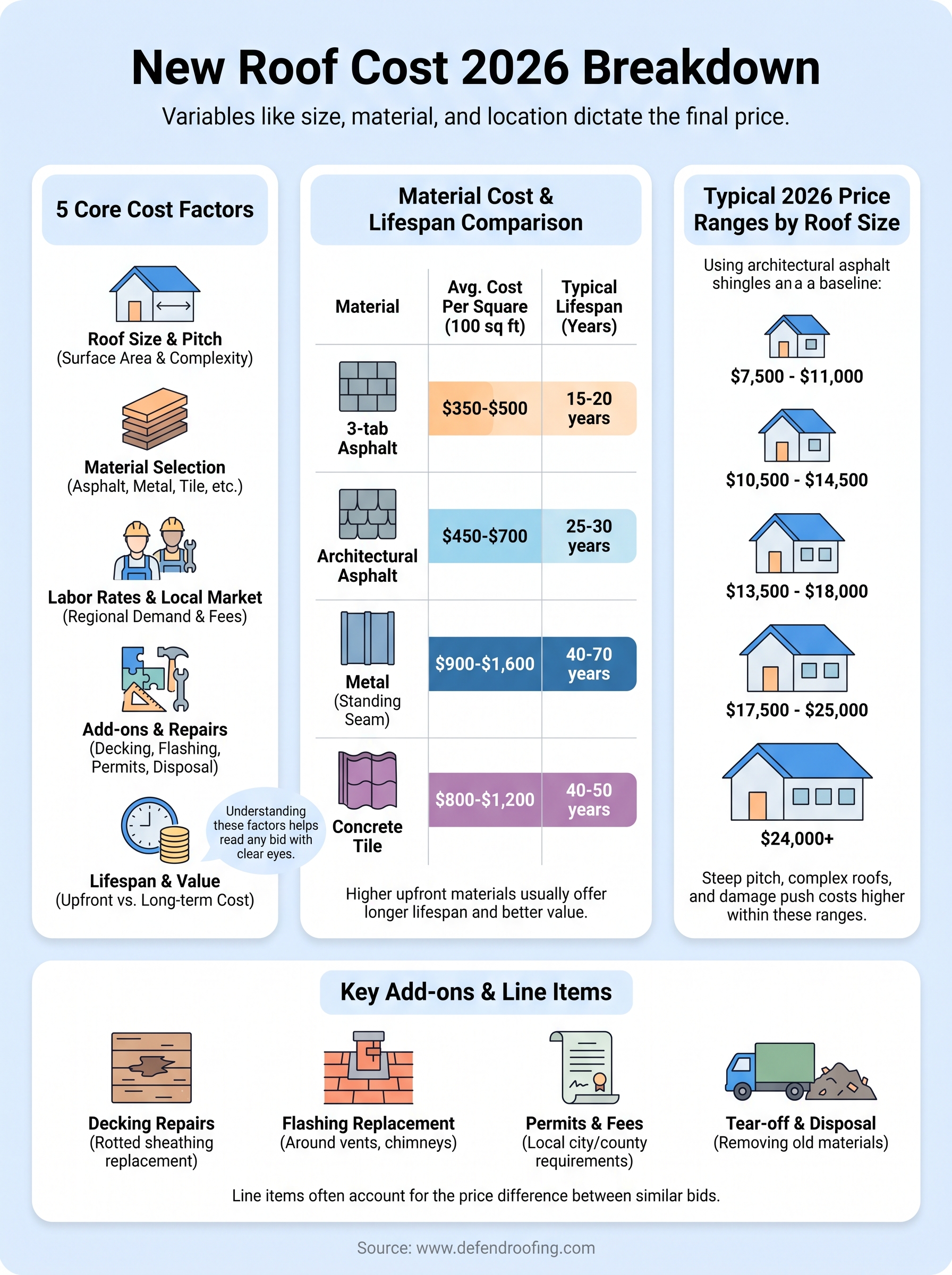
When people ask how much does a new roof cost, they usually expect a single number. The reality is that five core factors drive the final price up or down, and understanding each one helps you read any bid you receive with clear eyes. A contractor who quotes you without explaining these variables is likely skipping the detailed assessment your project actually needs.
The difference between an $8,500 roof and a $22,000 roof often comes down to decisions you can control, like your material choice, not factors that are entirely out of your hands.
Your roof's total square footage is the single biggest cost driver. Roofers measure in "squares," where one square equals 100 square feet of roof surface. A 1,500 sq ft home doesn't have 1,500 sq ft of roof - overhangs, hips, and valleys all add surface area. Steep-pitch roofs cost more because they require additional safety equipment and slow down the installation crew considerably.
A 4:12 pitch (four inches of rise for every 12 inches of run) is considered standard. Once you reach 7:12 or steeper, most contractors add a pitch premium that can push your total up 10% to 25% beyond the base material and labor figure.
The roofing material you choose has the largest single impact on both upfront cost and long-term value. Three-tab asphalt shingles run the cheapest, while architectural shingles, metal panels, and tile roofing each step up in price and lifespan. Here's how common materials compare:
| Material | Avg. Cost Per Square | Typical Lifespan |
|---|---|---|
| 3-tab asphalt | $350-$500 | 15-20 years |
| Architectural asphalt | $450-$700 | 25-30 years |
| Metal (standing seam) | $900-$1,600 | 40-70 years |
| Concrete tile | $800-$1,200 | 40-50 years |
Where you live directly shapes what you'll pay for installation. Labor rates in Austin, Texas run higher than rural markets because of demand, cost of living, and new construction pulling skilled crews in multiple directions. Material delivery costs and local permit fees also vary by city and county, which is why a quote built for Houston won't translate cleanly to Central Texas.
Before a contractor sets foot on your property, you can build a rough working estimate using three inputs: your roof's square footage, your material choice, and a regional labor multiplier. This approach won't replace a professional assessment, but it gives you a solid baseline number so you can tell whether a bid is in the right range before you commit to anything.
Start with your home's ground-floor square footage from your property records or tax documents. Multiply that number by a pitch factor: flat roofs use 1.0, a standard 4:12 pitch uses roughly 1.15, and a steep 8:12 pitch pushes the multiplier to 1.4 or higher. Divide the result by 100 to get your square count, since contractors price roofing by the square (one square equals 100 sq ft of roof surface).
Once you have your square count, every other variable in your estimate becomes straightforward to calculate.
Take your square count and multiply it by the cost-per-square for your chosen material from the table in the previous section. For a 20-square roof with architectural asphalt shingles at $575 per square, your baseline lands near $11,500 before extras. That number becomes your anchor when you're asking how much does a new roof cost for your specific home.
Permits, decking repairs, flashing, and disposal fees typically add $1,000 to $3,500 on top of your baseline. Build in a 10% buffer for surprises the crew finds once the old shingles come off, and you'll walk into your first contractor conversation with a realistic working range.
When homeowners ask how much does a new roof cost, they want real numbers tied to actual house sizes. The table below shows 2026 price estimates based on common home footprints, using architectural asphalt shingles as the baseline since they're the most popular choice in Central Texas. These figures include labor, standard flashing, and disposal but do not cover decking repairs or material upgrades.
| Home Size (sq ft) | Est. Roof Squares | Typical Range |
|---|---|---|
| Under 1,500 | 16-20 | $7,500 - $11,000 |
| 1,500 - 2,000 | 20-26 | $10,500 - $14,500 |
| 2,000 - 2,500 | 26-32 | $13,500 - $18,000 |
| 2,500 - 3,500 | 32-44 | $17,500 - $25,000 |
| Over 3,500 | 44+ | $24,000+ |
Smaller roofs carry a higher cost per square than larger ones because fixed expenses like crew mobilization, permit fees, and equipment setup spread across fewer squares. A 16-square roof won't cost half of what a 32-square roof costs; you'll typically pay 60% to 70% of the larger job's price despite having half the surface area.
Mobilization and permit costs stay nearly the same whether a crew is replacing 18 squares or 35, so smaller homes see a higher effective rate per square.
Steep pitch, complex roof lines, and existing damage all push your project toward the upper end of its size bracket. A 2,000 sq ft home with multiple valleys and dormers can cost as much as a straightforward 2,500 sq ft ranch-style home with a simple gable design. Common factors that push estimates higher include:
Material choice shapes how much does a new roof cost more than almost any other single decision. Choosing between asphalt, metal, or tile isn't just about upfront price. It determines how many times you'll replace your roof over the decades you own your home.

Three-tab shingles are the cheapest option at $350 to $500 per square, but they carry the shortest lifespan at 15 to 20 years. Architectural (dimensional) shingles cost $450 to $700 per square and last 25 to 30 years, making them the most popular choice for Central Texas homeowners who plan to stay put.
Over a 30-year horizon, architectural shingles typically cost less per year of protection than three-tab, even though the upfront price runs higher.
Your timeline matters when choosing between these two options. If you're selling within five years, three-tab shingles make financial sense. Staying long-term means the extra cost per square for architectural shingles pays back through fewer replacements down the road.
Standing seam metal roofing runs $900 to $1,600 per square and lasts 40 to 70 years, meaning many homeowners never replace it again. Concrete tile costs $800 to $1,200 per square with a 40 to 50-year lifespan, and it performs well in Central Texas heat.
Both materials carry a significantly higher upfront cost, but they reduce the total number of replacements you'll pay for over time. For homeowners who want to buy once and stop thinking about the roof, metal and tile deliver strong long-term value.
When you compare bids from multiple contractors, the total price often looks different even when the square count and material are identical. Individual line items account for most of that gap, and knowing which ones carry real cost weight helps you ask sharper questions and avoid paying for padding.
Decking repairs are the most common surprise in any roof replacement. Once the crew pulls your old shingles, they may find rotted or damaged sheathing that needs replacement before new material goes down. A single sheet of OSB decking runs $80 to $150 installed, and a roof with moisture damage can require several sheets at once. Flashing replacement around chimneys, skylights, and valleys adds another $200 to $600 depending on complexity.
Permits are non-negotiable in most Texas municipalities, and any contractor who suggests skipping them is putting your homeowner's insurance at risk.
Permit fees in the Austin area typically run $150 to $400, depending on your city or county.
Removing your existing roof adds $1 to $2 per square foot to the total, so a 25-square roof carries roughly $250 to $500 in tear-off cost alone. If your home has multiple layers of old shingles, that number increases because crews spend more time on removal and haul more material to the dump.
Understanding these line items tells you whether asking how much does a new roof cost is really asking about materials, or about the full scope of work underneath them.
You now have everything you need to answer how much does a new roof cost for your specific home. Take your square footage, apply your pitch factor, choose your material, and stack on the line items that apply to your project. That working range tells you whether a contractor's bid lands where it should or whether something is being left out.
Keep three things in mind as you move forward: steep pitch, material upgrades, and decking damage are the most common reasons a project sits at the top of its size bracket. If a bid comes in well below your estimate, ask the contractor exactly what they excluded before you sign anything.
When you're ready for a real number tied to your actual roof, request a Precision Roof Assessment from Defend Roofing. Our 100+ photo documentation process gives you clear evidence of your roof's condition and a transparent, no-pressure quote built around what your home actually needs.