Find the best gutters for heavy rain to protect your home. Compare sizes and materials like seamless aluminum and steel to prevent overflow and damage.
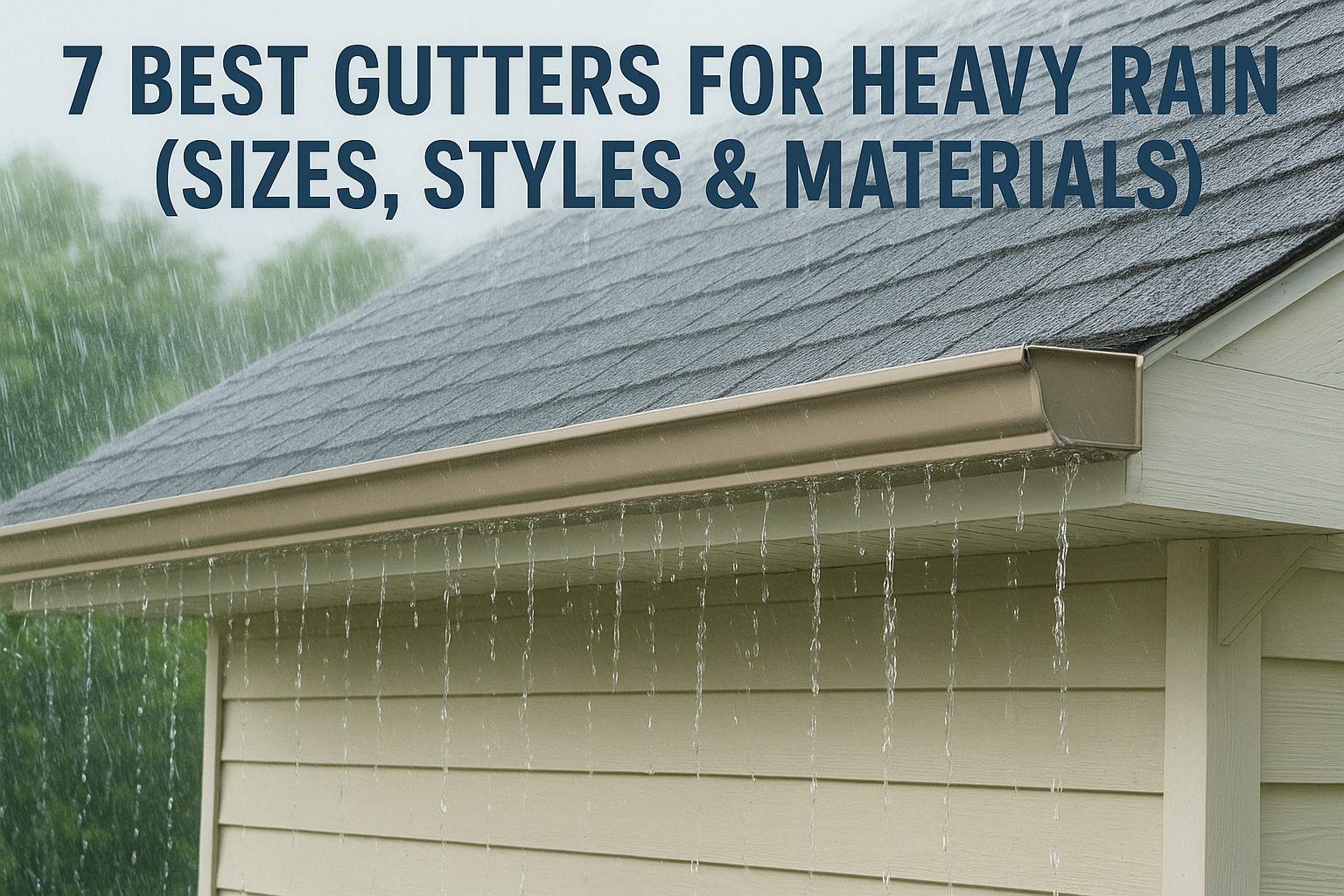
Central Texas storms don't ease up, and standard gutters often can't keep pace. When a heavy downpour hits, undersized or poorly matched gutters overflow, sending water straight into your fascia, foundation, and landscaping. Choosing the best gutters for heavy rain comes down to three factors: size, style, and material, and getting any one of them wrong can leave your home exposed.
At Defend Roofing, we install and replace gutters across the Austin area as part of our exterior services. Chris and Greyson Buster, our father-and-son team, have seen firsthand how the wrong gutter setup fails homeowners during Texas-sized rainstorms. That hands-on experience shapes every recommendation we make, and it's why we put together this guide with honest, practical advice instead of vague product lists.
Below, we break down seven gutter options that actually hold up when rain is at its heaviest. You'll learn which sizes handle the most volume, which styles resist clogging, and which materials last the longest, so you can make a confident decision for your home. Let's get into it.
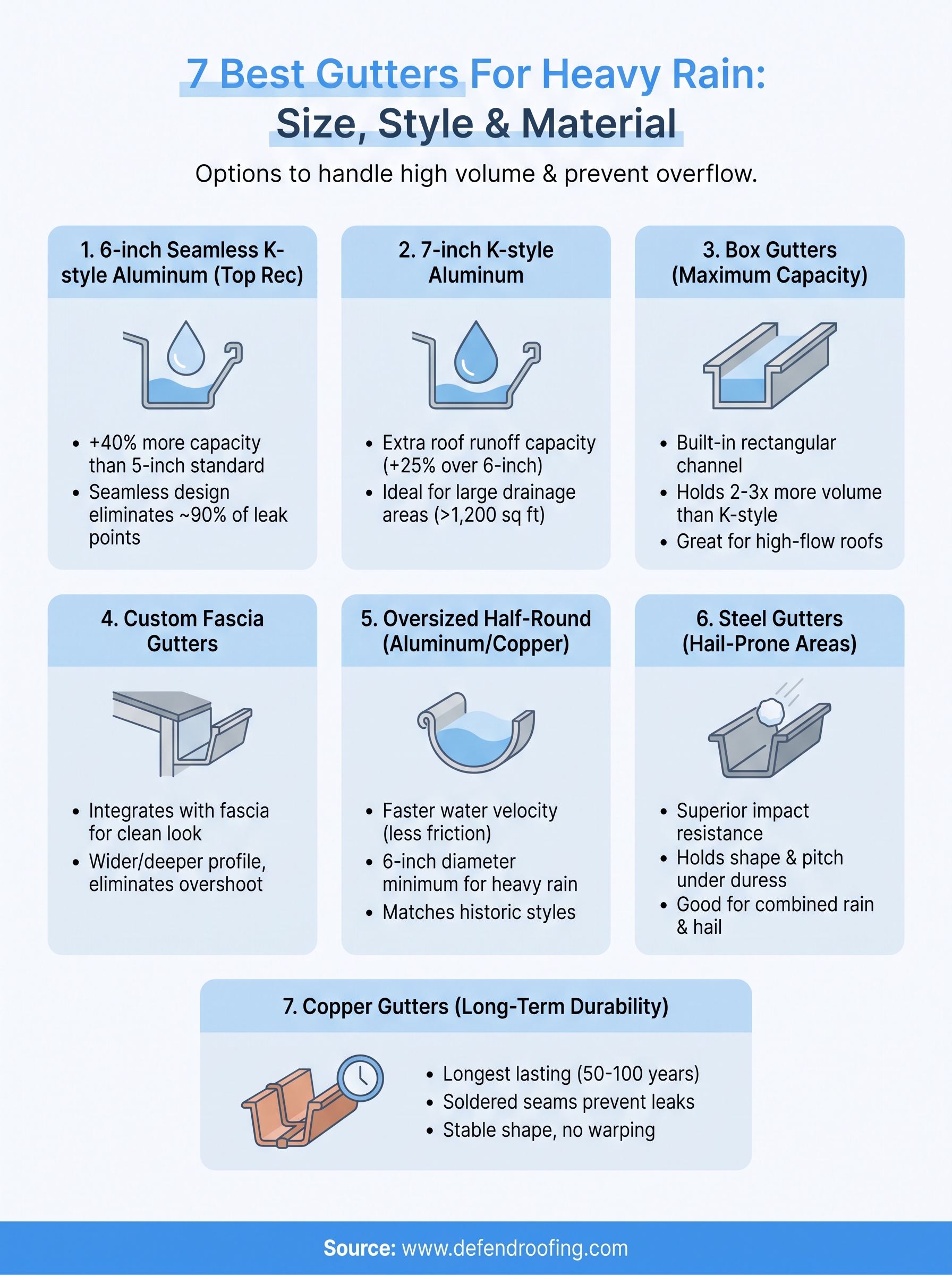
Our top recommendation for Central Texas homeowners is the 6-inch seamless K-style aluminum gutter, and it's the system we install on the majority of projects across the Austin area. This combination of size and style directly addresses the most common failures we see during heavy storms: overflow at mid-run, sagging from standing water weight, and joint leaks that quietly rot fascia boards over time.

The K-style profile features a flat back and a decorative ogee front, but its real advantage is water capacity. A 6-inch K-style gutter holds roughly 40% more volume than a standard 5-inch version, which matters when a Central Texas storm drops an inch of rain in under 30 minutes. Seamless construction removes every joint along the gutter run except at corners and downspouts, cutting out the weak points where sectional gutters typically fail first.
Seamless gutters eliminate up to 90% of the leak points found in sectional systems, making them the smarter choice for high-rainfall climates like Central Texas.
This gutter fits best when your roof has a large drainage area or a steep pitch that pushes water toward the edges fast. It also performs well on homes with long eave runs, where a 5-inch gutter would overflow before water ever reaches the downspout. If your current gutters overflow during moderate rain rather than only during extreme events, switching to a 6-inch seamless aluminum system is typically the most cost-effective upgrade you can make.
Before approving any quote, confirm these details in writing:
Any installer worth hiring should provide these specs without hesitation. If they can't confirm hanger spacing and downspout sizing upfront, that's a sign the installation will underperform.
Installed prices for 6-inch seamless aluminum gutters in the Austin market typically run between $8 and $14 per linear foot, depending on story height, access difficulty, and downspout count. A single-story home with 150 linear feet of gutter generally lands between $1,200 and $2,100 all in, including removal of old gutters, new hangers, and sealed connections throughout.
When a 6-inch gutter still isn't enough, a 7-inch K-style gutter is the next step up. These oversized systems are less common in residential work, but they belong in the conversation when you're searching for the best gutters for heavy rain on homes with unusually large roof surfaces.
A 7-inch K-style gutter carries roughly 25% more volume than a 6-inch version, which adds up fast on roofs with complex geometry or wide spans. The same K-style ogee profile keeps debris from settling flat against the bottom, and the extra width gives water more room to spread before it reaches the downspout. When your roof drains more than 1,000 square feet into a single gutter run, that added capacity prevents the overflow that would otherwise pound your foundation and siding.
For roof drainage areas exceeding 1,200 square feet per run, a 7-inch gutter can reduce overflow risk significantly compared to a standard 6-inch system.
This size fits best on large single-story homes, multi-wing layouts, or steep-pitch roofs where water accelerates quickly before hitting the gutter. If your current 6-inch gutters overflow only during extreme storms rather than everyday rain, a 7-inch upgrade makes sense. Homes with long continuous eave lines and limited downspout placement options also benefit from the added holding capacity.
Ask your installer to confirm these before signing off:
Installed pricing for 7-inch K-style gutters in the Austin area typically runs between $10 and $16 per linear foot, reflecting the larger material size and the extra labor involved in handling wider profiles at height.
Box gutters are the highest-capacity option available for residential and light commercial rooflines. Unlike K-style or half-round profiles that hang on the exterior fascia, box gutters are typically built into the roof structure itself, creating a wide rectangular channel that holds significantly more water volume before any overflow risk appears.
A box gutter's rectangular cross-section maximizes the water-holding area for a given width, making it one of the best gutters for heavy rain on roofs that shed enormous volumes quickly. Standard residential box gutters run 4 to 6 inches deep and 6 to 8 inches wide, giving them a capacity that dwarfs any hung K-style system of comparable width. That extra depth allows water to queue up during peak storm flow rather than spilling immediately over the edge.
Box gutters can hold two to three times the water volume of a comparably sized K-style gutter, making them a strong choice for high-drainage roof systems.
This style fits best on older homes with built-in gutter channels, low-slope roofs, or larger structures where standard hung gutters simply cannot keep pace. If your home already has a built-in trough system that's failing, restoring it with new liner material is often more cost-effective than converting to a hung system entirely.
Installed pricing runs higher than standard hung systems due to custom fabrication and structural access requirements. Expect costs between $15 and $30 per linear foot in the Austin area, with restoration of existing built-in channels typically landing at the lower end of that range.
Custom fascia gutters integrate directly into the fascia board itself, creating a clean, flush appearance that disappears into the roofline rather than hanging below it. Builders and architects specify these on contemporary and modern homes where exposed gutter hardware would break the visual design, but their appeal goes beyond aesthetics.
Fascia gutters are wider and deeper than standard K-style profiles, giving them a cross-section that moves high water volumes without the overflow risk that plagues narrower hung systems. Because the gutter body replaces the fascia board entirely, there is no gap between the roof deck edge and the water channel, which means runoff enters the gutter immediately rather than overshooting a mounted profile during heavy flow. That direct capture makes them one of the best gutters for heavy rain on roofs with steeper pitches.
Fascia gutters eliminate the overshoot gap that causes standard hung gutters to miss fast-moving water during intense storm events.
This style fits best on new construction or full roof replacements where the fascia is already being replaced. Retrofitting fascia gutters onto an existing roofline requires removing the old fascia entirely, which adds labor cost. Your home is a strong candidate if you have a low-profile modern design and want performance without visible hardware.
Expect installed pricing between $12 and $20 per linear foot in the Austin area, reflecting the custom fabrication and additional fascia removal labor involved.
Half-round gutters have been used on homes for over a century, and oversized versions in 6-inch or larger diameters remain one of the best gutters for heavy rain when paired with the right roof style. Their rounded trough profile moves water quickly without trapping debris against flat surfaces, which keeps flow rates high even during sustained downpours.
The curved interior of a half-round gutter creates less friction against moving water than a flat-bottomed K-style profile, which means water accelerates toward the downspout rather than pooling mid-run. An oversized 6-inch half-round gutter carries volume comparable to a standard K-style of the same width while also shedding sediment and debris more efficiently. That combination of speed and self-cleaning behavior reduces overflow risk during sudden heavy storms.
Half-round gutters outperform flat-bottomed profiles in water velocity, making them a strong choice for roofs that shed water rapidly during peak storm flow.
This style fits best on historic, craftsman, or Tudor-style homes where the rounded profile matches existing architectural details. Copper versions work particularly well on older homes where a long-lasting, low-maintenance finish justifies the higher upfront cost. Aluminum versions give you the same performance at a lower price point if visual match is less of a priority.
Aluminum half-round systems run between $9 and $15 per linear foot installed in the Austin area. Copper versions climb to $25 to $45 per linear foot, reflecting both material cost and the skilled soldering work required for watertight joints.
Steel gutters bring something aluminum and copper can't match: impact resistance. If you live in a neighborhood that takes repeated hail hits, a standard aluminum gutter dents and deforms after a few storms, which changes the pitch and creates pooling spots. Steel holds its shape under that kind of punishment, making it a reliable choice when your area sees both heavy rain and hail in the same storm.
Galvanized and Galvalume steel gutters are available in 6-inch K-style profiles, giving them the same volume capacity as the aluminum systems described earlier in this guide. The material's rigidity also means steel gutters maintain their slope over time better than thinner aluminum profiles, keeping water moving toward downspouts instead of settling mid-run. That consistent pitch is one of the reasons steel remains one of the best gutters for heavy rain in markets with wide temperature swings and frequent severe weather.
Steel gutters hold their shape under hail impact better than aluminum, preserving the slope that keeps water draining correctly during heavy storms.
Steel gutters fit best when hail is a recurring concern in your neighborhood and you want a system that survives impact without needing replacement after every major storm. They work well on both standard and steep-pitch roofs and pair with the same downspout sizing as K-style aluminum systems.
Installed steel gutters in the Austin area typically run between $10 and $18 per linear foot, reflecting the heavier material and additional hanger reinforcement required.
Copper gutters represent the longest-lasting option available for residential homes. When properly installed with soldered seams, a copper gutter system can last 50 to 100 years without the corrosion, denting, or coating failures that eventually affect aluminum and steel. That longevity makes them the most cost-effective choice over a long enough time horizon, even though the upfront price is the highest of any option in this guide.
Copper gutters are available in 6-inch half-round and K-style profiles, giving them the same volume capacity as other oversized systems in this list. The key advantage is structural stability: copper maintains its original shape and pitch for decades without thermal warping or hanger fatigue, which keeps water moving consistently toward downspouts even after years of heavy storm exposure. That dimensional stability makes copper one of the best gutters for heavy rain when you want performance that doesn't degrade over time.
Copper gutters soldered at every joint eliminate the seam failures that cause other materials to leak after years of thermal expansion and heavy-load storm events.
Copper fits best on high-value homes or historic properties where the premium material cost aligns with the overall investment in the structure. If you plan to stay in your home long-term and want a gutter system you'll never replace again, copper is the right call. It also pairs well with slate, tile, or cedar shake roofing where replacement costs are high and material longevity matters.
Copper gutters in the Austin area typically run between $30 and $50 per linear foot installed, reflecting both the material premium and the skilled labor required for proper soldering throughout the system.
Picking the best gutters for heavy rain comes down to matching your roof's drainage area, pitch, and storm exposure to the right size, style, and material. Before you approve any quote, run through these questions: Does your installer specify gauge and hanger spacing in writing? Does the downspout size match the gutter output? Does the pitch hit at least 1/4 inch drop per 10 linear feet? If any answer is unclear, push for specifics before work starts.
Your budget matters too, but don't let upfront cost be the only deciding factor. A well-installed 6-inch seamless aluminum system outperforms a poorly installed copper one every time. Prioritize confirmed specs and installer accountability over the lowest price on the page.
If you're in the Austin area and want a straight answer on what your home actually needs, get a free gutter assessment from Defend Roofing and we'll walk you through the right setup for your roof.