See what factors affect the cost roof inspection in Central Texas, compare pricing $150-$600+, and learn when to schedule for savings.

You noticed a few missing shingles after last week's storm, or maybe your insurance agent asked for documentation before they'll process a claim. Either way, you're trying to figure out the cost roof inspection companies charge before you pick up the phone. Prices swing more than you'd expect, and knowing why keeps you from overpaying or settling for a rushed walkthrough that misses real damage.
Most homeowners in Central Texas pay somewhere between $150 and $600 for a professional inspection, depending on roof size, pitch, accessibility, and whether the visit includes a written report for insurance purposes. A basic visual check costs less than a full roof inspection report with photo documentation, and a roof leak inspection aimed at tracking down an active leak often runs higher because it takes more time and sometimes involves attic access or moisture testing.
In this article, we'll break down what actually drives the average roof inspection cost, compare pricing for storm damage versus routine checkups, and explain what a thorough inspection should include so you know you're getting your money's worth before hiring anyone.
Homeowners often treat the cost roof inspection companies quote as an afterthought, something to compare against three other numbers and pick the cheapest. That approach backfires more often than not. A roof problem you catch early, like a cracked pipe boot or a handful of lifted shingles, costs a few hundred dollars to fix. Ignore it for two storm seasons and you're looking at rotted decking, mold in the attic, and a replacement bill running into five figures. The average cost of roof inspection is small change compared to what it prevents.
Plenty of roofing companies advertise free inspections, and there's nothing wrong with taking one, as long as you understand the arrangement. A free inspection is usually a sales visit. The inspector's job is partly to find enough damage to justify a replacement quote, and that creates an incentive to lean toward "you need a new roof" even when a repair would do. A paid inspection, by contrast, is a service you're hiring outright. Nobody's commission depends on the outcome, which means the findings tend to be more objective. If you're gathering documentation for a home sale, a refinance, or a dispute with your insurer, that independence matters more than the money you'd save going the free route.
A paid inspection buys you an honest answer, not a sales pitch dressed up as one.
Not every inspection at a given price point delivers the same value. A $150 walkthrough that takes fifteen minutes and ends with a verbal "looks fine" isn't the same product as a $350 visit that includes photo documentation and a written report you can hand to an adjuster, so it helps to know how long a proper roof inspection should take. Before you agree to a roof inspection report cost, ask what's actually included and get familiar with what a roof inspection checks. A thorough inspection worth paying for should cover:
Our own Precision Roof Assessment builds every one of those steps in as standard, because a homeowner deciding whether to file an insurance claim or pay out of pocket needs more than a verbal opinion. They need evidence.
An inspection tied to a roof inspection for insurance cost conversation often runs higher than a routine checkup, and there's a reason for that beyond padding the bill. Insurance adjusters expect documentation that holds up: dated photos, measurements, and a report that ties damage to a specific storm event. Producing that level of detail takes longer on the roof and longer at the desk afterward writing the report. If you're filing a claim for hail or wind damage, paying a bit more for an inspector who knows how to document a roof inspection for an insurance claim usually saves you money in the long run, since a weak report gets claims denied or lowballed.
Understanding what you're paying for, and why, puts you in a much stronger position than simply hunting for the lowest quote. The next section walks through how to get pricing that actually reflects your roof, not a generic estimate pulled from a national average.
Generic price ranges only get you so far. If you want a number that actually applies to your house, you need to give a contractor real details when you compare roof inspection companies in Austin, TX, not just ask how much does a roof inspection cost over the phone and expect a firm quote. The size of your roof, its pitch, the number of stories, and whether there's existing damage all change the math. A contractor who quotes you sight unseen is guessing, and guesses tend to run high to cover their risk.
Start by pulling up your square footage, roughly, and note anything unusual: steep pitch, multiple roof lines, chimneys, skylights, or a second story that requires extra ladder work. Share that with whoever you're calling, and ask them to walk you through how they price. Here's a rough sense of how the roof inspection cost per square foot style pricing tends to break down against flat-rate visits:
| Inspection type | Typical price range | What you get |
|---|---|---|
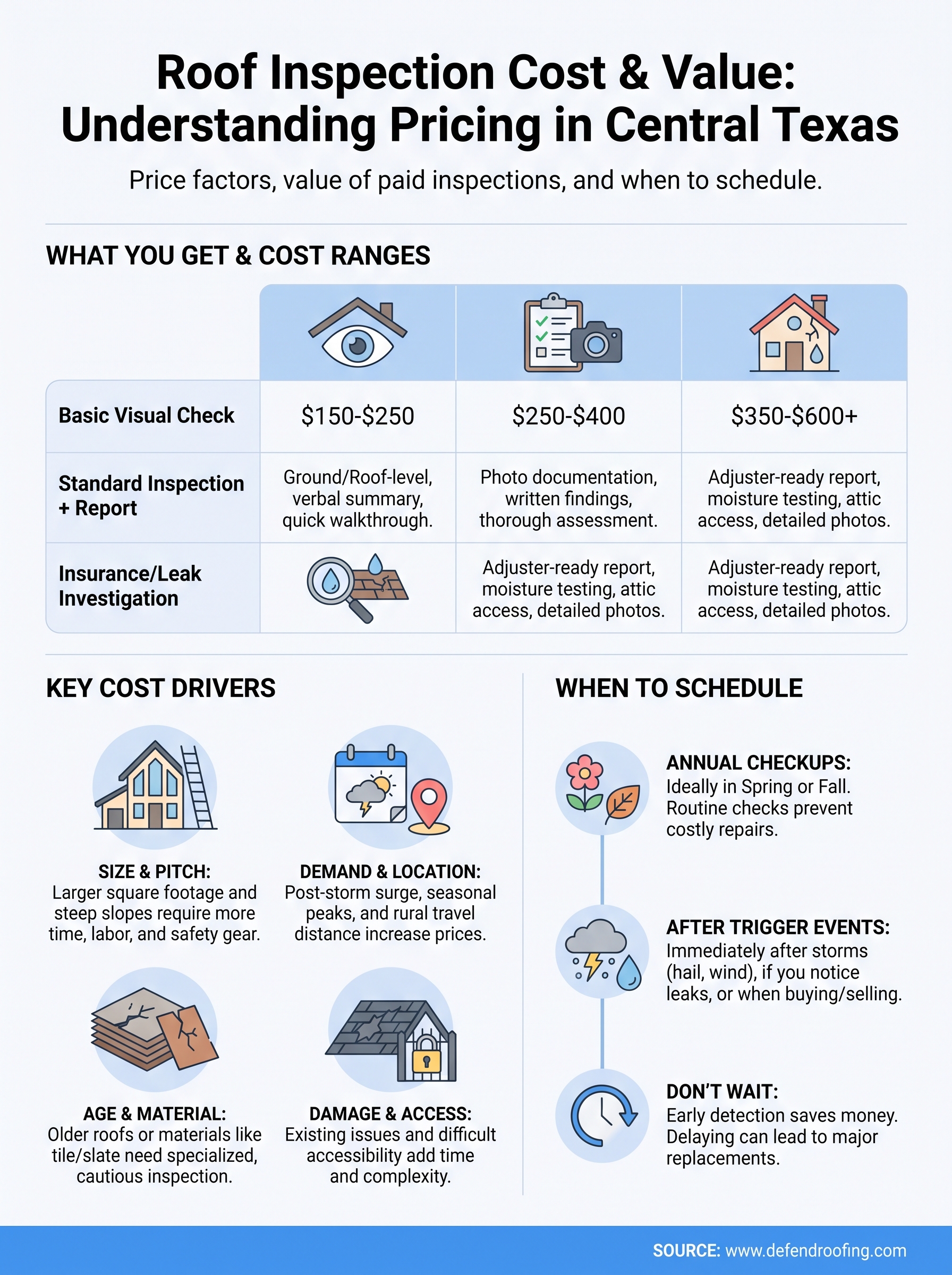
| Basic visual walkthrough | $150-$250 | Ground and roof-level check, verbal summary |
| Standard inspection with report | $250-$400 | Photo documentation, written findings |
| Insurance-focused inspection | $350-$600 | Adjuster-ready report, moisture readings, detailed photos |
| Leak investigation | $300-$600+ | Attic access, leak tracing, targeted moisture testing |
The clearer you are about your roof, the closer the quote comes to the final bill.
Phone quotes without context are a coin flip, so use the call to surface the details that actually move the price, and know the red flags to watch for when hiring an inspector. Before you book anything, ask:
Requesting answers to those five questions before you agree to anything weeds out the contractors who pad invoices after the fact.
Getting two or three estimates isn't about squeezing out the cheapest number, it's about comparing roof inspection services and their costs to calibrate what's normal for your specific roof in your specific market. Homeowners looking for roof repair and replacement in Cedar Park, TX, Avery Ranch, or Leander should expect similar ranges to each other, so a quote that's dramatically higher or lower than the rest deserves a second look. We walk Central Texas homeowners through this pricing conversation directly when they schedule a roof inspection with our team, so there's no guesswork about what you're paying for.
Several factors combine to set the final number on your invoice, and understanding them helps you spot a fair quote from an inflated one. Two houses in the same Cedar Park neighborhood can get inspection quotes $200 apart, and it's rarely about one company being dishonest. It usually comes down to roof characteristics the homeowner didn't think to mention when they called.
Bigger roofs take longer to walk, photograph, and document, so square footage is the first variable that moves your price. A 1,200 square foot ranch home costs less to inspect than a 3,500 square foot two-story with multiple gables. Pitch matters just as much. A low-slope roof lets an inspector walk it safely and quickly, while a steep pitch requires harnesses, extra time, and sometimes a second person for safety, all of which get baked into the average roof inspection cost. Accessibility issues, like a roof surrounded by mature trees, a locked gate blocking ladder access, or a detached garage that also needs checking, add time on top of that.
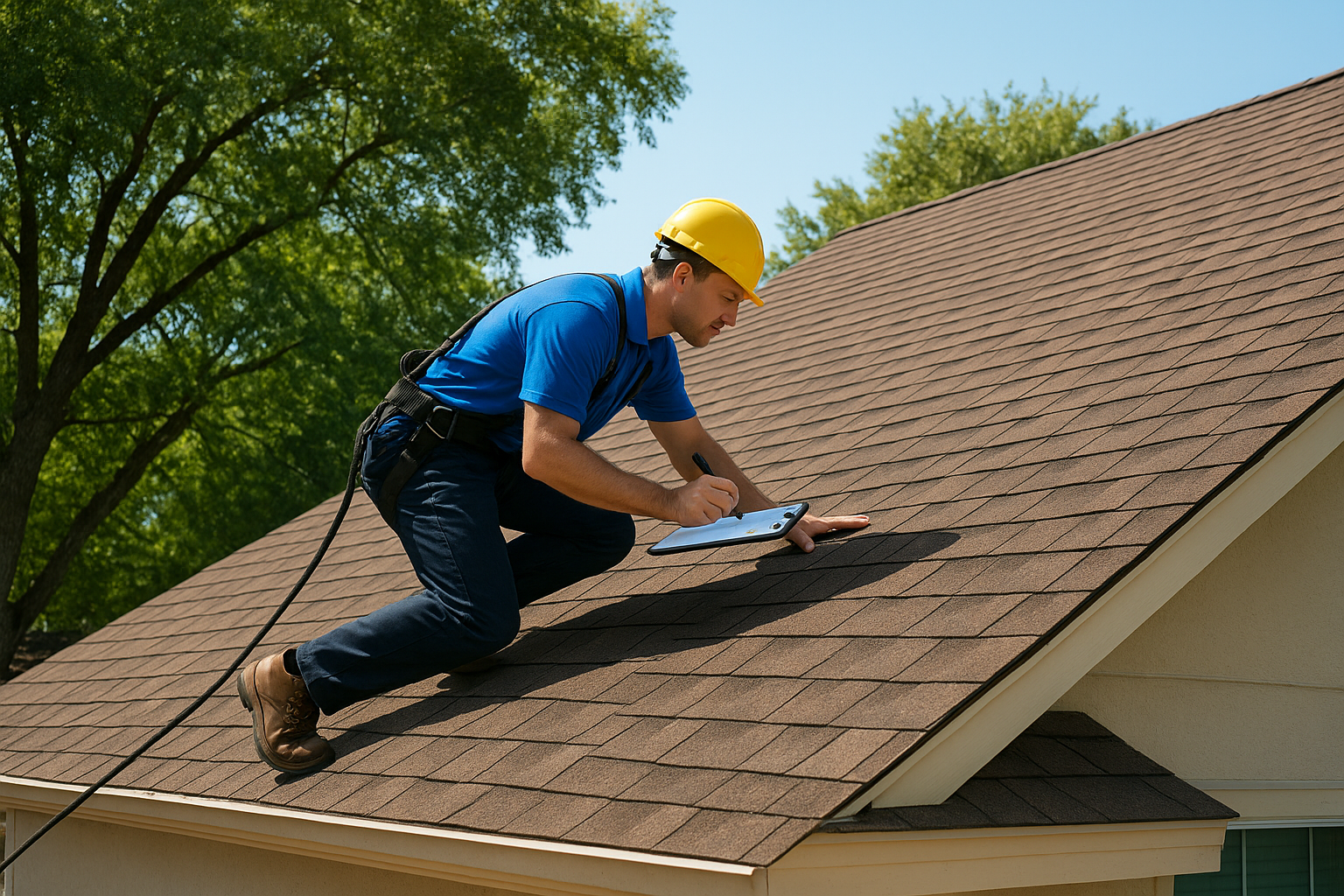
The steeper and larger the roof, the more labor goes into inspecting it safely, and the price follows.
Older roofs and unusual materials change the inspection scope too. A 20-year-old asphalt shingle roof nearing the end of its lifespan typically needs a more thorough look than a five-year-old roof in good shape, since the inspector is hunting for granule loss, brittle shingles, and multiple failure points rather than confirming everything looks fine. Metal, tile, and slate roofs often carry higher inspection fees than standard asphalt shingles because they require specialized knowledge and, in tile's case, extra caution to avoid cracking material while walking on it. Consider how these variables typically stack up:
Geography and timing play a role most homeowners overlook. Contractors serving rural properties outside Austin proper may add a trip fee for the drive. Seasonal demand matters too. Booking an inspection right after a major hailstorm, when every roofing company in Central Texas has a backlog, sometimes means paying a premium for a faster slot, or waiting weeks for a discounted one. Scheduling during slower months, typically late fall or early spring in this region, often gets you better pricing and more attention per visit.
Timing your inspection right saves money two ways: you avoid emergency service fees, and you catch problems before they multiply into expensive repairs. Most homeowners ask how much for a roof inspection without asking when to schedule one, but the two questions are connected. A well-timed routine check costs less and finds more than a rushed inspection squeezed in after visible damage already shows.
Every roof, regardless of age or material, benefits from at least one inspection a year, ideally in spring after winter weather and before summer storm season ramps up in Central Texas, and this homeowner inspection schedule spells out the rhythm. Homes with roofs older than 15 years, or ones that have already weathered a major hailstorm, should consider a second annual check in fall. Sticking to that rhythm means an inspector spots granule loss, lifted flashing, or a slow leak while it's still a $300 repair instead of a $3,000 one.
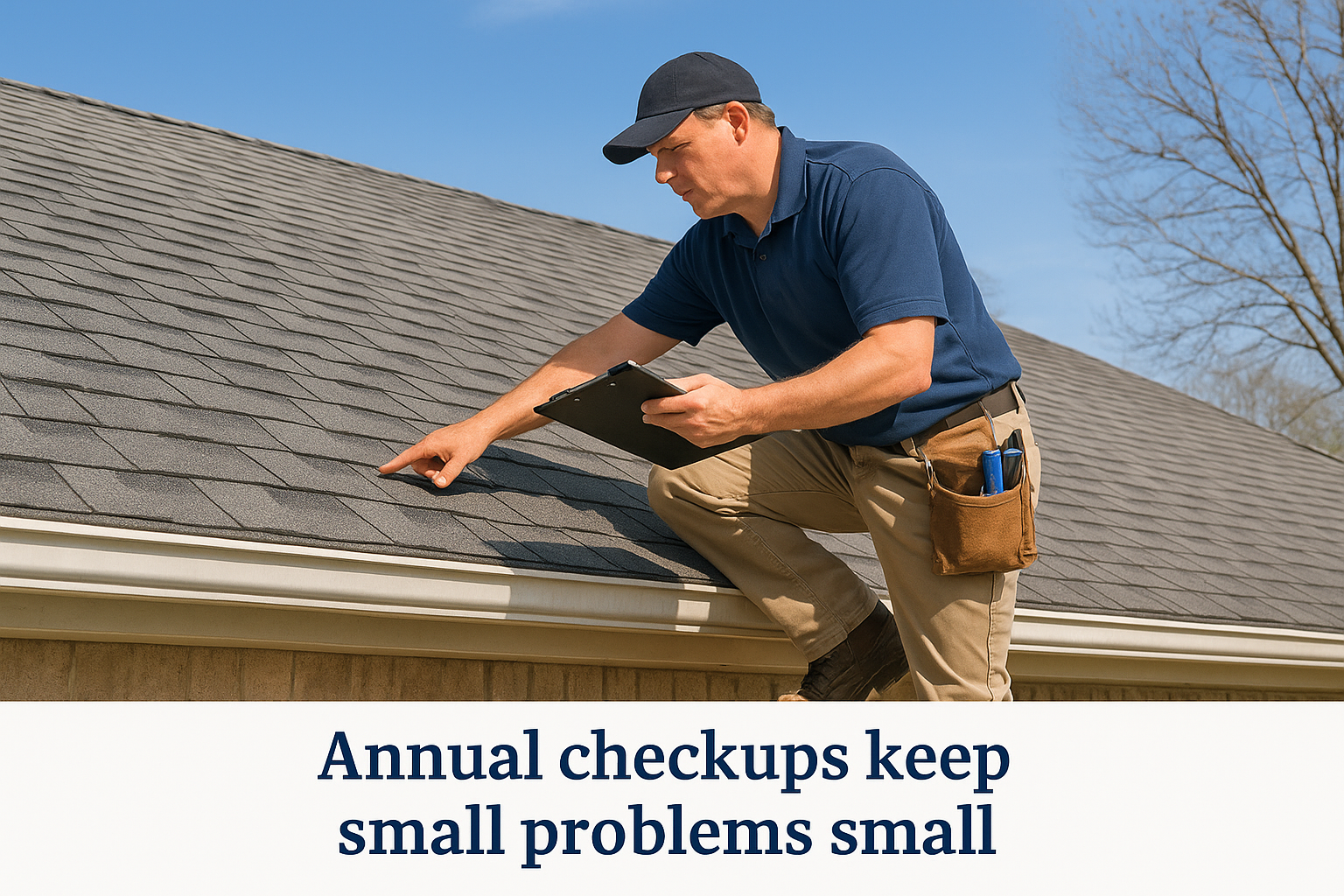
Catching a problem on schedule almost always costs less than catching it in an emergency.
Certain events should trigger an inspection regardless of when your last one happened. Waiting for your annual slot after one of these situations risks turning a minor fix into a major claim:
Any one of those is reason enough to book a visit outside your usual schedule, and doing so quickly after a storm strengthens your position if you end up filing a claim.
Scheduling matters for your wallet too. Booking right after a regional storm means competing with every other homeowner in Cedar Park, Avery Ranch, or Steiner Ranch for a limited number of inspection slots, which can push prices up and shorten the time an inspector spends on your roof. Getting ahead of storm season, or scheduling during quieter months, tends to get you a more thorough visit at a fairer price. If it's been more than a year since your last check, or you're not sure what condition your roof is in, scheduling a roof inspection now is cheaper than waiting for a problem to force the issue.
The cost roof inspection companies charge in Central Texas typically lands between $150 and $600, and now you know exactly why one quote sits at the low end while another climbs higher. Roof size, pitch, material, insurance documentation needs, and timing all move that number, and none of it is random once you understand the variables.
Spending a few hundred dollars on a thorough inspection protects you from the kind of surprise that costs thousands later. A home roof inspection cost feels like an expense right up until it saves you from a denied insurance claim or a rotted deck you didn't know was hiding under your shingles. Treat it as insurance for your insurance, not an optional extra.
If it's been a year or more since your last checkup, or a storm just rolled through your neighborhood, don't wait on it. Call, text, or request a straightforward quote from Defend Roofing before small damage turns into a big bill.