Do I need gutters on my house? Check roof slope, soil type, and foundation risks—plus warning signs—with Defend Roofing's Central Texas guide.

If you're asking do I need gutters on my house, you've probably noticed water pooling near your foundation, mulch washing away, or streaks forming on your siding after every storm. Central Texas rain doesn't fall gently. It comes in bursts that dump inches in an hour, and where that water lands matters a lot more than most homeowners realize until foundation cracks or basement seepage show up on an inspection report.
The honest answer depends on your specific property, not a blanket rule. Roof slope, soil type, and grading around your house determine how much risk you're actually carrying without gutters. A steep roof over sandy, well-draining soil behaves nothing like a low-slope roof over the clay-heavy ground common around Austin and Cedar Park. We'll walk through the factors that actually decide this, not generic advice that ignores your lot.
This article breaks down the climate and terrain conditions that push a house from optional to necessary, how foundation risk factors into the decision, and what it costs to install gutters versus what you risk by skipping them. By the end, you'll know exactly where your house falls.
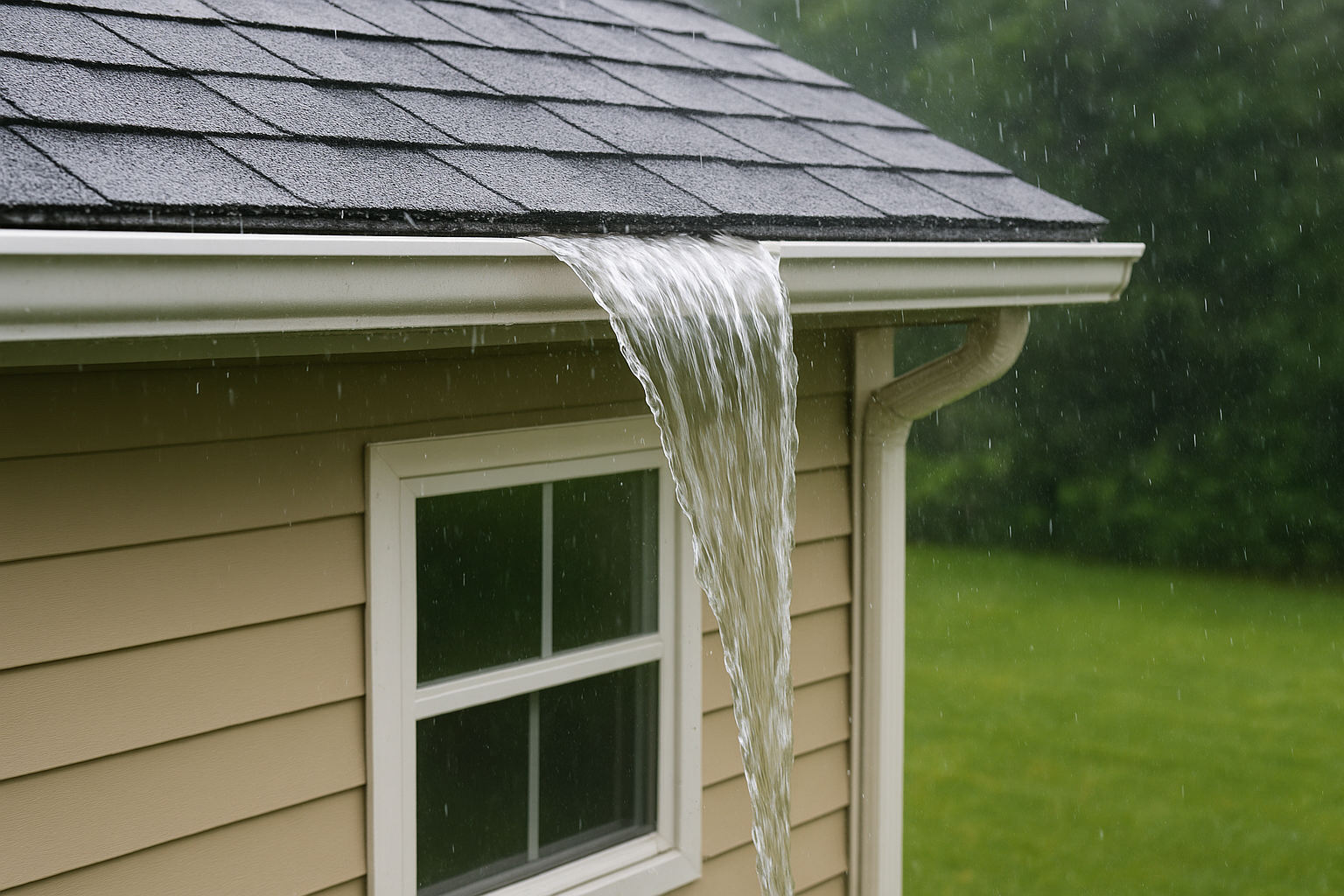
Every roof collects far more water than you'd guess. A modest 2,000-square-foot roof sheds roughly 1,200 gallons during a single inch of rain, and Austin storms regularly drop two or three inches in an hour. Without gutters, all of that water leaves the roof edge in one uncontrolled sheet, concentrating along your foundation line instead of spreading harmlessly across the yard. That single fact is why the question of whether you need gutters isn't cosmetic. It's about where thousands of gallons of water go every time it rains.
Consider how quickly runoff adds up depending on roof size and rainfall intensity:
| Roof Size | 1 Inch of Rain | 3 Inches of Rain |
|---|---|---|
| 1,500 sq ft | 900 gallons | 2,700 gallons |
| 2,000 sq ft | 1,200 gallons | 3,600 gallons |
| 3,000 sq ft | 1,800 gallons | 5,400 gallons |
Numbers like these explain why homes that seem fine after a light drizzle can develop soaked flower beds, standing water, or a soggy crawl space after a real Central Texas downpour. Once you see the volume, the risk stops feeling abstract.
Runoff volume matters most because of what's under your house. The clay-heavy soil common around Cedar Park, Avery Ranch, and Leander expands when saturated and contracts when it dries out. That cycle, repeated every rainy season, shifts the ground beneath your slab. Concentrated runoff along one section of foundation accelerates that swelling far more than water that's spread evenly across the yard by a gutter and downspout system.
Uncontrolled roof runoff pushed against a clay foundation is one of the most preventable causes of slab movement homeowners face in Central Texas.
Foundation repair isn't cheap, and it isn't quick either. Piering a slab typically runs into the thousands of dollars, and it disrupts landscaping, driveways, and sometimes interior flooring. Gutters cost a fraction of that and address the problem at the source instead of after the cracks appear.
Soil erosion tells a similar story. Water sheeting off a roof edge digs trenches into mulch beds, washes away topsoil, and undermines walkways over time. Homeowners often notice the mulch first, then the exposed roots, then the uneven ground near the porch steps. None of it happens overnight, which is exactly why it gets ignored until the yard needs regrading.
Siding and paint take a hit too. Splashback from unguttered roof edges throws dirt and moisture onto the lower few feet of exterior walls, leading to staining, mildew, and premature paint failure. Wood siding is especially vulnerable, since repeated soaking softens fibers and invites rot faster than sun exposure ever would.
Taken together, these three factors, foundation stress, erosion, and exterior wear, explain why gutters matter more than most homeowners assume when they're simply picking a roofing feature off a checklist. It's not about tidiness. It's about controlling where a serious amount of water goes every time it rains, and whether that water works against your house or away from it.
Answering this question for your specific house means looking past the weather forecast and examining four things: roof slope, ground grading, soil type, and foundation vulnerability. Each factor either sends water away from your home naturally or sets you up for the erosion and slab problems covered above. Walk your property with these in mind before you decide gutters are optional.
Steep roofs with wide overhangs throw water further from the foundation than low-slope roofs with tight eaves. If your overhang extends two feet or more and your yard slopes away from the house at a decent grade, you're carrying less risk than a neighbor with a shallow-pitched roof and eaves that barely clear the wall. Measure your overhang before assuming your roof design is doing the job for you.
Grab a hose or wait for the next storm and watch where the water goes. Pooling near the foundation, water pushing toward the house instead of away, or puddles that sit for hours are signs your grading isn't handling runoff on its own.
Answering yes to any of these means gutters are doing real work, not just decoration.
Sandy or well-draining soil absorbs runoff quickly and moves it away from your slab. Clay soil, common throughout Cedar Park, Steiner Ranch, and Jonestown, holds water and swells, putting direct pressure on your foundation.
If your soil is clay-heavy, gutters aren't a nice-to-have. They're foundation protection.
Slab foundations sit closer to grade and take the brunt of concentrated runoff, while homes with raised piers or deep footings tolerate saturated soil a little better. If you've got a slab, clay soil, and a low-slope roof, that combination almost always points toward needing gutters. Mix in a steep roof, sandy soil, and a raised foundation, and the calculation shifts, though it rarely eliminates the need entirely.
Some houses don't need you to run the calculations above because the damage already answers the question. If you're spotting any of the signs below, you're past the point of weighing pros and cons and into the territory of actual repair costs. Recognizing these signs early can save you from a much bigger bill down the road.
Start at ground level, since that's where roof runoff does the most damage. Mulch beds that wash out after every storm, soil that pulls away from your slab, or small trenches carved into the dirt along your roofline are all telling you water is landing in the same spot every time. Cracks in your foundation or interior drywall, especially ones that seem to widen after heavy rain, point to soil movement that's already underway.
Water stains climbing your lower siding, peeling paint near the roofline, or mildew forming on brick and stucco all signal splashback from an unprotected roof edge. Doors and windows that have started sticking, particularly on the side of the house that catches the most rain, often mean the foundation nearby has shifted slightly from repeated saturation.
Pay attention the next time it rains hard. A few clear signs stand out:
If your yard tells the same story after every storm, your roof is telling you it needs gutters, not luck.
One bad storm doesn't prove much on its own. What matters is repetition. If the same trench reappears after every downpour, or the same window keeps sticking every rainy season, that's not coincidence. It's your house showing you where water is concentrating, and it's a strong argument for adding gutters before the next storm makes the problem worse. At that stage, gutters aren't a cosmetic upgrade. They're the fix for a pattern your home has already started showing you.
Not every house in Central Texas needs gutters, and pretending otherwise ignores real exceptions. Some properties handle roof runoff just fine without a single downspout, thanks to a combination of slope, soil, and landscaping that does the work gutters would otherwise handle. If your home checks several of the boxes below, you may be looking at a lower-priority upgrade rather than an urgent one.
Homes with a steep pitch and overhangs of two feet or more throw water well past the foundation line on their own. That extra distance gives runoff room to soak into the yard before it ever reaches the slab. Pair that roof design with a lot that slopes noticeably away from the house, and you've got a natural drainage system already in place.
Soil type changes the equation more than most homeowners expect. Sandy or loamy soil absorbs water quickly and doesn't hold moisture against your foundation the way clay does. If a soil test or a simple observation after rain shows water disappearing within minutes rather than pooling, you're carrying far less risk than a neighbor sitting on clay.
Fast-draining soil and a well-sloped lot can do the job gutters usually handle.
Houses built on raised piers or deep footings tolerate saturated ground better than slab homes do, since the structure isn't sitting directly at grade. A little extra runoff near the perimeter matters less when there's clearance underneath.
Before skipping gutters altogether, confirm your property actually meets these conditions:
Even then, treat this as a case-by-case call rather than a permanent pass. A drought year followed by a wet season can shift soil behavior, and additions or landscaping changes can undo grading that used to work. Reassess anytime your yard or roofline changes, since the conditions that let you skip gutters today won't necessarily hold five years from now.
Homeowners often ask whether French drains, splash blocks, or regrading can do the same job as gutters for less money. The honest answer is that these alternatives handle different problems, and none of them intercept water at the roofline the way gutters do. Understanding what each option actually fixes helps you avoid paying for a solution that misses the real source of the damage.

Grading moves water that's already on the ground, but it does nothing to control the volume dropping off your roof edge in the first place. French drains capture and redirect subsurface water, which helps with a soggy yard but won't stop splashback against your siding or erosion right at the foundation line. Splash blocks reduce concentrated erosion directly under a downspout, yet they're useless on a house that has no downspouts to begin with, since they only work in combination with gutters, not instead of them.
| Solution | What It Fixes | What It Misses |
|---|---|---|
| Gutters | Roof runoff at the source | Nothing significant if sized right |
| Regrading | Surface water flow direction | Volume and force from roof edge |
| French drains | Subsurface saturation | Splashback and erosion at roofline |
| Splash blocks | Erosion under downspouts | Requires gutters to function |
Layering solutions gets you closer to real protection than picking just one. A house with gutters, a downspout extension, and a slight grade away from the foundation handles a Central Texas storm far better than a house relying on regrading alone. Combining gutters with proper drainage addresses both the volume problem and the direction problem at the same time, which is exactly why most professional assessments recommend pairing them rather than choosing between them.
Gutters control the water at the source. Grading and drains only manage what gutters miss.
Skipping gutters and betting entirely on drainage work downstream almost always costs more over time. Regrading a yard or installing a French drain system after foundation cracks appear runs into thousands of dollars, while gutters installed upfront prevent that concentrated runoff from ever becoming a problem. Alternatives have a place in a complete drainage plan, but they work best as a supplement to gutters, not a replacement for them.
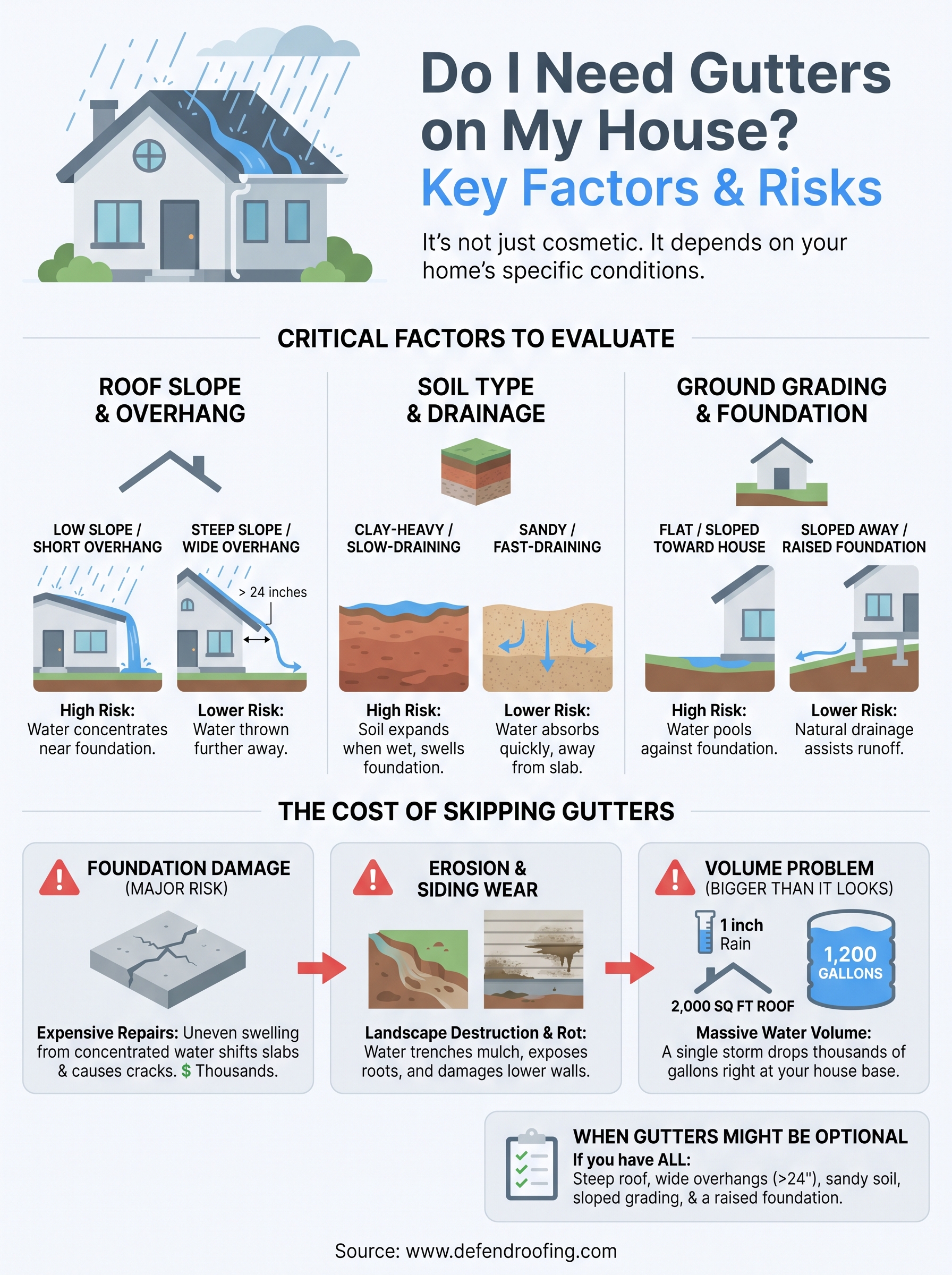
So, do you need gutters on your house? If you've got a slab foundation, clay soil, or a low-slope roof, the answer is almost always yes. Skipping gutters on that combination invites foundation movement, erosion, and siding damage that cost far more to fix than installing gutters would have cost upfront. If your roof throws water well past the foundation and your soil drains fast, you might genuinely be in the clear, at least for now.
Either way, don't guess. Walk your property, check the warning signs, and weigh your specific slope, soil, and grading against what we've covered here. Central Texas storms don't wait for you to figure this out after the damage shows up.
If you want a second opinion from people who've assessed thousands of roofs across Cedar Park, Austin, and Leander, reach out to Defend Roofing for a straight answer and a quote.