See real Austin-area pricing and learn what a trustworthy flat roof repair estimate should include before you sign anything or file a claim.
You spotted a wet ceiling stain, a pooling puddle on the flat section over your garage, or a contractor's quote that seemed way higher than what your neighbor paid. Now you're trying to figure out if a flat roof repair estimate in Central Texas should run $300 or $8,000, and honestly, the range is that wide because flat roofs fail in very different ways.
Here's the direct answer: most flat roof repairs in the Austin area fall between $400 and $2,500, while a full replacement typically lands between $8 and $14 per square foot depending on material. What changes the number is the roofing material (TPO, EPDM, modified bitumen), how much of the deck underneath got wet, and whether you're patching one leak or dealing with widespread ponding water that's been sitting for years.
In this guide, we break down real cost ranges by repair type, explain what inflates a quote from reasonable to outrageous, and show you the specific damage signs that separate a $500 patch job from a full tear-off. We'll also cover when insurance should be covering the bill instead of your own pocket.
Ask five roofing contractors to look at the same flat roof and you might get five different numbers. That's not because someone's trying to rip you off (though that happens too). It's because a flat roof repair estimate depends on several variables stacking on top of each other, and small differences in each one add up fast.
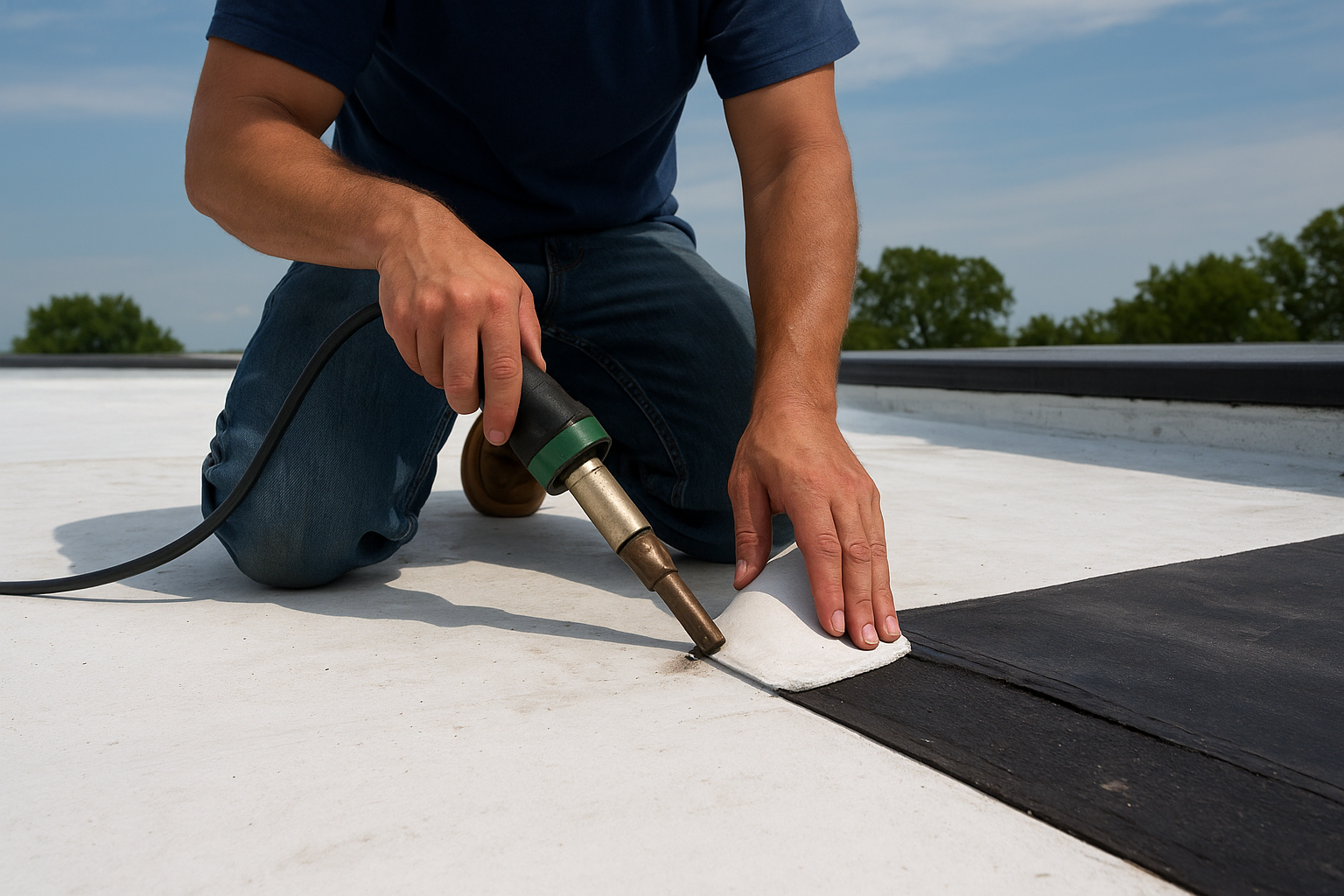
Flat roofs aren't one product. TPO, EPDM (rubber membrane), modified bitumen, and built-up roofing (BUR) all patch differently, cost different amounts per square foot, and require different skill levels to repair correctly. A TPO seam repair might need a hot-air welder and specific training. An EPDM patch uses a different adhesive system entirely. If your contractor doesn't stock the right material or hasn't worked with your specific membrane before, expect a markup for sourcing it or subcontracting the job out.
| Material | Typical Repair Cost | Typical Replacement Cost (per sq ft) |
|---|---|---|
| TPO | $400 - $1,200 | $8 - $10 |
| EPDM (rubber) | $350 - $1,000 | $7 - $9 |
| Modified Bitumen | $500 - $1,800 | $9 - $12 |
| Built-Up Roofing (BUR) | $600 - $2,500 | $10 - $14 |
This is the single biggest cost driver, and it's the one homeowners underestimate the most. A leak you noticed last week might have been dripping into your insulation for two years. Wet insulation doesn't dry out on its own, and it doesn't just get patched over. It has to be cut out, dried, and replaced, or you're paying to fix the same leak again in six months. A quote that only covers surface patching without checking the deck below is a quote that's about to become two quotes.
The real cost of a flat roof repair isn't the leak you can see, it's the water damage you can't see until someone cuts the membrane open.
Steiner Ranch and Avery Ranch homes often have flat sections tucked over garages, porticos, or additions with tricky access. If a crew has to haul materials up a ladder instead of driving a lift onto a driveway, that's added labor time. HVAC units, solar panels, or satellite equipment sitting on the membrane also slow things down, since everything has to be lifted, protected, or temporarily relocated before repair work starts.
Central Texas has seen a construction labor crunch for years, and flat roof specialists are rarer than steep-slope crews. A contractor who's spent a decade specifically on commercial-style flat membranes will price differently than a general residential roofer who occasionally handles a flat section. That's not always a bad thing. Paying more for genuine expertise on TPO welding usually costs less over five years than paying less for a patch that fails again next summer.
Here's a quick rundown of what typically drives your number up or down:
Getting a number you can trust starts before anyone climbs on your roof. A flat roof repair estimate built on a five-minute visual look from the ground is barely more useful than a guess, and you deserve better than that when you're deciding whether to spend $500 or $5,000.
Walking the roof and photographing the damage is the only way to know what you're actually paying for. A contractor should be able to show you the ponding areas, the soft spots in the decking, and the seams that are separating, not just tell you about them. At Defend Roofing, every assessment includes 100+ photos documenting the roof's condition, because a homeowner shouldn't have to take a stranger's word for what's wrong up there.
An estimate you can't verify with your own eyes isn't an estimate, it's a guess with a price tag.
Two quotes that look similar on price can cover completely different work. One might include deck replacement under the wet spot; the other might just skim the surface and hope for the best. Before you pick a contractor, line up exactly what each proposal promises.
Even a thorough inspection can't always see everything until the membrane is cut open. A trustworthy contractor tells you upfront how they'll handle surprises, whether that means a call before extra work starts or a pre-agreed cap on added cost. Vague answers here usually mean vague invoices later.
Finally, get everything in writing before work begins. A verbal number over the phone means nothing once a crew is standing on your roof with a utility knife. Written estimates protect both sides and give you something concrete to compare if you're weighing repair against replacement, or handing documentation to an insurance adjuster.
Opening a written estimate for the first time can feel like reading a foreign language if you don't know what to look for. A solid flat roof repair estimate breaks the job into distinct line items, not one vague number covering "roof work." Knowing what should be listed helps you spot a thin, rushed quote before you sign anything.
Most trustworthy estimates separate labor cost from material cost, even if they show a combined total at the bottom. This matters because material prices shift with the market, and a contractor who can't tell you how much membrane, adhesive, or flashing they're using probably hasn't measured your roof carefully. Expect line items for membrane square footage, fasteners or adhesive, flashing material around vents and edges, and disposal of the old damaged section.
Any estimate worth trusting includes a line for checking the roof deck underneath the membrane, since that's where hidden rot lives. If the deck is soft or the insulation is saturated, the estimate should spell out a per-sheet or per-square-foot cost for replacement, not bury it as a vague "additional charges may apply" note. This is where a lot of surprise invoices come from later.
If the estimate doesn't mention the deck, it's not really estimating the repair, just the patch on top of it.
A repair without a warranty is a gamble. Look for a specific warranty period on the workmanship itself, plus any manufacturer warranty tied to the membrane material used. The estimate should also give you a realistic project timeline, including weather contingencies, since flat roof adhesives and welds need dry conditions to cure properly.
Here's what a complete, honest estimate should spell out:
A growing number of reputable contractors now attach photo documentation directly to the written estimate, showing the exact areas that need repair. This protects you if a dispute comes up later and gives you something concrete to hand an insurance adjuster if the damage is storm-related. Without photos, you're relying entirely on trust, and trust alone shouldn't be the basis for a five-figure decision.
Once you understand what drives the price, actual numbers start making more sense. Below are the repair types Central Texas homeowners run into most often, along with realistic cost ranges based on typical Austin-area jobs. Treat these as starting points for your own flat roof repair estimate, not a guarantee, since the specifics of your roof will always shift the final number up or down.
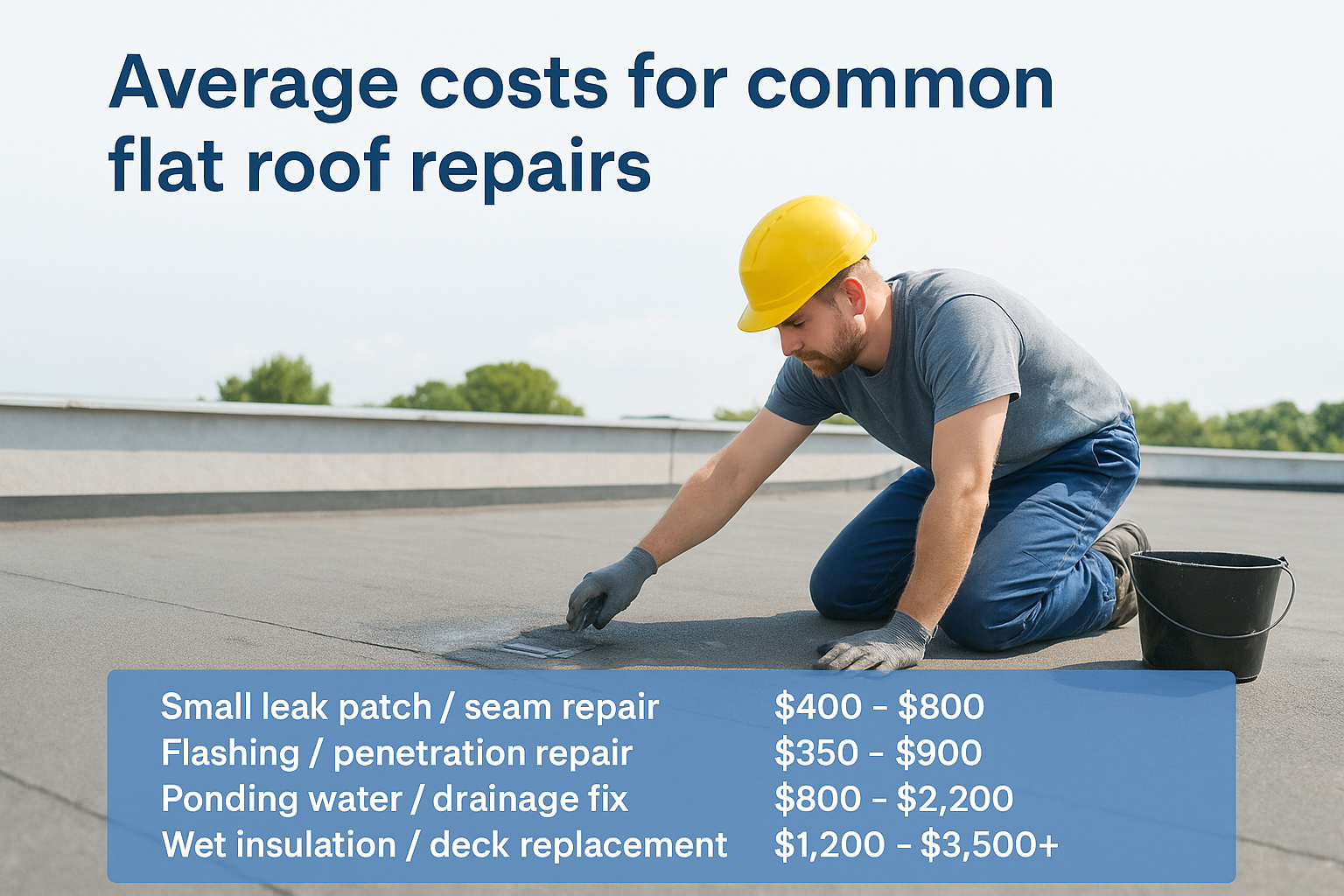
A localized leak caught early, before water spreads under the membrane, is the cheapest fix on this list. Most seam separations or small punctures run $400 to $800, assuming the deck underneath stayed dry. Quick action here saves real money later.
Catching a flat roof leak in its first month is almost always a $500 problem. Ignoring it for a year turns it into a $5,000 one.
Ponding that sits for more than 48 hours after rain breaks down membrane faster than any other issue on a flat roof. Fixing the drainage itself, adding a scupper, tapered insulation, or a secondary drain, typically costs $800 to $2,200, depending on how much re-sloping is needed.
Vents, HVAC curbs, and roof edges are common failure points because flashing seals get brittle in Texas heat. Repairing flashing around a single penetration usually runs $350 to $900, while multiple penetrations on an older roof can push toward $1,500.
This is where costs jump. Cutting out saturated insulation, drying the deck, and replacing damaged plywood or OSB adds labor and material fast, often landing between $1,200 and $3,500 depending on the affected square footage.
| Repair Type | Typical Cost Range |
|---|---|
| Small leak patch / seam repair | $400 - $800 |
| Flashing / penetration repair | $350 - $900 |
| Ponding water / drainage fix | $800 - $2,200 |
| Wet insulation / deck replacement | $1,200 - $3,500 |
| Multiple combined repairs | $2,500 - $5,000+ |
Notice how the price climbs steeply once water reaches the deck. That's the pattern worth remembering: surface repairs stay affordable, but anything involving the structure underneath the membrane gets expensive quickly, which is exactly why a thorough inspection before repair work starts matters so much.
At some point, every flat roof owner asks the same question: is this worth fixing, or should I just replace the whole thing? A good flat roof repair estimate doesn't dodge that question. It should point you toward an answer based on the roof's age, the extent of damage, and how many times you've already paid for patches that didn't hold.
Most experienced roofers use a rough guideline: if the repair cost approaches 20-30% of what a full flat roof replacement would run, replacement usually makes more financial sense. On a 1,500 square foot flat roof priced around $9 per square foot to replace, that's roughly $13,500 total. If your repair estimate is climbing past $3,000 to $4,000, you're in the zone where a contractor should be laying out both options side by side, not just pushing the cheaper-sounding fix.
When a repair estimate creeps past a quarter of the replacement cost, you're not saving money anymore, you're delaying the inevitable.
Certain findings during inspection are red flags that no patch will solve for long. Your estimate should flag these clearly instead of quietly pricing around them.
Regardless of which direction makes sense, an honest estimate lays out the tradeoff plainly instead of steering you toward whichever option pays the contractor more. Repair buys you time at a lower upfront cost but carries the risk of recurring issues. Replacement costs more now but resets the clock with a manufacturer warranty and a workmanship guarantee behind it. At Defend Roofing, that's the actual conversation we have with homeowners, laying out real numbers for both paths and letting you decide based on your budget and how much longer you plan to stay in the home, not on which option sounds better in a sales pitch.
Storm damage changes the entire estimate conversation. When hail or wind causes the leak, your flat roof repair estimate isn't just a quote for you to approve, it becomes evidence in a claim that an insurance adjuster will scrutinize line by line. A vague estimate that works fine for a cash job often falls apart under insurance review, because adjusters expect specific measurements, material codes, and photo evidence tied to a documented storm event.
Most homeowner policies cover sudden, storm-related damage, hail impacts, wind-lifted membrane, or a tree limb puncture, but they exclude gradual deterioration from age or poor maintenance. This distinction matters because adjusters are trained to look for signs of long-term wear and deny claims that look like neglect rather than a covered event.
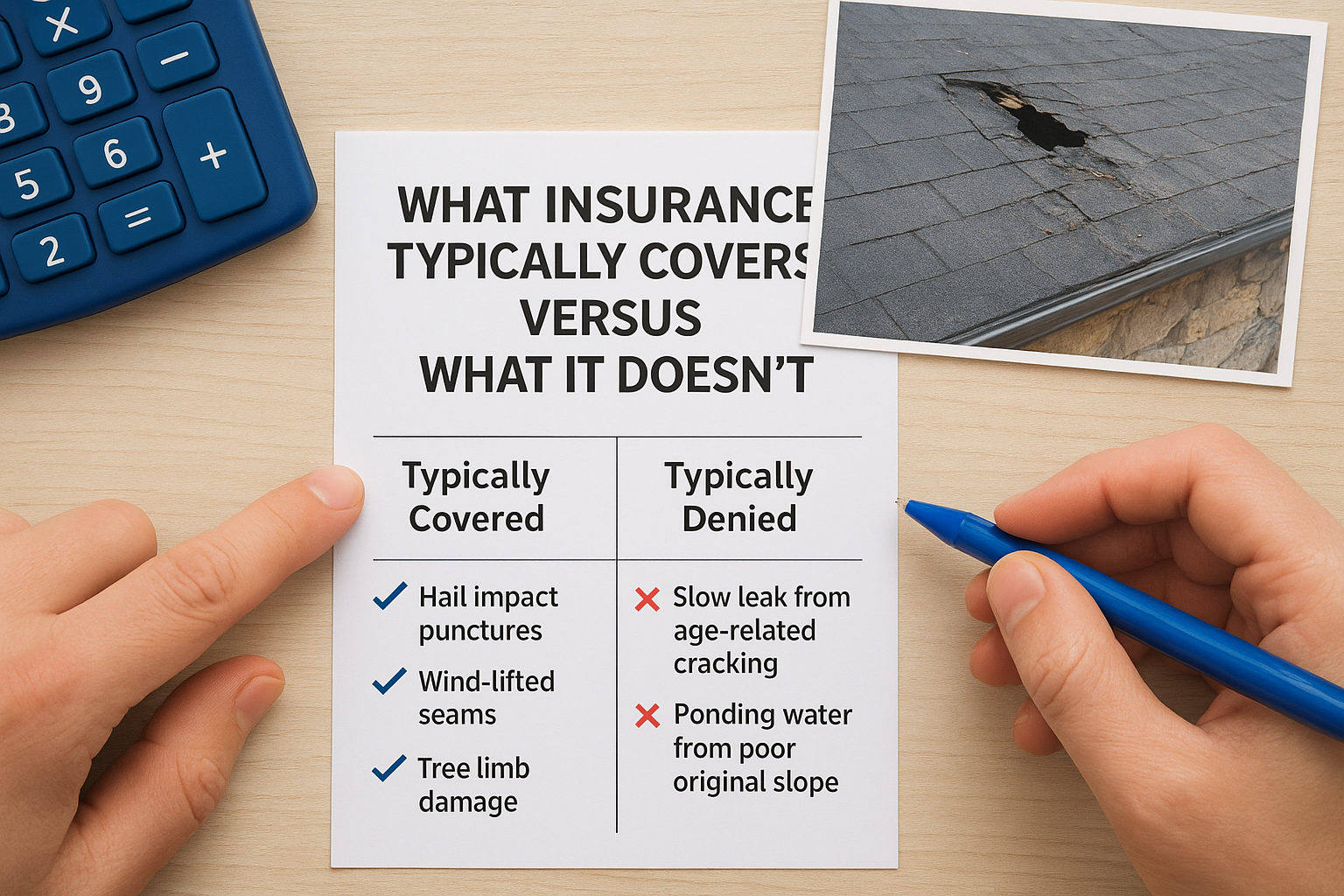
| Damage Cause | Typically Covered | Typically Denied |
|---|---|---|
| Hail impact punctures | Yes | No |
| Wind-lifted seams from a named storm | Yes | No |
| Slow leak from age-related cracking | No | Yes |
| Ponding water from poor original slope | No | Yes |
| Tree limb damage | Yes | No |
An adjuster isn't judging your roof's condition, they're judging whether your documentation proves a specific storm caused it.
Insurance adjusters often spend fifteen minutes on a roof they've never seen before. If your contractor's estimate includes date-stamped photos, measurements of the affected area, and clear notes tying damage to a specific storm date, you're handing the adjuster a stronger case than they'd build on their own. Defend Roofing's 100+ photo assessments exist partly for this reason. They give homeowners something concrete to submit rather than a one-page number that raises more questions than it answers.
Depreciation catches a lot of homeowners off guard. Insurance companies usually issue an actual cash value payment first, holding back a portion called recoverable depreciation until repairs are completed and documented. Your out-of-pocket cost during the claim isn't always the full estimate total, but you do need the contractor's paperwork to unlock that second check. Skipping documentation at this stage often means leaving real money on the table, sometimes thousands of dollars that homeowners never realize they were owed.

A fair flat roof repair estimate never leaves you guessing. It names the material, measures the damaged area, checks the deck underneath, and puts a warranty in writing before anyone touches your roof. Numbers alone don't tell you much without that context, so treat any quote missing photos, scope details, or a clear repair-versus-replace breakdown as unfinished work, not a real answer.
Central Texas weather doesn't give flat roofs much slack, and small leaks left alone turn into deck damage fast. Whether you're staring at a $500 patch or weighing a full replacement against an insurance claim, get a documented inspection before you commit to anything. That documentation protects your wallet now and your case later if a storm's involved.
If you want a number built on real photos and honest scope, not a drive-by guess, get in touch with Defend Roofing for a quote you can actually verify.