Find out how long does a flat roof last based on your material. Compare lifespans for TPO, EPDM, and SPF, and see how to prevent premature roof failure.
If you own a home with a flat or low-slope roof in Central Texas, you've probably wondered how long does a flat roof last, and whether yours is getting close to the end of its useful life. It's a fair question, especially when Austin's heat, UV exposure, and hail storms put roofing materials through more stress than most regions in the country.
The short answer is that flat roofs generally last between 10 and 50 years, but that range depends heavily on the material installed, how well it was put on, and whether it's been properly maintained. A cheap single-ply membrane on a garage isn't going to hold up the same way a well-installed modified bitumen system will. Material choice matters, and so does the contractor behind the work. At Defend Roofing, we've seen flat roofs across Central Texas in every condition imaginable, from systems barely holding on at year eight to ones still performing well after two decades with the right upkeep.
This article breaks down the expected lifespan of each major flat roofing material, the factors that shorten or extend those numbers, and what to look for when your roof is approaching the end of its service life. Whether you're planning a replacement or just trying to understand what you're working with, this guide will give you the information you need to make a smart decision.
Understanding how long does a flat roof last starts with recognizing that the number on a product data sheet is only an estimate under ideal conditions. In the real world, several variables interact to push that number up or down significantly, and most of them are within your control if you act early enough. Knowing what drives deterioration lets you protect your investment and plan ahead rather than get caught off guard by a failure.
The material your flat roof is made from sets the ceiling on its potential lifespan, but the quality of the installation determines whether it ever reaches that ceiling. A TPO membrane rated for 20 years can fail in 10 if the seams weren't heat-welded properly or if the underlayment was installed over a wet deck. Poor workmanship leaves weak points that expand under heat cycles, allow moisture to creep in at edges, and void manufacturer warranties before you ever get a claim filed.
Choosing the cheapest bid on a flat roof installation almost always shortens the roof's life, because labor quality directly determines whether the material performs to spec.
When you're evaluating contractors, ask specifically about their process for seaming, how they handle penetrations like HVAC units and vents, and whether their work carries a workmanship warranty separate from the manufacturer's material warranty. Those details tell you a lot about whether the roof will perform as promised.
Central Texas is one of the harder environments for flat roofing materials. Prolonged UV radiation breaks down membranes at the molecular level, causing them to dry out, crack, and shrink away from flashings and edges. Austin routinely sees summer temperatures above 100°F, which accelerates the aging of rubber-based and asphalt-based systems significantly faster than cooler climates.
On top of the heat, hailstorms can punch through or bruise membranes in ways that aren't always visible from the ground but quietly allow water intrusion for months before you notice damage inside. Thermal cycling, the repeated expansion and contraction of the roof surface as temperatures swing between day and night, also stresses seams and attachment points over time. The climate here simply demands better materials and more consistent maintenance than many national product guides account for.
Flat roofs aren't actually flat. They're designed with a slight slope to move water toward drains or scuppers. When drainage systems get clogged with debris, water pools on the surface and sits there for extended periods. This is called ponding water, and it's one of the fastest ways to cut years off a flat roof's life.
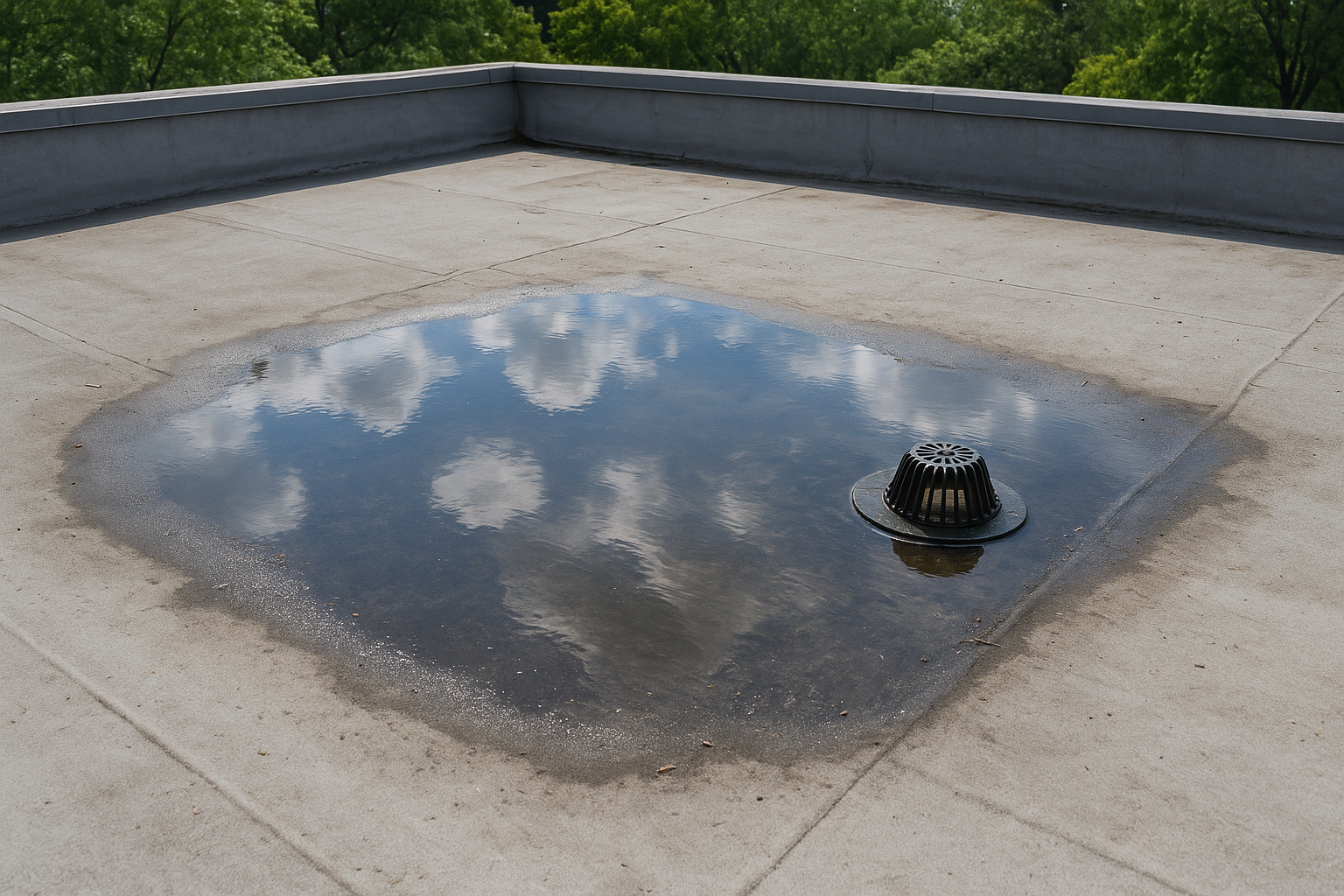
Standing water adds structural weight, promotes algae and organic growth, and keeps the membrane constantly wet, which breaks down adhesives and seams far ahead of schedule. Checking that your drains and scuppers stay clear is one of the simplest and highest-return maintenance tasks you can do for a flat roof system.
Flat roofs need more active attention than sloped roofs do, and skipping inspections is where most flat roof failures start. Small issues like a lifted seam, a crack near a penetration, or a clogged drain can sit undetected through one season and turn into a major repair by the next. Regular inspections twice a year, ideally in spring and fall, give you the chance to catch minor problems while they're still inexpensive to fix. Homeowners who stay on a consistent schedule consistently get more useful years from their roofs than those who wait for a problem to show up on the ceiling.
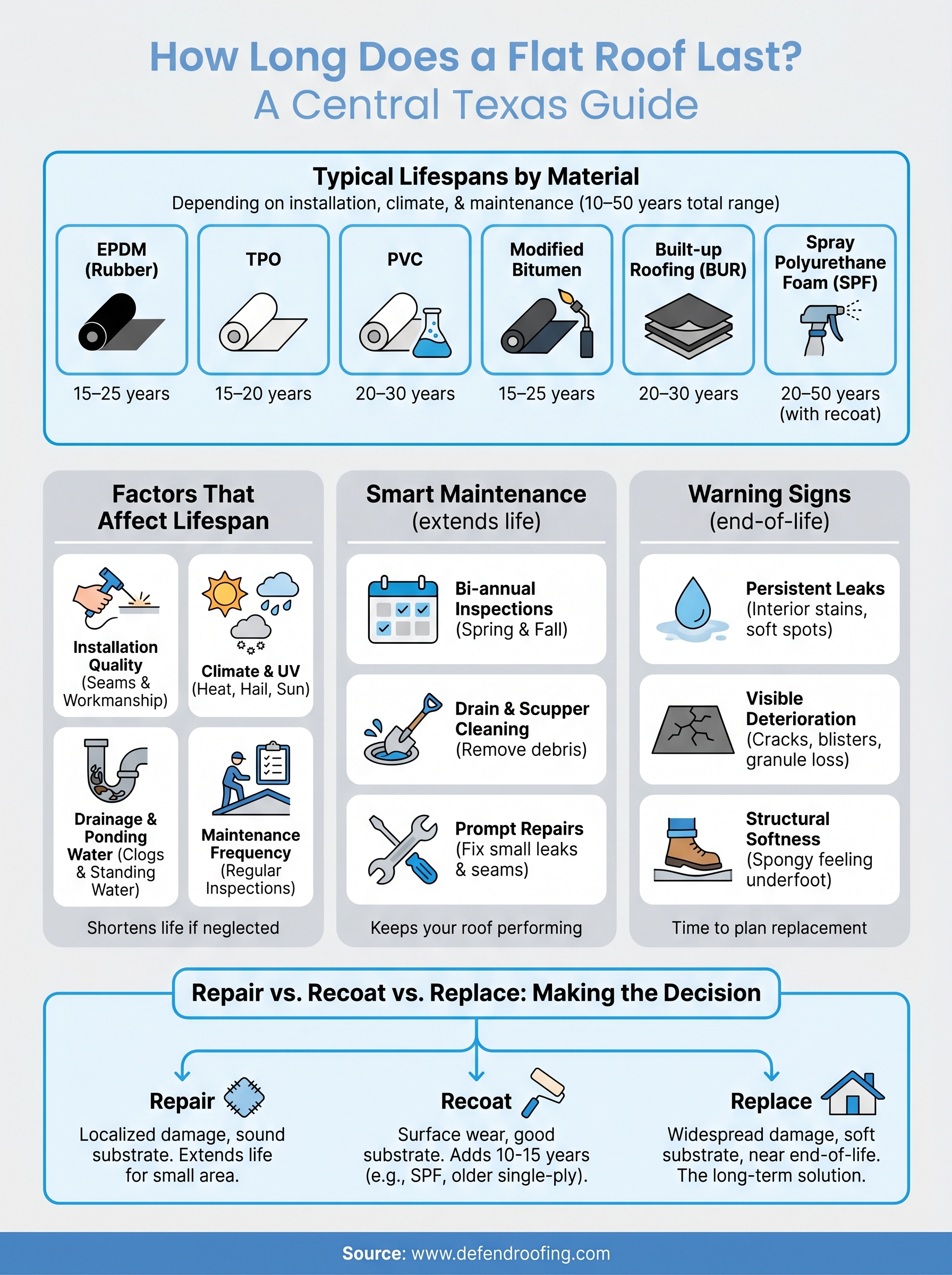
The most direct answer to how long does a flat roof last depends on what's sitting on top of your home right now. Each material comes with a different performance profile, and knowing those numbers lets you set realistic expectations and plan your budget accordingly. The table below gives you a quick reference across the most common flat roofing systems.
| Material | Typical Lifespan | Notes |
|---|---|---|
| EPDM (rubber) | 15-25 years | Extends well with UV coating |
| TPO | 15-20 years | Seam quality is critical |
| PVC | 20-30 years | Strong chemical resistance |
| Modified bitumen | 15-25 years | Common in residential installs |
| Built-up roofing (BUR) | 20-30 years | Multi-layer durability |
| Spray polyurethane foam (SPF) | 20-50 years | Requires periodic recoating |
Single-ply membranes are the most widely installed flat roofing systems on residential properties, and they cover a meaningful range in both price and performance. EPDM, the black rubber membrane most homeowners recognize, holds up well under UV exposure and performs reliably in wide temperature swings. TPO and PVC are white membranes that reflect heat more effectively, which matters in Central Texas summers where roof surface temperatures can exceed 150°F.

The gap between a 15-year and a 25-year single-ply roof often comes down to seam quality, not the membrane itself.
PVC consistently outlasts TPO because it resists chemical exposure better and holds seams more reliably over time. TPO seams are more sensitive to installation temperature and technique, which is why contractor experience directly impacts how long the system performs.
Multi-layer systems like built-up roofing stack alternating layers of bitumen and reinforcing fabric to create thickness and redundancy, which is why they often reach the 25 to 30-year mark when installed correctly. Modified bitumen is a close relative, typically installed in one or two layers with a torch-applied or self-adhering method, and it's common on Central Texas homes because of its flexibility in heat.
Spray polyurethane foam stands apart from everything else on this list. SPF systems can last 40 to 50 years with proper recoating every 10 to 15 years, making them the longest-lived option available. The recoating requirement is a real cost to factor in, but the cumulative lifespan often makes the math work in your favor.
If you're not sure how long does a flat roof last on your specific property, you don't need a professional inspection to get a rough idea. You can make a reasonable estimate by combining a few pieces of information: the material type, the installation date, the current surface condition, and your maintenance history. None of these factors tells the full story on their own, but together they give you a clear working picture of where your roof stands and what decisions you should be making right now.
Your first step is figuring out when the roof was installed and what material was used. Check your home inspection report, permit records, or any paperwork from the original contractor. If you bought the home without that documentation, look for a label on the membrane near an HVAC unit or rooftop access point, as many manufacturers stamp their product name and install date directly on the material.
Once you have both pieces of information, compare the age of the roof against the expected lifespan ranges in the material table above. A 12-year-old TPO roof is in the back half of its typical service window, while a 12-year-old SPF system with a recent recoat has plenty of life remaining. The math here is straightforward once you know what you're working with.
Walk the roof if it's safe to do so, or have a contractor do it for you. You're looking for visible cracking, blistering, or separation at the seams and flashings, which are the areas most likely to fail first. Surface granule loss on modified bitumen, significant discoloration on TPO, or soft spots underfoot on any system all indicate accelerated aging.
A roof that looks rough at year 12 is in worse shape than one that looks clean at year 18, because surface condition reflects real-world performance better than age alone.
Consistent maintenance extends flat roof life, and the absence of it shortens it. If the roof has had two inspections per year, regular drain cleaning, and prompt seam repairs, subtract less from the theoretical lifespan. If the roof has gone five or more years with no attention, add that neglect into your estimate and assume the remaining life is shorter than the raw numbers suggest.
How long does a flat roof last is ultimately a question that maintenance can answer in your favor. Consistent upkeep is the single most controllable factor that determines whether your roof hits the low end or the high end of its expected lifespan. Most flat roof failures that show up as interior water damage or major structural issues started as small, fixable problems that sat unattended for too long.
Scheduling two roof inspections per year, once in the spring and once in the fall, gives you the best chance of catching problems before they grow. Spring inspections let you assess any damage from winter temperature swings, while fall inspections confirm the roof is sealed and draining properly before rain season arrives. Either a contractor or a careful homeowner can conduct a surface walkthrough looking for lifted seams, cracked flashings, and blistering membrane.
Catching a lifted seam in October costs far less to fix than dealing with the water intrusion it allows through the winter.
Here is what to check during each inspection:
Clogged drains are one of the most preventable causes of early flat roof failure, and clearing them takes very little time. After any significant storm or heavy leaf fall, remove debris from drains and scuppers so water can move off the roof freely. Ponding water sitting on a membrane for more than 48 hours accelerates seam breakdown and adhesive failure in ways that are not visible until the damage is already well established.
Seams and flashings are where most flat roofs fail first, because those transition points endure the most movement from thermal expansion and contraction. Repairing a small separation at a flashing with the right compatible sealant or membrane patch is straightforward and inexpensive when caught early. Letting a minor seam separation go through even one rainy season can allow enough moisture into the substrate to require a full section replacement rather than a simple repair.
Knowing how long does a flat roof last in theory is useful, but recognizing when your specific roof is actually running out of time is more important. End-of-life signs rarely appear all at once, but they tend to show up in a predictable pattern, and catching them early gives you time to plan a replacement on your schedule rather than respond to an emergency after a storm.
A single isolated leak after a major hailstorm isn't necessarily a sign of overall roof failure. Repeated leaks, or leaks that come back after repair, are a different story entirely. When water is getting through the membrane in multiple locations or the same spot won't stay sealed, the system as a whole is losing its ability to perform.
If a contractor repairs the same section twice within a year and the leak returns, the problem is the roof, not the repair.
Look at your interior ceilings and attic framing for brown water stains, soft drywall, or peeling paint, because those are downstream evidence of membrane failure that has been happening long enough to work its way through the roof assembly.
Walk the roof or have a contractor walk it, and pay attention to what the surface looks like up close. Widespread cracking, shrinkage pulling away from walls and curbs, or large blistered sections all indicate a membrane that has lost its elasticity and can no longer handle thermal expansion without failing further.
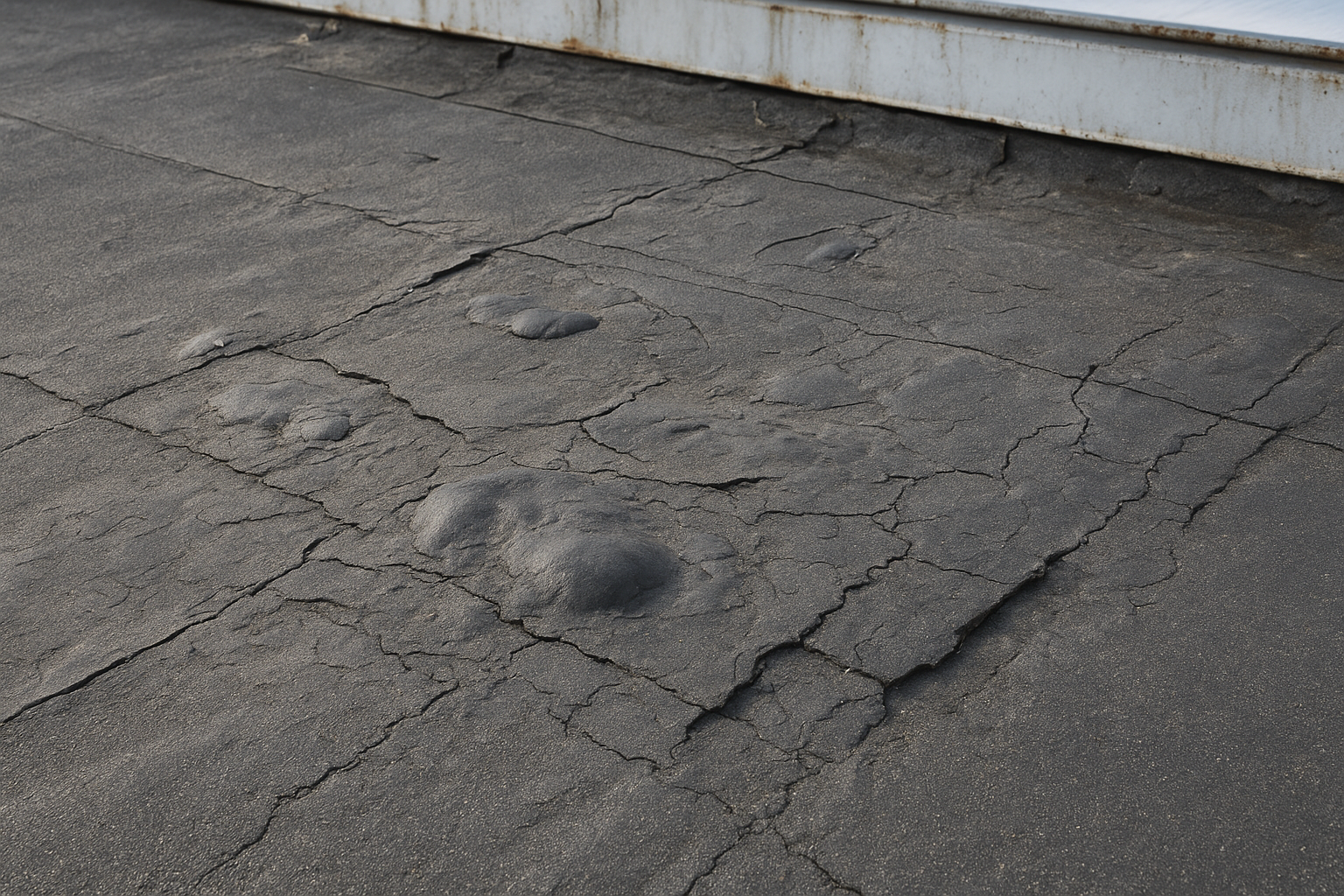
Granule loss on modified bitumen systems exposes the underlying asphalt directly to UV radiation, which accelerates breakdown rapidly. On single-ply systems, significant discoloration, chalking, or a brittle texture when you press on the membrane are signs the material has aged past the point where repairs make economic sense compared to replacement.
When you walk a flat roof and feel soft or spongy spots beneath your feet, the problem has moved beyond the membrane and into the substrate. Moisture has likely been sitting in the insulation or decking long enough to cause compression or rot, and that changes the repair calculation entirely.
Repairing the membrane over a compromised deck won't hold, and any contractor who recommends that approach without addressing what's underneath is setting you up for the same problem within a few years. Structural softness is one of the clearest indicators that a full replacement is the right path forward.
Once you know how long does a flat roof last and where your specific system sits in that window, the next decision is what to actually do about it. The choice between repair, recoating, and full replacement depends on three things: how much of the membrane is damaged, what condition the substrate is in, and how many useful years the roof has remaining. Getting that decision right saves you from either spending too much money on a roof that needed to be replaced or replacing one that had years of life left.
Repair makes sense when the damage is localized to a specific area and the rest of the membrane is still in solid condition. A single failed seam near an HVAC curb, a cracked flashing around a vent, or a small puncture from foot traffic are all situations where a targeted repair extends the roof's life without requiring a much larger investment. The substrate underneath must be dry and structurally sound for a repair to hold, so any contractor doing repair work should probe or test adjacent areas before sealing the surface over a problem that runs deeper.
Recoating works best on spray polyurethane foam systems and older single-ply membranes that are showing surface wear but still have sound substrate and intact seams. If a roof is showing UV degradation, minor surface cracking, or loss of reflectivity but hasn't failed structurally, applying a compatible elastomeric coating can add 10 to 15 years of service life at a fraction of replacement cost. Recoating is not a substitute for addressing active leaks, failed seams, or soft substrate, so you need a thorough inspection before committing to this approach.
Recoating a roof that has underlying moisture in the insulation locks that moisture in and accelerates the decay of both the deck and the membrane above it.
Full replacement becomes necessary when damage is widespread, the substrate has taken on moisture, or the roof is within a few years of the end of its expected lifespan. Continuing to patch a system at this stage costs more over time than a clean replacement would. If you're finding multiple leak points, widespread membrane shrinkage, or soft spots across more than 25 percent of the roof area, the economics shift clearly toward starting fresh with a new system and a new warranty.
Understanding how long does a flat roof last goes hand in hand with knowing what you'll pay upfront and what protection you get in return. Flat roofing costs vary widely by material, and so do the warranty structures that back them. Setting realistic expectations on both fronts helps you compare bids accurately and avoid being surprised by coverage gaps when you need them most.
The price you pay for a flat roof installation depends on the material, the size of the roof, and the complexity of the job, particularly around penetrations and drainage. The table below reflects typical installed costs per square foot for each major flat roofing system, including labor and materials, for a standard residential application in Central Texas.
| Material | Installed Cost (per sq ft) | Typical Warranty Range |
|---|---|---|
| EPDM | $4 - $8 | 10-20 years (manufacturer) |
| TPO | $5 - $9 | 10-20 years (manufacturer) |
| PVC | $6 - $10 | 15-25 years (manufacturer) |
| Modified bitumen | $4 - $8 | 10-20 years (manufacturer) |
| Built-up roofing (BUR) | $5 - $10 | 10-20 years (manufacturer) |
| Spray polyurethane foam | $5 - $9 | 10-20 years (with recoat) |
These figures can shift based on deck repairs needed, tear-off of an existing system, and current material costs in your area. Always get an itemized estimate so you can see exactly what you're paying for rather than comparing single bottom-line numbers between contractors.
Manufacturer warranties and workmanship warranties are separate, and most homeowners don't realize that until they try to file a claim. The manufacturer's warranty covers defects in the material itself, not the installation. If a seam fails because the contractor didn't weld it correctly, that claim falls under the workmanship warranty, which is issued by the contractor, not the manufacturer.
Always confirm that any contractor you hire offers a written workmanship warranty, and read it closely for exclusions around ponding water, foot traffic damage, and penetration flashings.
Workmanship warranties typically run between 2 and 10 years depending on the contractor, and some premium installers offer extended coverage that mirrors the manufacturer's material term. When you're comparing bids, factor warranty length and coverage scope into the decision alongside price. A lower bid with a shorter or weaker workmanship warranty often costs more over the life of the roof.
Now that you understand how long does a flat roof last and what drives those numbers, the most useful thing you can do is assess where your own roof stands today. Pull your installation records, identify your material type, and compare the age against the lifespan ranges covered in this guide. If you're past the halfway mark on your roof's expected service life, schedule an inspection before minor issues become expensive ones.
If you're in Central Texas and want a clear, documented picture of your flat roof's condition, Defend Roofing can help. Every assessment includes detailed photos and honest guidance on whether repair, recoating, or replacement makes the most sense for your situation. There's no pressure and no unnecessary upselling, just straightforward information so you can make the right call. Schedule your flat roof assessment today and get the answers you need before the next storm season arrives.