Learn what a roof inspection report includes, see a copyable sample and filled-in example, and use it for insurance, repairs, or replacement decisions.

A roof inspection report is a written record of your roof's condition on a specific date. It lists what the inspector found, where each problem sits, how serious it is, and what to do about it, usually backed by numbered photos. You can fill one out yourself with a simple form or have a roofer produce one. Either way, it becomes the document that insurers, buyers, and contractors read before they decide anything.
This article walks you through the whole document. You get a copyable sample you can use as a template, a filled-in example, and a breakdown of what a strong report looks like. You also see which findings fail a roof, how to turn the report into a repair-or-replace decision, and who should write yours.
We are Defend Roofing, a family-owned roofer serving the Austin area. Our free inspections end with a photo-documented Integrity Report that includes 100+ photos and a repair-versus-replace recommendation. We have written and read these reports on many Central Texas roofs, so the advice below comes from the field.
A roof inspection report matters because it turns an opinion about your roof into evidence you can act on. Without one, you rely on memory, a verbal estimate, or whoever is selling the next job. With one, you hold a dated record that other people can check.
Central Texas gets hail and strong wind, and both leave damage that is easy to miss from the ground. An insurance adjuster has to see verified damage tied to a date before a roof insurance claim moves forward. A report with numbered photos, slope-by-slope notes, and hit counts gives the adjuster that proof.
The report also protects you from the opposite problem. If your roof shows old wear, a baseline report from before the storm helps show what was already there and what is new. That separation keeps your claim credible and avoids arguments over pre-existing damage.
A roof inspection report is the difference between saying your roof is damaged and showing it.
Roofs fail slowly, then suddenly. A report filed after each yearly roof inspection lets you compare granule loss, flashing condition, and sealant cracks over time, so you catch a trend before it becomes a leak. Two reports a year apart tell you more than any single visit.
Keep every report in one folder with repair invoices and photos. When you replace the roof, that history also shows the manufacturer and any warranty reviewer that you maintained it.
A contractor who says you need a new roof has told you something. A report that shows 40 percent of the shingles creased, soft decking at the valley, and an age of 19 years has told you why. You can take that to a second contractor and compare bids on the same scope.
If you sell, a recent report answers the buyer's biggest question about the roof before they ask. If you buy, it tells you what the roof will cost you in the next few years, which is real negotiating leverage.
To fill out a roof inspection report, record the property details, inspect the roof in a fixed order, rate each component, attach numbered photos, and finish with prioritized recommendations. The order matters less than finishing it the same way every time, so reports from different years can be compared.
Start with the plan, because most mistakes happen before you ever look at a shingle. Do not walk a steep or wet roof. A fall costs far more than any inspection saves. From the ground, binoculars and a phone with zoom show a surprising amount. From the attic, you can see decking, stains, and daylight. If the roof needs a hands-on look, a roofer or a drone roof inspection is the safer route.
Work through the roof in this order:
Copy the text below into a document or note app and fill it in on site. It covers what an insurer, buyer, or contractor expects to see. Add rows for anything unusual on your roof.

ROOF INSPECTION REPORT

1. PROPERTY AND INSPECTION DETAILS
Property address:
Owner / client:
Inspection date:
Inspector name and company:
Reason for inspection: (maintenance / storm damage / sale / insurance / other)
Weather at inspection:
Method: (walked roof / ladder / drone / ground with binoculars / attic only)

2. ROOF OVERVIEW
Roofing material:
Approximate roof age:
Approximate size (squares):
Pitch: (low / medium / steep)
Number of layers:
Known past repairs or claims:

3. CONDITION BY COMPONENT (rate Good / Fair / Poor / Failed)
Shingles or roof covering:        Rating:   Photo #:   Notes:
Flashing (chimney, walls, valleys): Rating:   Photo #:   Notes:
Vent pipes and boots:             Rating:   Photo #:   Notes:
Ridge and hip caps:               Rating:   Photo #:   Notes:
Gutters and downspouts:           Rating:   Photo #:   Notes:
Eaves, soffits, fascia:           Rating:   Photo #:   Notes:
Skylights and chimney:            Rating:   Photo #:   Notes:
Decking (soft spots, sagging):    Rating:   Photo #:   Notes:
Attic (ventilation, insulation, stains, daylight):
Interior ceilings and walls:

4. STORM DAMAGE CHECK
Hail hits per test square (10 ft x 10 ft), by slope:
Wind damage (creased, lifted, missing shingles):
Collateral damage (vents, gutters, AC fins, fences):

5. OVERALL FINDINGS
Overall condition:
Estimated remaining life:
Active leaks: (yes / no / location)

6. RECOMMENDATIONS
Immediate (0 to 30 days):
Soon (within 12 months):
Monitor (re-check at next inspection):
Repair or replace, with reason:
Estimated cost range (if provided):

7. PHOTO LOG
Photo # / Location / What it shows

8. SIGN-OFF
Areas not accessed or limitations:
Inspector signature and date:
Here is how a few rows look on an 18-year-old asphalt shingle roof. Notice that every note says where the problem is and points to a photo.
| Component | Rating | Photo | Note |
|---|---|---|---|
| Shingles | Fair | 4 to 9 | Granule loss on south slope, three creased shingles near the ridge |
| Chimney flashing | Poor | 12 | Sealant cracked on uphill side, gap of about 1/4 inch |
| Vent boots | Poor | 15 to 16 | Rubber cracked on two of three boots |
| Gutters | Good | 20 | Clear and secure |
| Attic | Fair | 24 | Brown stain on decking near chimney, dry on inspection day |
The summary for this roof might read: overall condition Fair, estimated remaining life 3 to 5 years. Reseal the chimney flashing and replace two vent boots within 30 days, and monitor the south slope shingles at the next inspection. That recommendation is specific, ranked, and tied to evidence, which is what makes a report usable.
Rate every component, number every photo, and you can fill out a credible report in one visit.
A good roof inspection report is specific, visual, and ranked by urgency. You should be able to hand it to a stranger and have them find each problem on your roof without asking you a single question. If a report fails that test, it is a sales sheet, not an inspection.
Strong reports include an overview photo of every slope plus close-ups of each issue, with a number, a location, and a caption. A photo of a cracked boot that says "north slope, third vent from the ridge" is useful. A photo with no location is not.
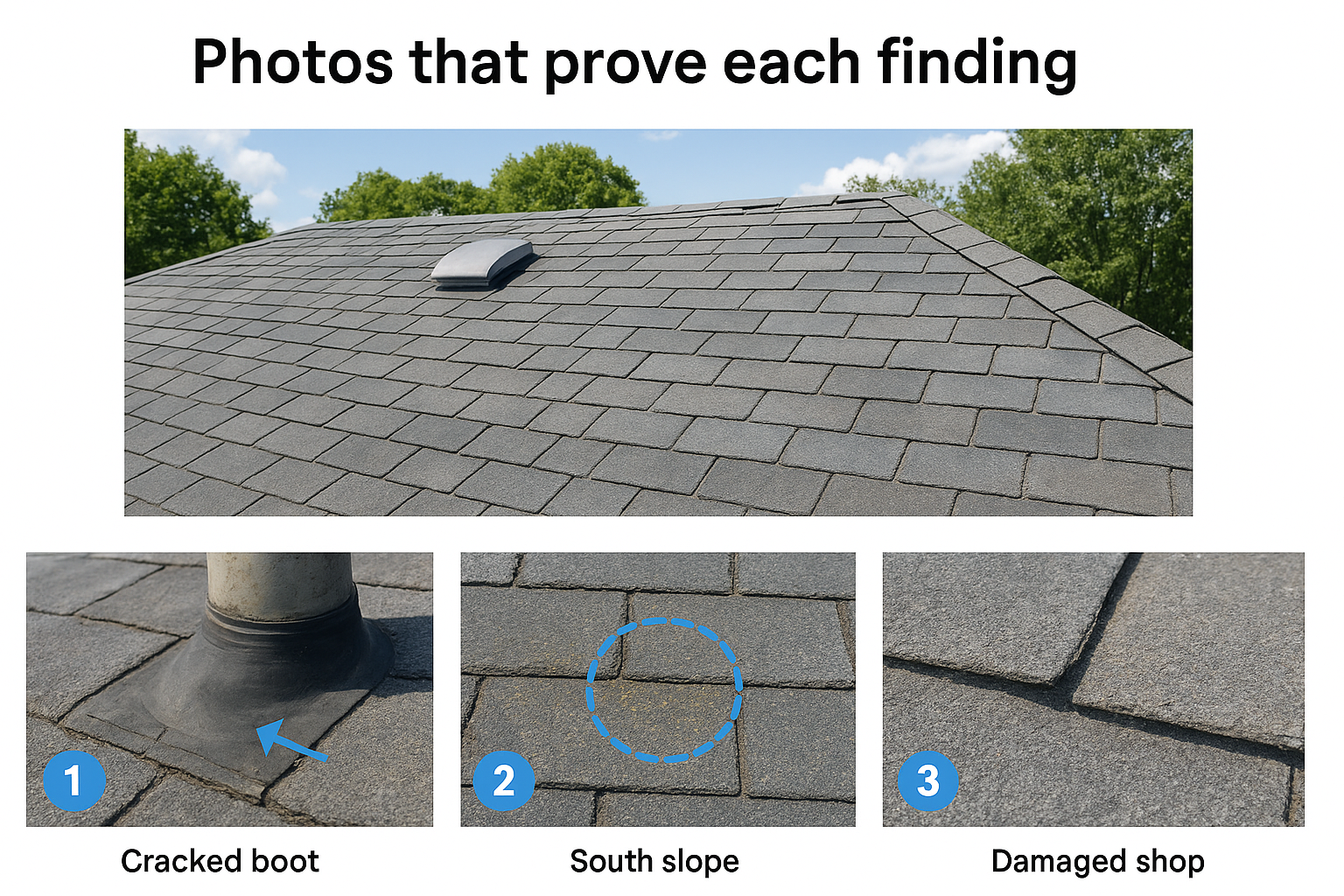
Photo volume depends on the roof, but a full residential inspection of a typical home produces dozens of images. Defend's reports run 100+ photos because we document the whole roof, not only the damage. Look for annotations such as arrows or circles, and for before-and-after shots when repairs are done.
Ratings only help when each one carries a timeframe. This scale is easy to use and easy to understand:
| Rating | What it means | Typical action |
|---|---|---|
| Good | Normal wear for age, no defects | Routine yearly inspection |
| Fair | Moderate wear, minor defects | Repair or monitor within 12 months |
| Poor | Defects that can let water in | Repair within 30 days |
| Failed | Active leak, structural issue, or end of life | Immediate repair or replacement planning |
Be wary of a single overall grade with nothing behind it. A roof rated "Fair" might need a $400 flashing fix or a $12,000 replacement in three years. The component ratings and the remaining-life estimate tell you which.
Vague language is the clearest sign of a weak report. Compare these two versions of the same finding:
| Weak | Strong |
|---|---|
| "Flashing needs attention." | "Chimney flashing, uphill side: sealant cracked, 1/4 inch gap, evidence of past water entry (Photo 12). Reseal within 30 days." |
| "Shingles are worn." | "South slope: granule loss across roughly half the slope, three creased shingles near ridge (Photos 4 to 9). Monitor; re-check in 12 months." |
| "Roof is old." | "Approximately 18 years old. Estimated remaining life 3 to 5 years given current wear." |
A good report also lists its limits. If the inspector could not access the attic or did not walk a steep slope, the report should say so. That honesty is part of why you can trust everything else in it.
If a report cannot tell you where, how bad, and how soon, it is not finished.
A roof fails an inspection when it shows a defect that lets water in, weakens the structure, or leaves the roof with little useful life. There is no single national pass-or-fail standard. The bar depends on who asked for the inspection, but the same defects cause trouble almost everywhere.
These findings usually produce a "Poor" or "Failed" rating and a request for repair before anything else happens:
| Finding | Why it matters | Usual response |
|---|---|---|
| Active leak or water stains on ceilings or decking | Water is already getting in | Immediate repair, then check for rot |
| Missing, lifted, or cracked shingles in several areas | Wind and rain can reach the underlayment | Repair, or replace if widespread |
| Failed flashing at chimneys, walls, or valleys | Most leaks start at these joints | Reseal or replace flashing |
| Cracked or missing vent boots | Small openings let water in over time | Replace boots |
| Soft spots, sagging, or a wavy roof plane | Decking or framing may be damaged | Structural evaluation, then repair |
| Heavy granule loss or exposed fiberglass mat | The shingle has lost its protective layer | Plan replacement |
| Wet insulation or mold in the attic | Moisture has been entering for some time | Find the source, then repair |
| Exposed or backed-out nails | Fastener failure lets shingles lift | Repair and reseal |
The same roof can pass one inspection and fail another. For a storm damage claim, the question is whether hail or wind caused new, verified damage. A roof with old wear and no storm damage can fail the claim while still needing work. For a home sale, a buyer or lender may care mostly about remaining life and active leaks. For a manufacturer or installer warranty, the focus is installation quality and proper ventilation.
Tell the inspector the purpose up front and write it in section 1 of the report. That way the findings are weighed against the right standard, and you do not mistake a failed claim for a healthy roof.
Fail or pass means little until you know what the inspection was meant to prove.
To read a roof inspection report for a repair-or-replace decision, compare the cost of recommended repairs to the cost of replacement, then weigh that against the roof's remaining life and how widespread the damage is. A localized problem on a roof with years left favors repair. Widespread wear on an old roof favors replacement.
These are common thresholds for talking through a report. They are guides, not laws.
| Situation | Leans toward |
|---|---|
| Repairs under about 20% of replacement cost, damage in one area, 5+ years of life left | Repair |
| Repairs between 20% and 30% of replacement cost | Judgment call, depends on age and your plans |
| Repairs above about 30%, damage across much of the roof, or wet decking | Replace |
| Roof at or near end of life, even with modest repairs needed | Replace, or repair only to buy time |
Many asphalt shingle roofs last roughly 15 to 25 years, and Texas heat and hail can shorten that. Age matters most in the gray zone. Spending money to repair a roof with two years left rarely makes sense.
Suppose a replacement quote is $16,000. Report A recommends $2,000 of repairs on a 12-year-old roof with localized flashing and boot problems. That is 12.5 percent of replacement cost, so you repair and re-inspect next year. Report B recommends $6,000 of repairs on an 18-year-old roof with creased shingles on three slopes. That is 37.5 percent, and the roof is close to the end of its life, so replacement is the better use of money.
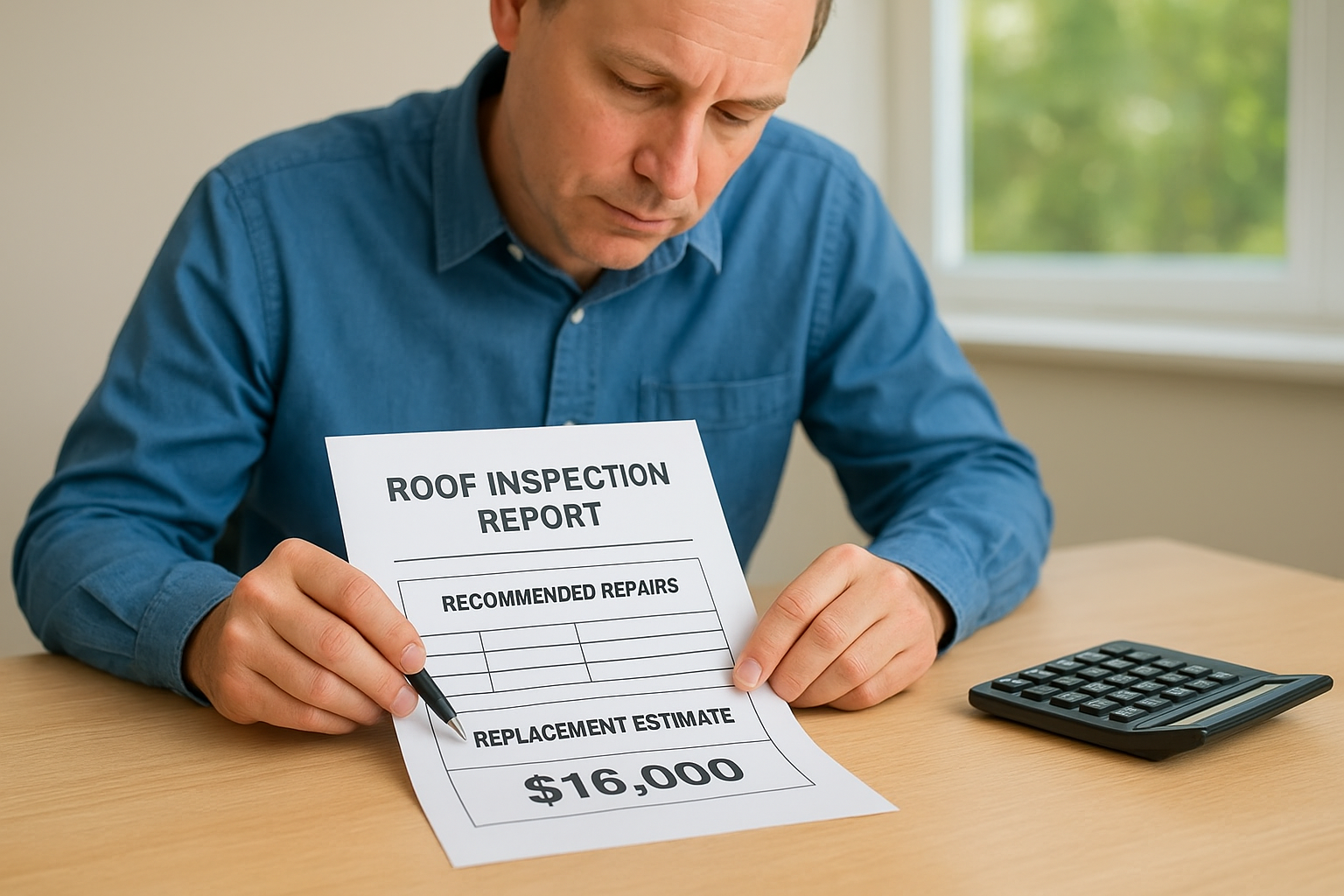
Targeted repairs are cheaper than most people expect. Defend's roof repairs start at $395, and each repair ends with 20+ photos of the completed fix so you have a record for your file.
If the report shows storm damage, take these steps in order when filing a roof insurance claim:
The report does not guarantee approval. It makes your claim easier to evaluate, and it keeps the conversation on facts.
Decide using three numbers: repair cost, replacement cost, and years of life left.
You have three realistic options for a roof inspection report: write it yourself, get one from a roofing contractor, or hire an independent inspector. The price of a roof inspection ranges from free to a paid fee, and the right choice depends on what you need the report to do.
| Option | Typical cost | Best for | Limits |
|---|---|---|---|
| DIY with the sample above | Free | Yearly maintenance and tracking | Limited access, no authority with insurers or buyers |
| Roofing contractor | Often free | Storm damage, repair or replace decisions | The contractor may also want the job, so check the evidence |
| Independent inspector | A fee that varies by roof size, pitch, and tools used | Sales, disputes, second opinions | Pay for the inspection, not for repair advice |
A free roof inspection report is fine as long as it is well documented and the contractor will not pressure you. Ask for a sample report before the inspection so you know what you will receive. A report with a handful of photos and no ratings is not worth your time at any price.
Ask these questions before anyone climbs your roof:
At Defend Roofing, the inspection is free, the Integrity Report comes with 100+ photos and a repair-versus-replace recommendation, and we meet adjusters on-site for storm claims. You owe us nothing for the report. Whoever you choose, hold them to the same standard.
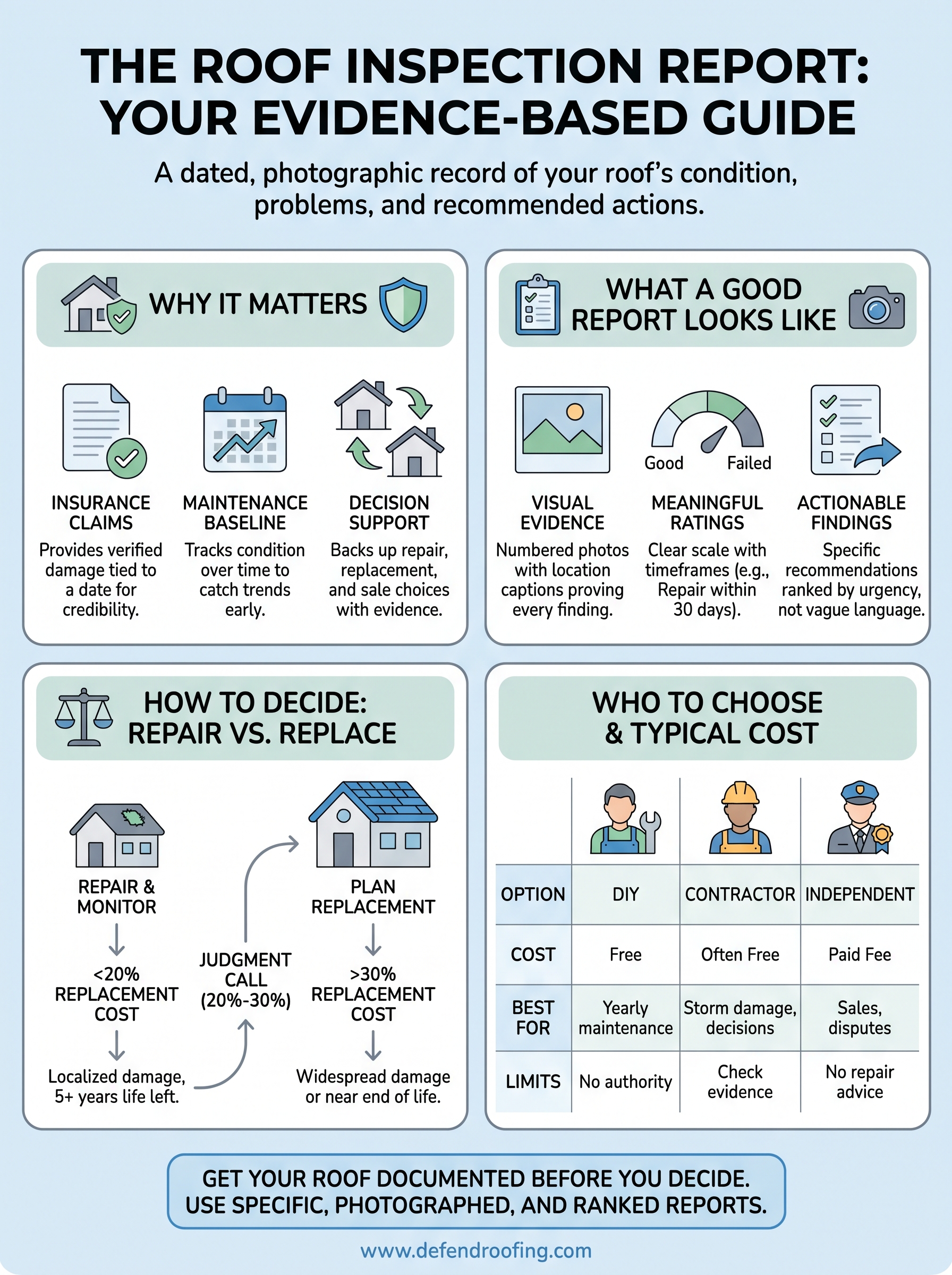
A roof inspection report is only worth having if it is specific, photographed, and ranked by urgency. Use the sample above to track your own roof each year, and rely on a professional report when money, insurance, or a sale is on the line. Read every finding against the rules in this guide, and you will know whether to repair, replace, or wait.
If you want a report on your Central Texas roof, call or text Defend Roofing for a free inspection. We will document the roof, explain what we found in plain language, and tell you honestly what it needs, including when the answer is nothing yet.