A roof certification inspection verifies your roof's condition for insurers and buyers. See what it covers, what it costs, and how to find an inspector.
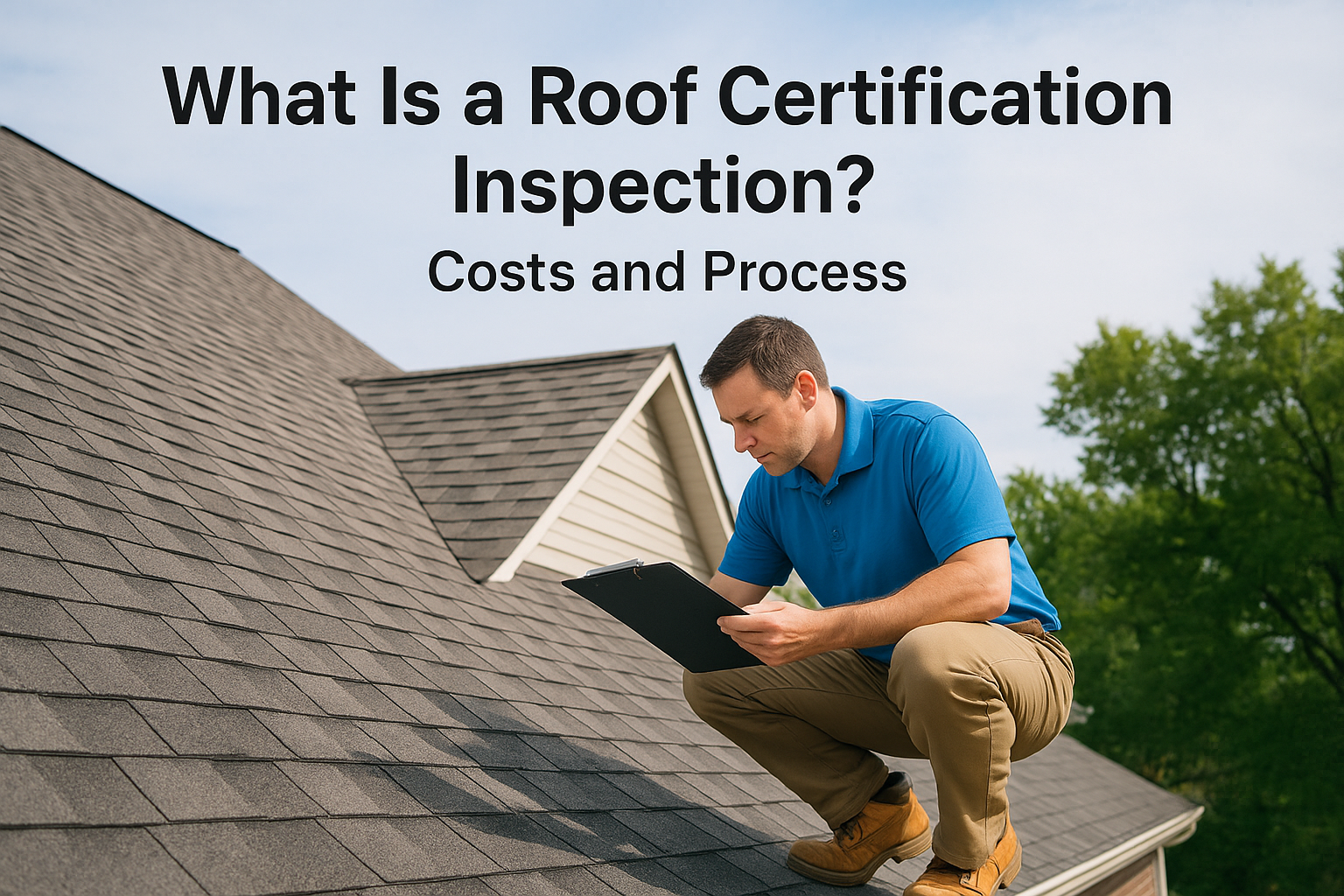
A roof certification inspection is a professional examination of your roof that ends in a signed document stating its current condition and how many more years it should last. Insurers ask for one when a roof gets older, buyers and lenders ask for one during a sale, and some homeowners order one just to learn what they actually own. Most certificates stay valid for one to five years. Fees run from under $100 for a simple roof to $600 or more for a large, steep one.
The terms "inspection" and "certification" get used as if they mean the same thing, and they do not. The inspection is the work: someone climbs up, looks closely, and documents what they find. The certification is the paper that states the roof passed and for how long. If you do not know which one your insurer or buyer wants, you may end up paying twice.
This guide covers why insurers and buyers require a certification, how to order one, and what the inspector checks. It also covers what it costs and how to choose a qualified inspector in Central Texas. We are Defend Roofing, a family-owned roofing contractor in the Austin area, so the examples come from roofs that face Texas sun, wind, and hail.
A roof certification inspection matters because someone else is betting money on your roof's condition. That someone is usually an insurer, a buyer, or a lender. A certificate turns "I think the roof is fine" into evidence that a third party can rely on.
Roofs are among the most expensive parts of a house to repair after a storm, so insurers want to know what they are covering. Many carriers ask for a certification when a roof reaches a certain age or when there is no proof of recent updates. The age cutoff varies by insurer and by roofing material, so ask your carrier which roof age triggers the request.
Also ask which form they accept. Some insurers want their own form filled out, and others accept an inspector's report. Get the answer in writing before you book anyone. A certificate also gives you a documented baseline. If hail hits the roof next spring, you can show what shape it was in before the storm.
In a home sale, the roof is the item most likely to stall a negotiation. A buyer who sees a 15-year-old roof and no paperwork will either ask for a price cut or walk away. Each party wants something different from the document:

| Who asks | Why they ask | What they want to see |
|---|---|---|
| Insurer | Decide whether to write or renew the policy | Condition, remaining life, often their own form |
| Buyer | Avoid a surprise repair bill after closing | Remaining years, defects, photos |
| Lender | Protect the property backing the loan | A statement that the roof is sound (rules vary by lender) |
| Seller | Take the roof out of the negotiation | A pre-listing report to hand to buyers |
| Owner | Plan a repair or replacement budget | A repair list and a realistic timeline |
Sellers who order the inspection before listing control the timing and the repair list. A buyer's inspection can surprise you at the worst moment.
Ordering one voluntarily is the cheapest way to catch small problems early. A cracked pipe boot, dried-out sealant, or a lifted row of shingles costs little to fix today. Left alone, any of them can turn into rotted decking and stained ceilings. Your roof gets older every summer, and Central Texas heat and storms speed that up.
A roof certification inspection turns "I think my roof is fine" into evidence that someone else can rely on.
You order a roof certification inspection by finding out exactly what the requesting party needs, hiring a qualified inspector, preparing access to the roof and attic, and reviewing the written report. Done in that order, the process is simple. Done out of order, it often means a second inspection.
Start earlier than feels necessary. The inspection takes a short visit, but repairs and a re-check can add days or weeks. Ask any inspector for their turnaround before you book, because a closing date or policy renewal deadline sets your clock.
If you are selling, order the inspection before listing. That leaves time to fix issues quietly instead of negotiating them under pressure. If you are renewing insurance, ask your carrier how long before renewal they need the document. A roof that needs repairs cannot be certified the same afternoon.
Ask the requester what form they want before you hire anyone. It prevents the most common reason for paying twice.
The inspector checks the roof surface, the flashing, every penetration, the drainage, and the attic and ceilings. They then record the roof's condition, the repairs needed, and its estimated remaining life. The certificate is the conclusion of that report, stating the roof is sound and for how long.
The inspector walks the roof, or uses a drone or ladder where walking is unsafe, and looks at shingle condition first. They check for cracked, curling, or missing shingles and for heavy granule loss. On Central Texas roofs, they also look for hail bruising, which shows up as soft spots or dents in the shingle mat.
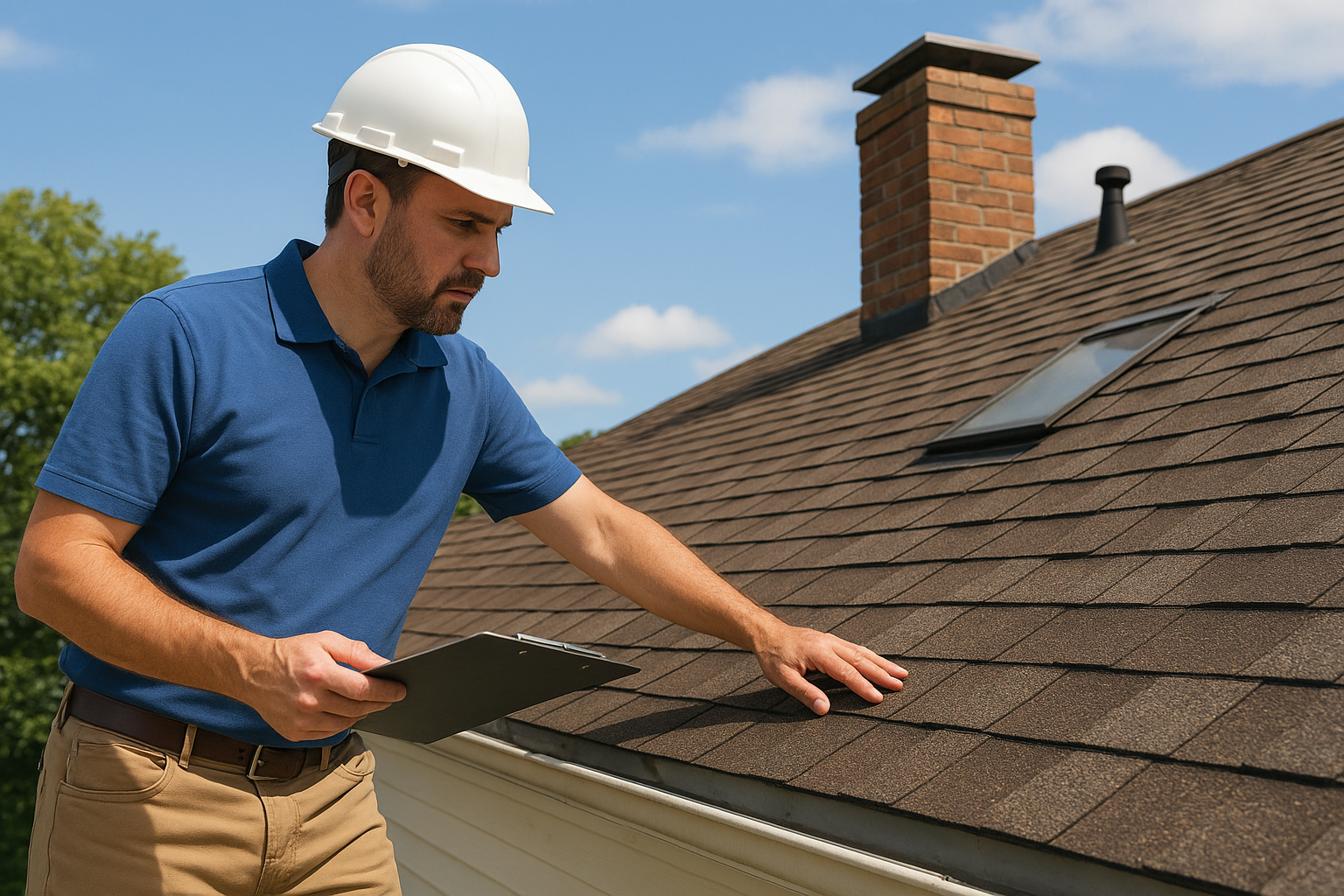
Next comes flashing and penetrations. Chimneys, skylights, vents, and pipe boots are where most leaks start, so these get close attention. They also check valleys, gutters, and drip edges, because water that cannot leave the roof will find its way into the house. A good inspector photographs every defect so you can see it too.
The inspection continues indoors, where leaks leave evidence even when the roof looks fine from above. The inspector looks for damp insulation, water stains on rafters or ceilings, and mold or mildew. They check the underside of the decking for soft or dark spots and for daylight showing through.
Ventilation matters here as well. Blocked or insufficient vents trap heat and moisture, which cooks shingles from below and shortens their life. If the attic is inaccessible, the inspector should say so in the report, because a limited inspection is a weaker basis for a certificate.
People mix up three different documents:
| Inspection | Certification | Warranty | |
|---|---|---|---|
| What it is | The act of evaluating the roof | A signed statement about the roof's condition | A promise to pay for certain repairs |
| What you receive | Report with findings and photos | Certificate with condition and remaining life | Written terms and a coverage period |
| Time frame | One visit | Typically one to five years | Set by the provider |
| Always included? | Yes | Only if the roof qualifies | Only from providers who offer it |
A certificate is an inspector's professional opinion. It is not insurance and it does not guarantee the roof will never leak. Some providers bundle a leak warranty with their certification, but that is an add-on you should confirm in writing.
A certificate states what the roof looked like on inspection day. A warranty is a separate promise, and not every certificate comes with one.
A roof certification inspection usually costs about $75 to $200 for a simple roof, and $300 to $600 or more when a roofing contractor inspects a larger or steeper one. These are commonly quoted U.S. ranges, and they differ because inspectors price their time, their liability, and their report differently. Local quotes vary, so get two before you commit.
| Roof situation | Commonly quoted fee |
|---|---|
| Low, simple roof with few penetrations | About $75 to $200 |
| Average home inspected by a roofing contractor | About $300 to $600 |
| Steep, multi-story, tile, or complex roof | $600 or more |
| Free roof inspection with no formal certificate | $0 |
The gap between the first two rows reflects what you get. A low-cost certificate may be a one-page form with a few photos. A higher fee usually buys a longer written report, more photos, and a more detailed estimate of remaining life.
Several things push a quote up or down:
Repairs are the cost people forget. A roof usually must be fixed before it can be certified, and that bill is often larger than the inspection fee.
Say your 14-year-old architectural shingle roof has a moderate pitch, and you get a $300 quote. The inspector finds a failed pipe boot and a handful of cracked shingles. A targeted repair at a starting rate of $395 brings the total to about $695 before the certificate is issued. Actual repair prices depend on scope.
Now compare the other outcome. If the inspector finds the roof is past saving, a replacement from Defend Roofing starts at $7,900. Spending $300 to learn that before a closing or a storm is cheap by comparison.
A free inspection and a paid certificate are not the same product. Many roofing contractors, including Defend Roofing, offer a free roof inspection that ends in a photo-documented report and a repair-or-replace recommendation. A formal certificate carries the inspector's name and liability, and that is typically what the fee pays for. If your insurer or buyer only needs documentation of condition, a free report may be enough. Ask them before assuming either way.
The inspection fee is the small number. The repairs it uncovers are the number to plan for.
A qualified roof inspector has verifiable credentials, local experience with your roofing material and weather, and a written, photo-backed report. Ideally they also have no hidden incentive to find work for themselves. Check those four things and you screen out most of the weak options.
Texas does not issue a statewide license for roofing contractors, so "licensed roofer" does not carry the weight it does in some states. Home inspectors in Texas are licensed by the Texas Real Estate Commission, and you can verify a license through TREC. For a roofer, look for manufacturer certifications, proof of liability insurance, and a track record you can check. Defend Roofing, for example, is a certified installer for IKO, Owens Corning, and CertainTeed shingles.
"Certified" has no single meaning. Some inspector associations issue credentials after training and an exam. Others are little more than a membership. Ask what the credential required and who issued it, then confirm that your insurer or buyer accepts it.
There are trade-offs either way. A roofing contractor knows how roofs fail and can fix what the report lists. The risk is a conflict of interest, because an inspector who also sells repairs has a reason to find them. An independent inspector has no stake in the outcome, but you will still need a contractor for repairs.
Ask the requester which they accept. Some insurers and buyers insist on a third party. If you use a contractor, choose one whose report stands on its own. At Defend Roofing, the free inspection ends in a report with 100+ photos and an honest repair-versus-replace recommendation, and we decline work a roof does not need.
Ask every candidate these before booking:
Walk away from a price far below the others, which often signals a rushed inspection. Be wary of a verbal-only verdict or pressure to sign a replacement contract on the spot.
Some inspector associations offer online roof inspection courses, and a few are free. Finishing one gives you a training credential, not a state license. If you plan to inspect homes for pay in Texas, you must meet TREC's requirements as a home inspector. Check which credential your target clients accept before you invest the time.
Check who issued the credential and whether your insurer or buyer accepts it. "Certified" alone proves nothing.
After the inspection, your roof either passes, passes after minor repairs, or needs major work before it can be certified. Once the repairs are done and verified, the certificate is issued and stays valid for one to five years, depending on the roof.
A failed inspection is not a verdict against you. It is a repair list. Common causes are brittle or worn shingles, damaged flashing, blocked vents, soft decking, and failed underlayment. The report should name each problem, show a photo, and say what fixing it involves.
Get written quotes from two or three contractors before you spend money. If the repair cost approaches the cost of a new roof, replacement may be the better value. Once the work is done, the inspector re-checks it and issues the certificate. A contractor should also photograph the finished repair so you have records for the file.
Expect one to five years of validity. A newer roof in good shape earns a longer period than an older one showing wear. Material, roof age, and local weather all influence the inspector's estimate.
A certificate describes the roof on the day it was written. If hail or high wind hits afterward, the document no longer tells the full story, so schedule a new inspection after any serious storm. Roofs here take hits from Central Texas hail, so annual checkups make sense. If storm damage turns up, a documented inspection also supports an insurance claim. Defend Roofing works directly with insurers and meets adjusters on site.
A certificate is a snapshot, so book a fresh inspection after any serious storm.
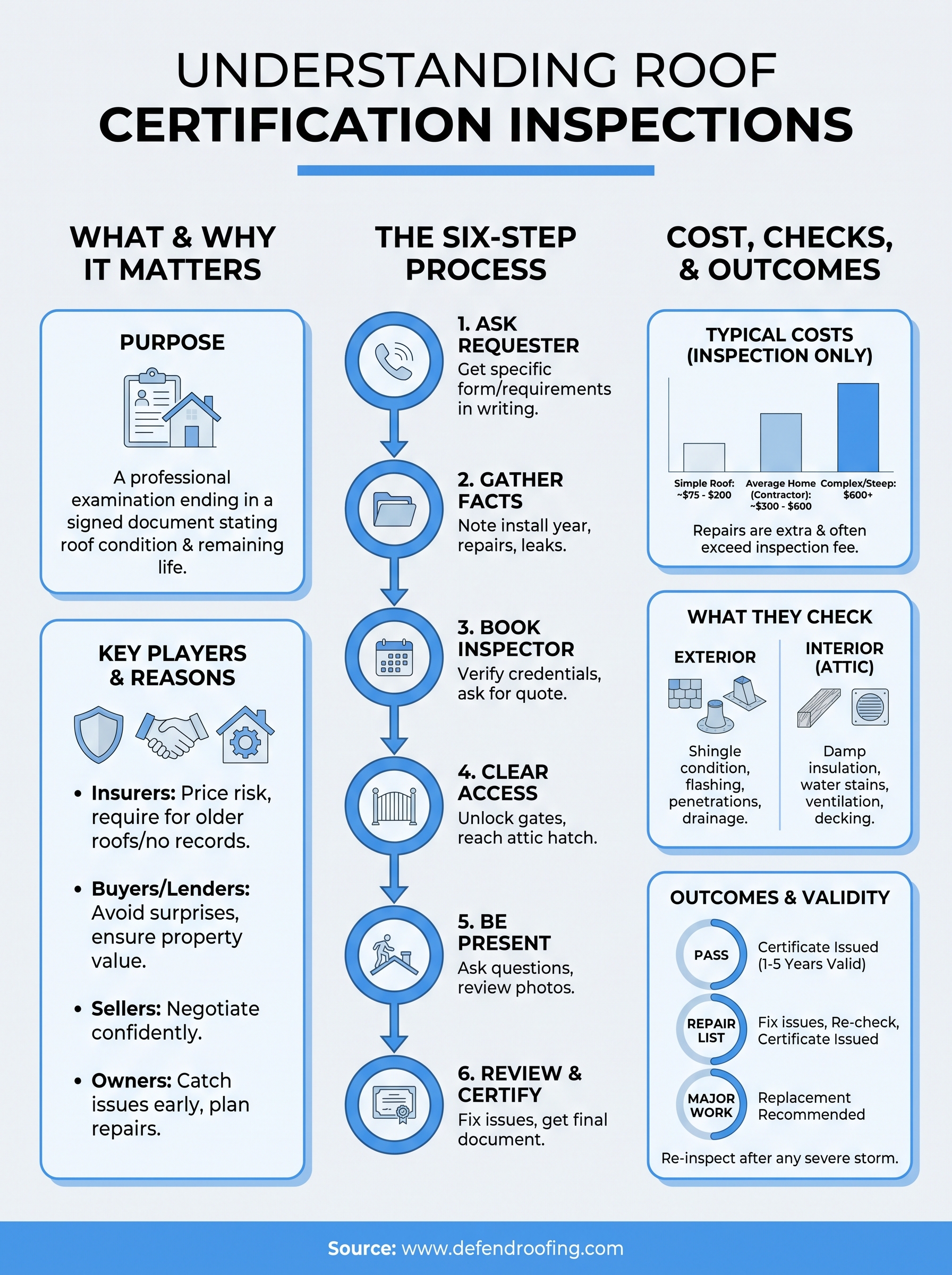
A roof certification inspection is a documented, professional opinion of your roof's condition and remaining life. Insurers require it to price risk, and buyers and lenders require it to avoid surprises. It also gives you a clear picture before small problems get expensive. Fees range from about $75 to $600 or more, and repairs often cost more than the inspection itself.
Start by asking your insurer or buyer exactly what they need. Then hire an inspector with credentials you can verify, and keep every report and photo. If you want a clear, photo-backed look at your roof before you decide anything, contact Defend Roofing to schedule a free roof inspection. Tell us what your insurer or buyer asked for, and we will explain what we can provide.