Learn what is roof ventilation and how it protects your attic from heat and mold. Discover the best vent types to lower energy costs and extend roof life.
Your roof does more than keep rain out. Beneath the shingles and decking, there's a system designed to move air through your attic, and when it works correctly, it protects everything from your framing to your energy bills. So what is roof ventilation, exactly? It's the balanced flow of outside air into and out of your attic space, driven by intake vents near the eaves and exhaust vents near the ridge. Without it, heat and moisture get trapped, and problems start compounding fast, warped decking, mold growth, ice dams, and shingles that age well before their time.
At Defend Roofing, our father-and-son team has seen the damage that poor ventilation causes across Central Texas homes. During every Precision Roof Assessment, we document not just surface wear but what's happening underneath, including whether your ventilation system is doing its job. It's one of the most overlooked parts of a roof, and one of the most important to get right.
This article breaks down how roof ventilation works, the different types of vents available, why balanced airflow matters, and what to look for if you suspect your attic isn't breathing the way it should.
Central Texas summers are brutal on roofs. When outdoor temperatures climb into the triple digits from June through September, an unventilated attic can reach 160°F or more, turning the space above your living area into a slow-burning oven that degrades every material it touches. If you've ever wondered what is roof ventilation actually doing for your home in the Austin area, the answer is keeping that heat from destroying your roof from the inside out.
Attic temperatures in poorly ventilated Texas homes can exceed 160°F in peak summer months, accelerating shingle aging by years.
In the Austin area, radiant heat from the sun transfers through your shingles into the decking below, and without a way for that heat to escape, it stays trapped against your framing. That sustained exposure warps your decking, dries out shingle adhesive, and can void manufacturer warranties on roofing materials that specify minimum ventilation requirements. Your HVAC system also works harder when attic heat radiates down into your living spaces, which shows up directly on your energy bills every summer.
Your roofing investment depends on airflow as much as it depends on material quality. Without adequate exhaust, even premium shingles rated for 30 or 50 years will age at an accelerated pace, often showing curling, cracking, and granule loss well before the midpoint of their rated lifespan.
Texas winters are mild but not moisture-free. Warm, humid air from inside your home rises into the attic during cooler months, and when that air meets a cold roof deck, it condenses. That condensation soaks into your wood framing and decking, creating the conditions mold needs to take hold. Repeated cycles of this moisture buildup can rot structural components that are expensive to replace.
Homes in areas like Steiner Ranch and Cedar Park also face occasional freeze events. When attic insulation becomes wet from condensation, it loses its effectiveness, meaning you lose both thermal protection and structural integrity at the same time. Proper ventilation keeps moisture moving out before it ever gets a chance to settle into your decking or framing.
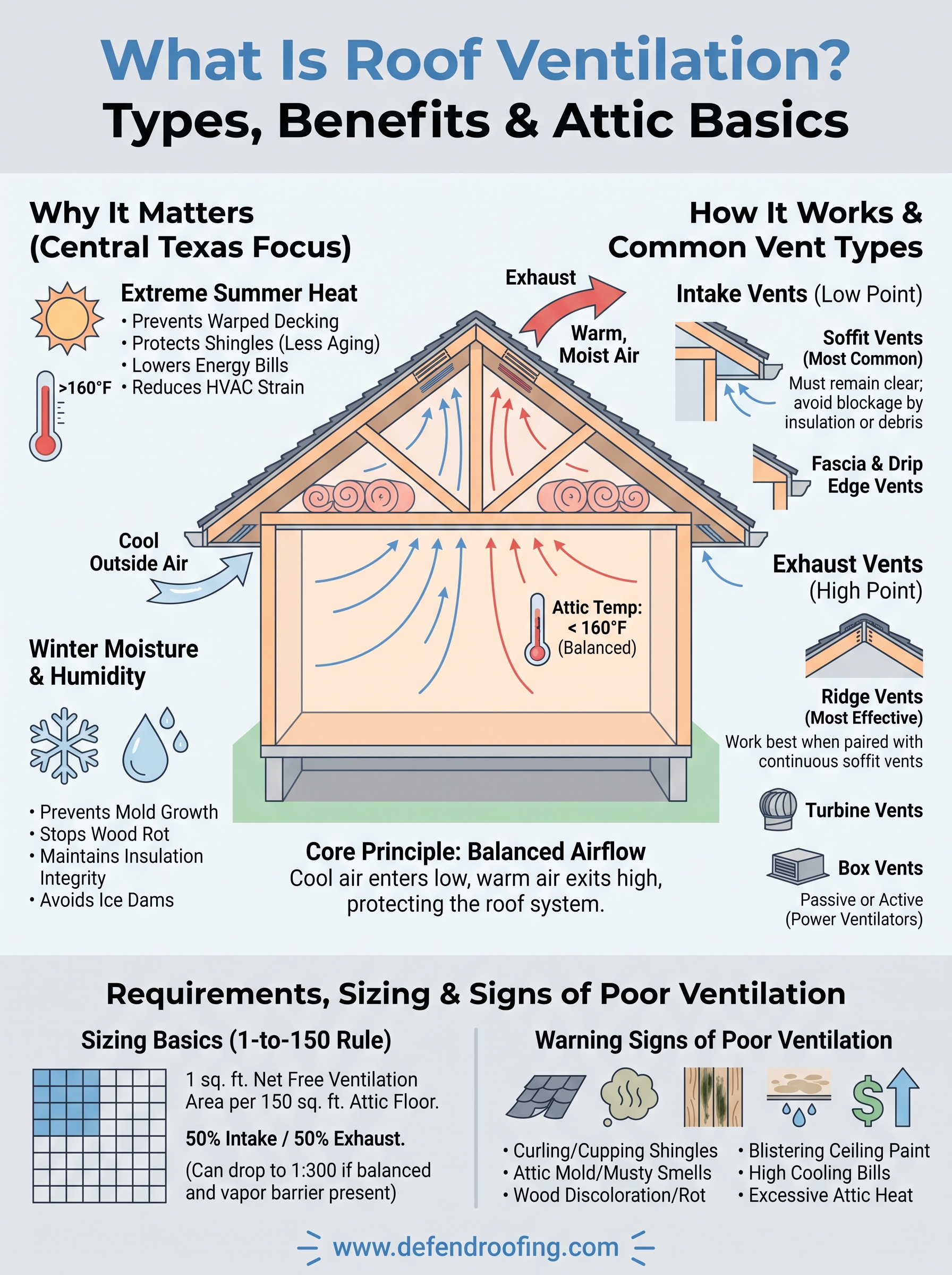
Understanding what is roof ventilation comes down to one core principle: balance. Your roof ventilation system relies on two separate sets of vents working together. Cool air enters low along your roofline, and warm air exits high near the ridge, creating a continuous flow that flushes heat and moisture out of the attic before either can cause damage.

Intake vents sit at the lowest point of your roof system, typically built into the soffits under your eave overhangs. When outside air enters through these vents, it pushes the hotter attic air upward toward the ridge. Blocked or insufficient intake is one of the most common ventilation failures we find during assessments, often caused by insulation pushed too close to the eaves or debris buildup in the soffit baffles.
Intake vents need to remain clear year-round; even partial blockage can cut your effective airflow in half and force exhaust vents to work against negative pressure.
Exhaust vents sit near or at the ridge of your roof, where heat naturally rises and collects. Ridge vents, turbine vents, and box vents all serve this same exit function. Your attic operates most efficiently when intake and exhaust areas are roughly equal, allowing air to flow through without creating pressure imbalances that reduce the system's overall effectiveness.
When one side outpaces the other, the entire system loses efficiency, and your attic pays the price in trapped heat and moisture that accelerates wear on everything above your living space.
Understanding what is roof ventilation also means knowing which physical components make it work. Not every home uses the same setup, and the right combination of vent types depends on your roof's pitch, layout, and existing infrastructure. Choosing the wrong mix, or relying on too few vents on one side of the system, creates imbalances that lead to accelerated roof failure well before you'd expect it.
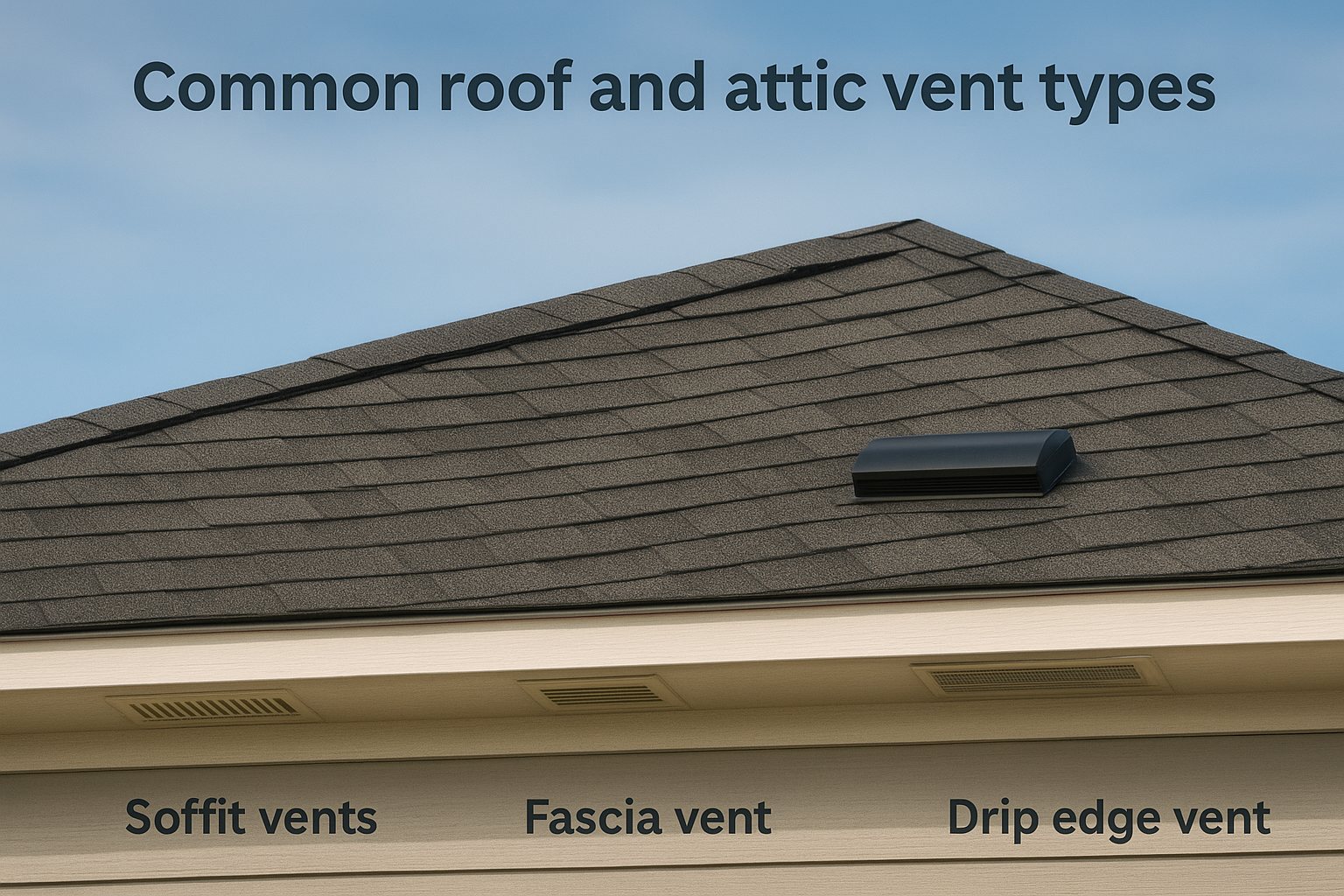
Soffit vents are the most common intake solution and come in two forms: individual rectangular vents spaced along the soffit or a continuous perforated strip that runs the full eave length. Both pull outside air into the attic at the lowest point of the roofline. Common intake vent types include:
Ridge vents are the most effective exhaust solution for most homes because they run the full length of the roof peak, giving hot air a uniform exit across the entire attic space. Turbine vents, also called whirlybirds, use wind to pull air out actively and perform well in open areas where steady breezes are consistent.
Ridge vents paired with continuous soffit vents deliver the most balanced airflow, which is why most roofing professionals favor this combination on new installations.
Box vents and power attic ventilators round out the exhaust options, though each has tradeoffs. Box vents are passive and work best installed in multiples across the upper roof, while power ventilators move more air but add mechanical complexity and ongoing energy costs to your system.
Knowing what is roof ventilation is one thing; knowing how much your home actually needs is another. The building code sets a baseline, but that baseline assumes ideal conditions that many attics don't have. Getting the sizing right determines whether your ventilation system performs or just exists on paper without actually protecting your roof.
The standard most building codes follow is a 1-to-150 ratio, meaning you need one square foot of net free ventilation area for every 150 square feet of attic floor space. If your attic covers 1,500 square feet, you need a minimum of 10 square feet of combined intake and exhaust area. That total splits equally between intake and exhaust, so neither side creates a pressure imbalance.
When your intake and exhaust areas are balanced, the 1-to-150 ratio can drop to 1-to-300, giving you the same protection with fewer total vents.
Some codes allow that ratio to relax to 1-to-300 when intake and exhaust are balanced and a vapor barrier is present on the attic floor. That flexibility rewards proper system design rather than just raw vent count.
Start by measuring your total attic floor area in square feet, then divide by 150 to find your minimum net free ventilation area. Split that number in half, and you have your required intake and exhaust areas separately.
Roof pitch also affects airflow efficiency. Steeper roofs create stronger natural convection, while low-slope roofs may need more venting surface area to compensate for reduced stack effect.
Poor ventilation rarely announces itself all at once. Instead, it builds up gradually through damage patterns that most homeowners mistake for normal wear. Recognizing the early warning signs gives you the chance to act before a ventilation problem turns into a structural one.
Your attic and your roof surface both signal when airflow has broken down. Suffocating attic heat on a summer afternoon, moisture stains on the underside of your decking, and soft spots in the sheathing all indicate that heat and condensation have been sitting without a way out. Common signs include:
If your attic smells musty or shows any wood discoloration, treat it as an urgent issue rather than a cosmetic one.
If you recognize any of these patterns, the next step is a professional roof assessment rather than a DIY fix. Ventilation problems are interconnected, and correcting one piece without evaluating the full system often shifts the imbalance rather than solving it.
Understanding what is roof ventilation and how intake and exhaust work together helps you ask the right questions when you talk with a roofing contractor. A thorough inspection will document your current vent placement and net free area, along with any blockages, so you know exactly what your attic needs before any work begins.
Understanding what is roof ventilation gives you a clearer picture of why your roof ages the way it does. Balanced intake and exhaust protect your decking, extend your shingles' lifespan, and reduce the heat load your HVAC system fights every Central Texas summer. When your ventilation system breaks down, the damage shows up slowly, then all at once in the form of rotted framing, curling shingles, and mold that costs far more to fix than it would have to prevent.
Your roof is one of your home's biggest investments, and proper airflow is what keeps that investment intact year after year. If you've noticed any of the warning signs covered in this article, or if you simply want to know where your attic stands, Defend Roofing documents every detail with 100+ photos so you get a clear, honest answer. Schedule your Precision Roof Assessment today and know exactly what your roof needs.