Compare asphalt shingles vs metal roof to find the best fit. Learn how each impacts your insurance, lifespan, and Central Texas home value.
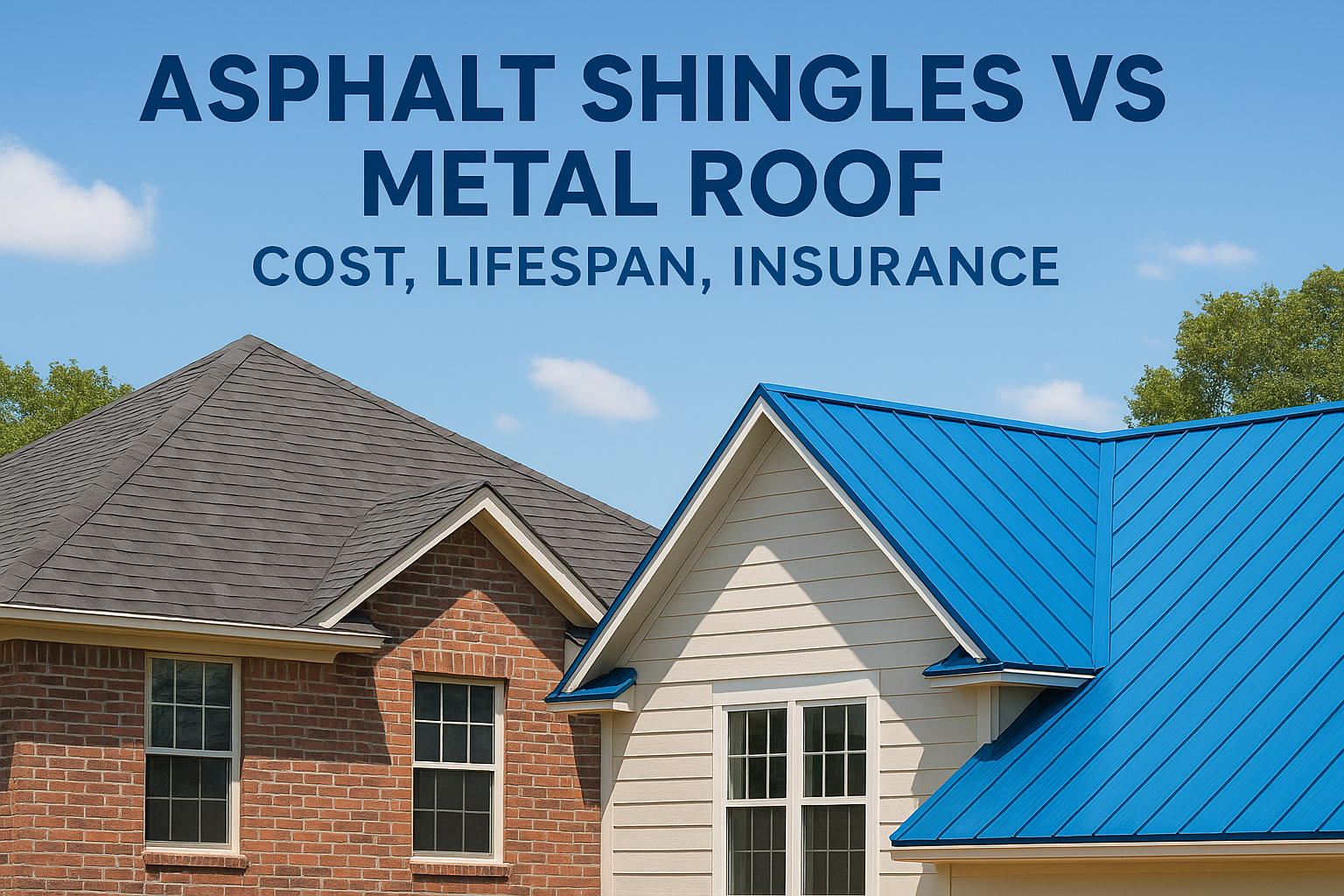
If you're weighing asphalt shingles vs metal roof for your home, you're probably getting hit with wildly different opinions depending on who you ask. A metal roofing company will tell you metal is the only smart choice. A shingle installer will say the opposite. The truth sits somewhere in between, and it depends heavily on your budget, your property, and how long you plan to stay in the home.
Here at Defend Roofing, we're a family-owned roofing contractor serving Central Texas homeowners, three generations deep in this trade. We install both asphalt shingle and metal roofing systems, so we don't have a financial reason to push you toward one over the other. What we do have is thousands of roof assessments' worth of real-world data on how each material actually holds up under Austin's heat, hail, and storms. That experience shapes everything in this guide.
This article breaks down the real differences between asphalt shingles and metal roofing across cost, lifespan, insurance impact, and long-term value. No fluff, no sales pitch, just the information you need to make a confident decision about your roof.
Choosing between asphalt shingles vs metal roof isn't just a materials question in Central Texas. It's a financial decision that affects your insurance premiums, your home's resale value, and how much maintenance you'll deal with over the next decade or two. Central Texas homeowners face a specific set of conditions that make this choice more consequential than it might be in other parts of the country.
Central Texas summers are brutal. Prolonged heat above 100°F and intense UV exposure accelerate the aging of roofing materials in ways that national product specs often don't account for. Asphalt shingles expand and contract through daily temperature swings, which over time causes the granules to shed and the mat underneath to become brittle. Metal roofing handles thermal movement differently, using expansion joints and panel systems designed to flex without cracking or losing structural integrity.
The difference between a roof rated for 25 years in a mild climate and one rated for 25 years in Austin can be significant, because manufacturer warranties don't always reflect regional performance.
Beyond heat, Central Texas gets wind-driven rain and severe thunderstorms during spring and fall. These events test fasteners, flashing, and seam integrity in ways that a casual inspection won't reveal. The roofing material you choose determines how well your home holds up through repeated storm cycles, not just the first one.
Austin and the surrounding Hill Country sit in a hail corridor that sees multiple significant hail events most years. This matters for both material choice and insurance outcomes. Asphalt shingles absorb hail impact and can sustain hidden damage that weakens them without obvious visual signs from the ground. Metal roofing can dent from large hail, though it typically maintains its waterproofing integrity even after impact.
When hail damages your roof, the type of material affects how your insurance claim gets handled, what a contractor documents during the assessment, and whether you qualify for a repair or a full replacement. In neighborhoods like Cedar Park, Leander, and Steiner Ranch, where hail events are frequent enough that some homeowners have filed multiple claims over a 15-year period, your roofing material choice connects directly to long-term insurance costs.
HOA rules in planned communities around Austin can restrict which roofing materials you're allowed to install, so checking your HOA guidelines before making any decision is essential. Even where HOAs don't restrict material type, the dominant roofing style in your neighborhood shapes buyer expectations when you eventually sell. In most Central Texas neighborhoods, asphalt shingles remain the standard, which means a metal roof can either add perceived value or stand out in a way that some buyers find unusual.
Your local real estate market, your neighborhood's price range, and your expected time in the home all factor into which material makes the most sense from a long-term value standpoint.
The sticker price difference between asphalt shingles and metal roofing is real and significant, but the upfront number alone doesn't tell you which option actually costs more over time. When you factor in lifespan, maintenance, and how many replacements you'll need, the math shifts in ways that surprise most homeowners.
For a typical Central Texas home, asphalt shingle installation runs roughly $8,000 to $16,000 depending on roof size, pitch, and shingle grade. Metal roofing costs considerably more, usually falling between $20,000 and $40,000 or higher for standing seam systems. That gap can feel like a dealbreaker, especially if you're already managing an insurance deductible or financing the project.
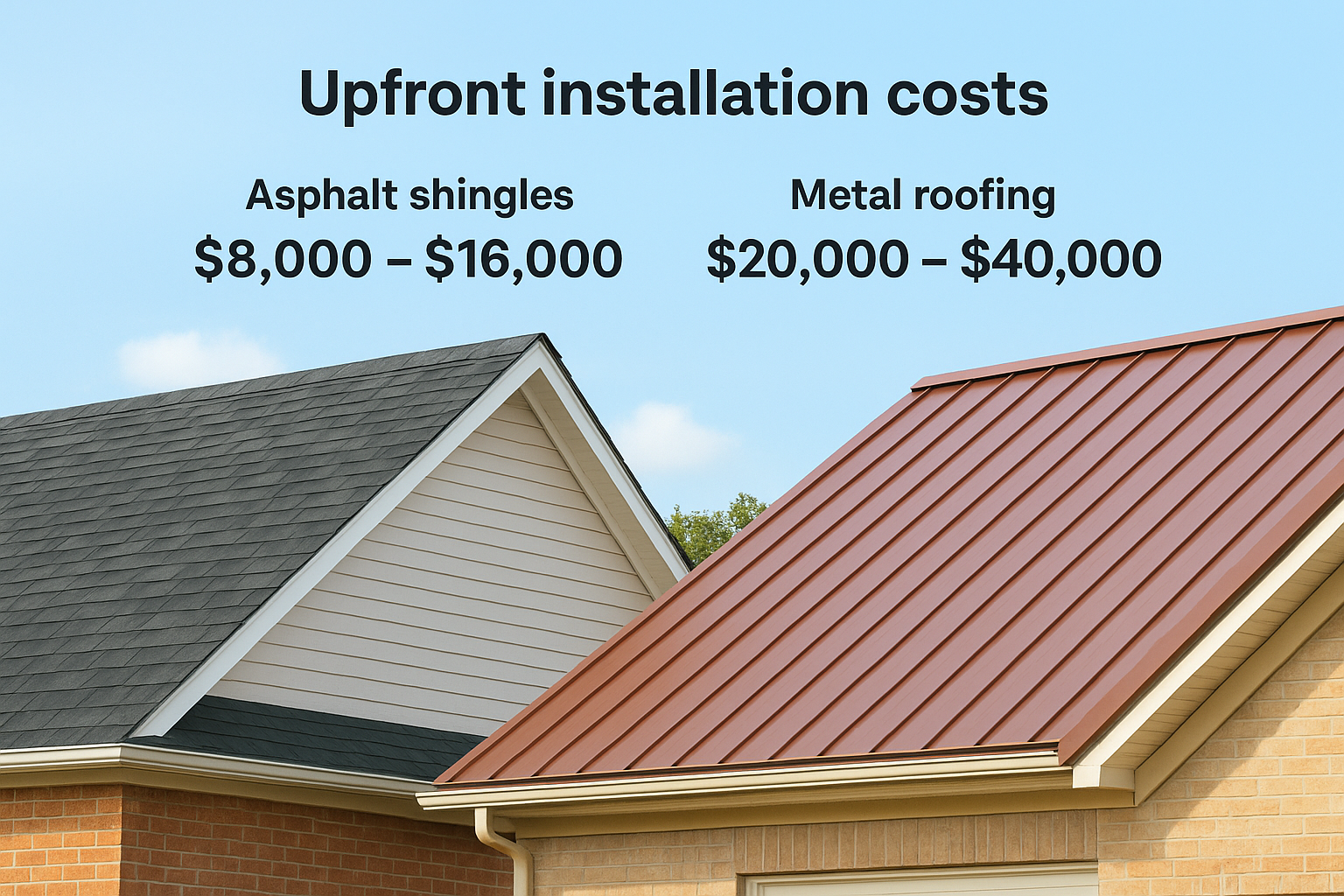
The upfront cost difference between asphalt and metal can exceed $20,000, which is why most homeowners don't get past the first quote.
Your choice of metal type also matters. Steel panels, aluminum systems, and stone-coated metal tiles each carry different price points and performance profiles, so the "metal roofing" category covers a wide cost range rather than a single fixed number.
Asphalt shingles in Central Texas realistically last 15 to 25 years given the heat and storm exposure, meaning most homeowners replace them at least twice over a 50-year window. Two asphalt replacements at $12,000 each totals $24,000, not counting maintenance or repair costs between those cycles. A metal roof installed today at $30,000 could cover that same 50-year window without a full replacement.
When you break each option down to cost per year of service, the numbers converge more than the upfront quotes suggest. The difference becomes which option fits your cash flow now versus what you're willing to pay upfront to avoid future expense. If you plan to sell the home in 7 to 10 years, asphalt shingles typically offer better short-term value because you won't capture the full benefit of metal's extended lifespan.
When you're comparing asphalt shingles vs metal roof performance over time, Central Texas conditions push both materials harder than manufacturer specs typically reflect. Heat, UV exposure, and repeated storm cycles compress the realistic lifespan of either option, so understanding what each material actually delivers in this climate matters more than what the product brochure says.
Asphalt shingles installed in the Austin area realistically last 15 to 25 years. The high end of that range requires quality materials, proper attic ventilation, and a clean installation. Poor ventilation alone can cut asphalt shingle life by 5 years or more, because trapped heat from below accelerates granule loss and mat breakdown from the underside. Three-tab shingles tend to fall closer to the 15-year mark in Texas; architectural shingles with better granule adhesion perform closer to the 20 to 25-year range.
In Central Texas, heat and UV exposure are the biggest factors shortening asphalt shingle lifespan, not just storm damage.
Metal roofing systems, particularly standing seam steel or aluminum, regularly last 40 to 70 years in similar conditions. Metal handles thermal cycling better than asphalt because properly engineered panel systems flex without cracking, rather than expanding and contracting in ways that degrade the surface layer.
Asphalt shingles need periodic inspections after major hail or wind events, gutter clearing to prevent moisture backup at the eaves, and occasional repair of lifted or cracked shingles. Over a 20-year roof life, you should expect at least two or three minor repair calls in addition to ongoing preventive upkeep.
Metal roofing is lower maintenance overall, but it still requires attention. Sealant around penetrations and fasteners can degrade over time and needs checking every several years. Debris accumulation in panel valleys can hold moisture longer than on a smooth shingle surface, which matters in areas with heavy tree coverage.
When comparing asphalt shingles vs metal roof from an insurance standpoint, the differences go beyond just which material holds up better in a storm. Your roofing material directly influences your premium, your claim eligibility, and how your insurer values a replacement. In Central Texas, where hail events are a recurring reality, this part of the decision deserves serious attention before you sign a roofing contract.
Many Texas insurance carriers now offer discounts for Class 4 impact-resistant roofing materials, which includes certain metal panels and some high-grade shingles. If your current policy doesn't reflect your roof's material class, you may be paying more than necessary. Check with your insurance agent before you choose a material, because the premium savings on a Class 4 metal or shingle system can meaningfully offset the higher upfront cost over time.
In some cases, switching to a Class 4 impact-resistant roof has reduced Texas homeowners' annual premiums by 20 to 30 percent, depending on the carrier and coverage type.
Hail damage shows up differently depending on what's on your roof. Asphalt shingles typically show granule loss, bruising, and cracking, which an experienced adjuster can document and use to support a full replacement claim. Metal roofing often dents without losing its waterproofing function, which can complicate your claim because cosmetic damage alone may not meet your insurer's threshold for full replacement coverage.
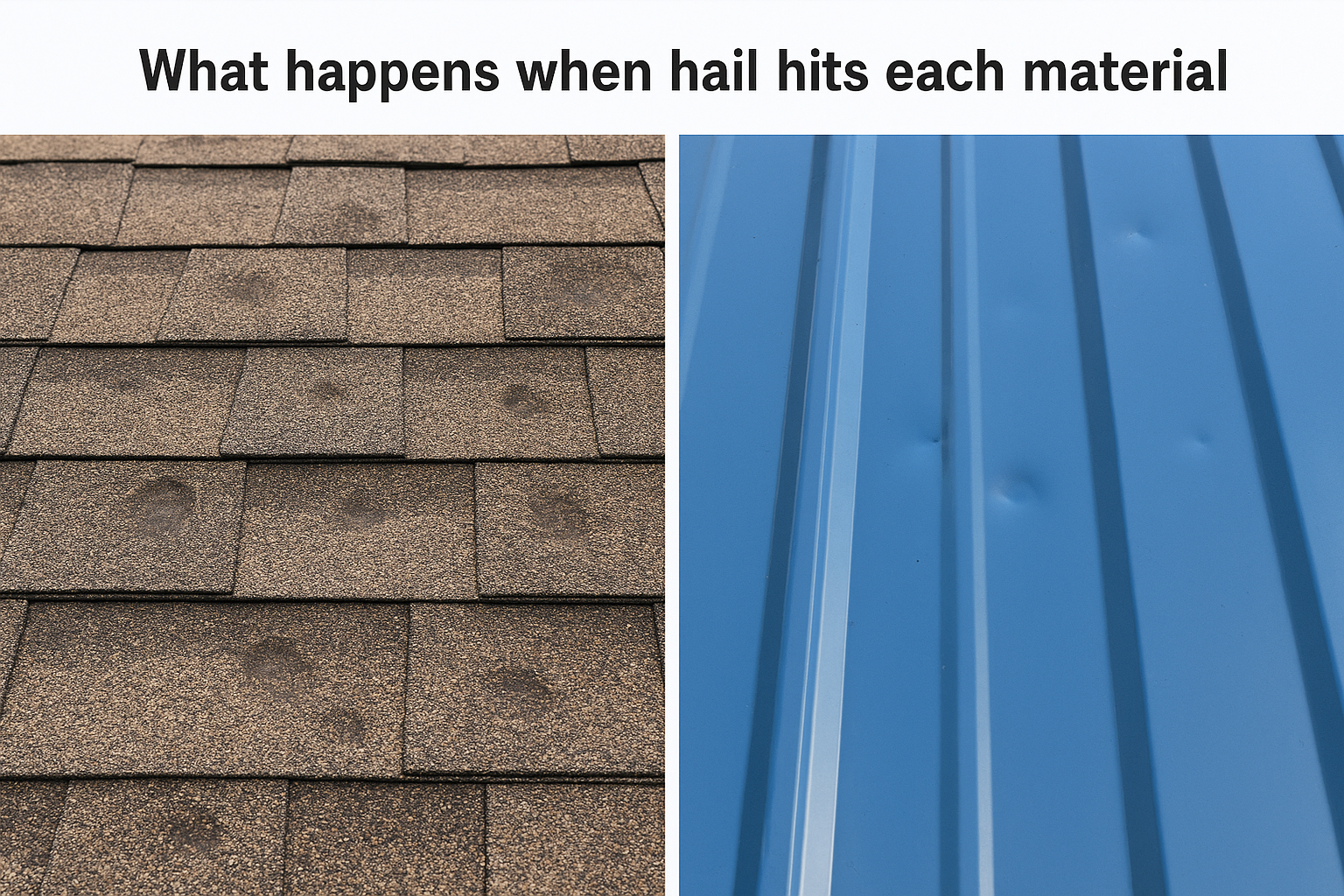
Your documentation matters significantly here. Detailed photo evidence from a professional roof assessment strengthens your claim regardless of which material you have. When hail hits a metal roof, the outcome of your claim often depends on whether your policy includes cosmetic damage coverage, which is a separate endorsement that many homeowners don't realize they're missing until after the storm.
No single answer fits every homeowner when comparing asphalt shingles vs metal roof for a Central Texas property. The right material depends on four factors specific to your situation: how long you plan to stay in the home, what your current budget allows, how your insurance carrier treats each material, and what your neighborhood or HOA permits.
If you plan to sell within the next 10 years, asphalt shingles almost always make more financial sense. You won't recoup a $30,000 metal roof investment in that window, and most buyers in standard Central Texas neighborhoods won't pay a premium large enough to close the gap. If you're staying in the home long-term, the lifetime cost calculation shifts significantly toward metal, because you eliminate one or two future replacement cycles entirely.
Your timeline is the single most reliable filter for this decision, and most homeowners skip it entirely.
Cash flow matters independently of total cost. If financing the upfront gap between metal and asphalt creates real financial pressure, choosing a quality architectural shingle system now beats overextending for a metal roof you'll spend years recovering from financially.
Before you finalize any material choice, call your insurance agent and ask two direct questions: Does my carrier offer a discount for Class 4 impact-resistant roofing? And does my current policy include cosmetic damage coverage for metal?
The answers can shift the financial comparison in a meaningful way. Some Texas carriers reduce premiums by 20 percent or more for qualifying Class 4 systems, which changes the total cost picture over a 10 to 20-year horizon. If your carrier doesn't reward impact-resistant materials, or if adding cosmetic damage coverage carries a significant cost, that affects whether metal's higher upfront price still makes sense for your specific home and budget.
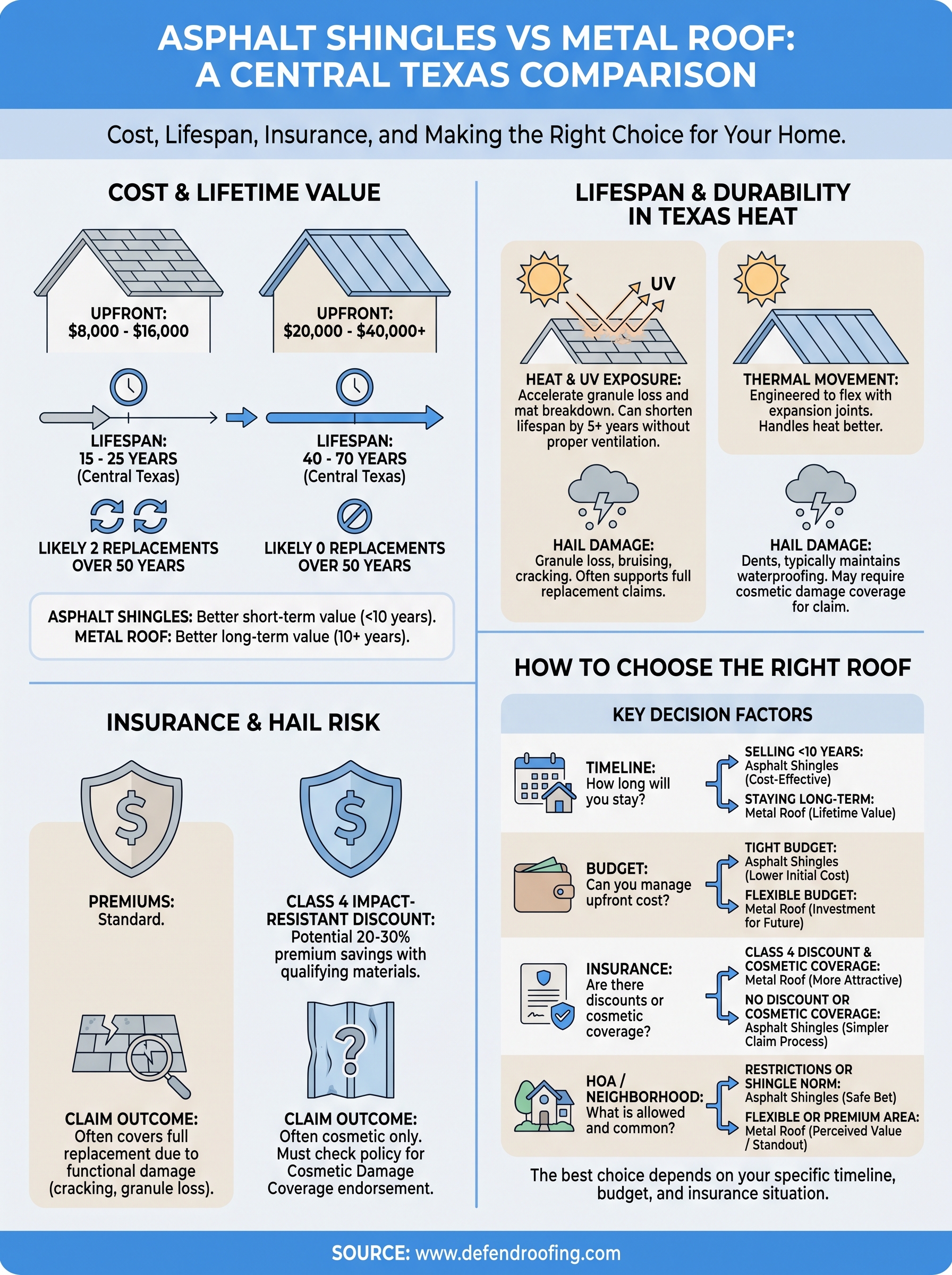
You now have the core framework for comparing asphalt shingles vs metal roof across the factors that actually matter for a Central Texas home: upfront cost, long-term value, lifespan in Austin's climate, and how your insurance carrier treats each material. The right choice comes down to your timeline, your budget, and your specific insurance situation, not a universal ranking of one material over the other.
Before you commit to any contractor or material, get a thorough roof assessment from someone who inspects both options honestly and documents what they find with real evidence. At Defend Roofing, every assessment includes 100+ photos and a clear repair-vs-replace recommendation based on your roof's actual condition, not a sales target. Chris and Greyson will walk you through exactly what your roof needs and why. Schedule your Precision Roof Assessment today and get the documentation you need to make a confident, informed decision.