See what drives leak roof repair cost in 2026, by location, damage, and roof age, plus how a photo-based inspection avoids repeat repairs.

You spotted a water stain on the ceiling or a drip during last night's storm, and now you want a number before you call anyone. Fair enough. The leak roof repair cost in Central Texas typically runs anywhere from $300 for a simple patch to over $2,000 for a valley or flashing repair that involves rotted decking underneath.
The honest answer to how much you'll pay depends on what caused the leak, how long it went unnoticed, and where on the roof it's located. A small leak roof repair cost often lands under $500 when caught early, while a roof valley leak repair cost climbs fast once water has traveled behind walls or soaked insulation. Insurance may cover part of the bill if a storm caused the damage, but not if it's wear and tear.
Below, we break down real price ranges by leak type and severity, the factors that push costs up or down, and how a proper roof assessment (photos included) helps you avoid paying for guesswork. We'll also cover when your insurance claim should foot the bill instead of your wallet.
Every homeowner wants a fast number, but chasing the lowest leak roof repair cost without understanding what's actually wrong can cost you far more down the road. A drip that shows up on your ceiling today might have started weeks or months ago, quietly soaking decking, insulation, and drywall the entire time. What looks like a $300 patch job on the surface can hide $2,000 worth of rot underneath. That gap between what you think you're paying and what the job actually requires is exactly why this number matters more than a quick online quote suggests.
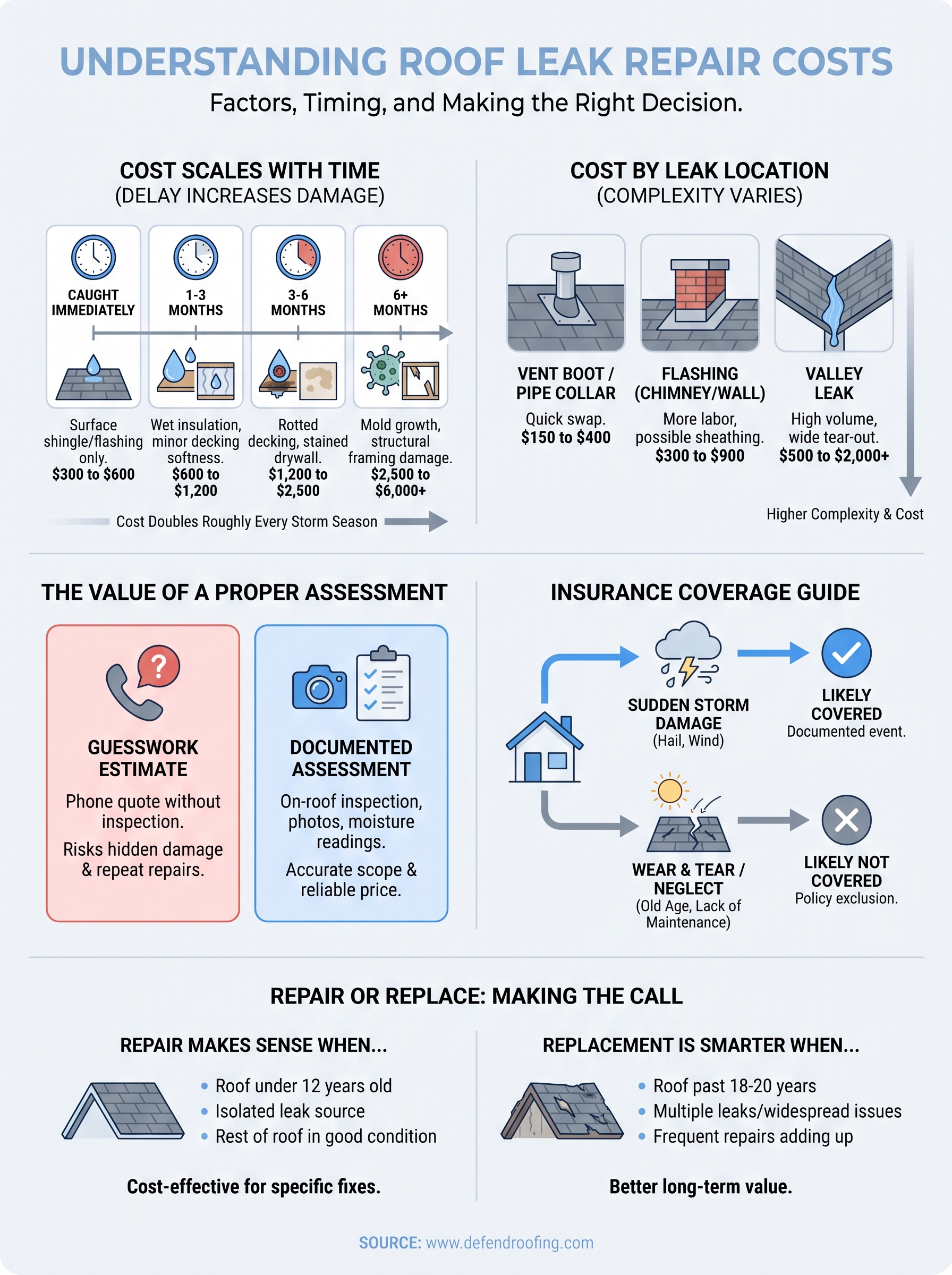
Water doesn't wait for your schedule. A pinhole leak around a nail pop or a cracked pipe boot lets in a small amount of moisture, but that moisture spreads along the roof deck, drips down rafters, and pools in places you can't see from the attic hatch. The average cost to repair roof leak damage roughly doubles every time you delay a repair by one storm season, according to patterns we see across Central Texas homes. Here's a rough look at how cost tends to scale with time:

| Time since leak started | Typical damage | Rough repair cost |
|---|---|---|
| Caught immediately | Surface shingle or flashing only | $300 to $600 |
| 1 to 3 months | Wet insulation, minor decking softness | $600 to $1,200 |
| 3 to 6 months | Rotted decking, stained drywall | $1,200 to $2,500 |
| 6+ months | Mold growth, structural framing damage | $2,500 to $6,000+ |
A $300 leak ignored for six months can turn into a $3,000 repair, and sometimes worse.
Homeowners who shop purely on price often end up paying twice. A contractor who quotes a rock-bottom number over the phone, without climbing on your roof or opening the attic, is usually guessing. That guess almost never accounts for what's happening below the shingles. We've replaced plenty of "quick fixes" from other companies where the visible symptom was patched, but what actually causes roof leaks, a cracked pipe boot three feet away or nail pops along a valley seam, kept leaking behind the new patch. The cost for roof leak repair should reflect what's actually causing the water intrusion, not just where it happens to be dripping into your living room.
Roofing material is only part of the bill. Once water reaches the plywood decking, that wood softens and eventually rots, which means it has to be cut out and replaced before any new shingles go down. Wet insulation loses its R-value and often needs replacing too, and if moisture sits long enough, mold remediation gets added to the invoice. None of that shows up in a five-minute estimate based on a photo you texted a contractor. It shows up once someone actually gets on your roof and opens things up.
That's the real reason cost matters beyond the sticker price. Knowing the true scope upfront, before a crew starts tearing into your roof, protects you from surprise change orders and protects your home from repeat leaks. A documented assessment gives you a number you can trust, not a placeholder that grows once work begins.
Getting a real number starts with a documented inspection from a roof inspection service near you, not a guess based on a stain you can see from your living room. A phone estimate can't tell you whether the leak comes from a cracked flashing seam, a torn boot, or a soft spot in the decking that's been spreading for months, which is why finding the leak from inside and outside matters first. If you want a cost to repair leak in roof figure you can actually plan around, someone needs to get on the roof, open the attic, and document what they find.
Defend Roofing's Precision Roof Assessment uses over 100 photos to map exactly where water is entering and how far it's traveled, so the quote you get matches the work your roof actually needs. A thorough assessment typically covers:
You can't price a leak you haven't opened up and looked at.
Homeowners often accept the first number they hear without asking what's actually included. Before signing anything, there are questions worth asking a roof repair contractor near you: whether they climbed onto the roof, whether they checked the attic side of the leak, and whether the quote covers decking replacement if it's needed. Request photos of the damage area, not just a verbal description, since photos are what separate an honest repair roof leak cost from a guess dressed up as a quote.
It's smart to get two or three estimates, but line them up side by side and check what each one actually includes. One contractor's $400 quote might only patch the visible shingle, while another's $900 quote includes decking repair and a warranty on the work. Comparing scope keeps you from picking the cheapest bid and then paying the difference later when the leak comes back. A documented, photo-backed assessment gives you the leverage to compare apples to apples instead of guessing which contractor left something out.
Several factors decide whether your bill lands near $300 or climbs past $2,000, and most of them have nothing to do with the size of the drip you noticed. The average cost for roof leak repair shifts based on your roofing material, how steep and accessible your roof is, how old the system is, and even the time of year you call. Knowing these variables ahead of time helps you understand a quote instead of just trusting it.
Asphalt shingles are the cheapest to patch since materials are inexpensive and widely stocked, while tile, metal, and low-slope membrane roofs require specialized skills and materials that raise labor costs. A steep pitch also means more time spent rigging safety equipment, which adds to the invoice even for a small job. Roof age matters just as much: shingles over 15 years old are often brittle, so a crew can't simply lift and reseal them without cracking surrounding material, which turns a spot repair into a larger section replacement.
| Factor | Lower cost | Higher cost |
|---|---|---|
| Material | Asphalt shingle | Tile, metal, low-slope membrane |
| Roof pitch | Low slope, easy access | Steep, multiple stories |
| Roof age | Under 10 years | Over 15 to 20 years |
| Access | Ground-level, clear yard | Tall trees, tight setbacks |
The same leak can cost twice as much depending on the roof it's sitting on.
Getting equipment onto a roof surrounded by mature trees, a fenced pool, or a steep driveway takes extra time, and contractors price that time into the estimate. Damage that has already spread into decking, insulation, or drywall adds line items beyond the roof itself, since those materials have to be removed, dried, and replaced before new shingles go down. Homeowners sometimes assume roof leak cost to repair only reflects the shingles, but labor for tear-out and disposal often makes up a bigger chunk of the total than the materials do.
Requesting repairs right after a major hailstorm or during peak spring roofing season often means paying more, simply because every roofing crew in Central Texas is booked solid and demand pushes prices up. Scheduling a repair during a slower stretch, when it's not an emergency, can shave real money off the same job.
Where a leak shows up on your roof changes the price just as much as how long it's been leaking. Valleys, flashing, and vent boots each fail differently, and each one demands a different repair approach, so lumping them into one flat number never gives you an honest picture. A roof valley leak repair cost almost always runs higher than a simple vent boot swap because valleys collect more water and sit at a seam where two roof planes meet, which makes them harder to seal correctly.

Valleys funnel rainwater from two roof slopes into one channel, so they take the heaviest volume during a storm. When the metal or shingle valley liner cracks or the seal fails, water runs straight down into the decking below instead of off the roof. Fixing a valley properly usually means pulling back shingles on both sides, replacing the underlying liner, and reshingling the seam, which pushes labor time up compared to a flat patch elsewhere on the roof.
Flashing sits around chimneys, skylights, and where the roof meets a wall, and it's one of the most frequent leak sources we find during an assessment. Thin metal flashing corrodes or pulls loose from nail movement over time, opening a gap that water slips through during wind-driven rain. Resealing or replacing flashing is often quicker than a valley repair, but cost climbs if the leak has been active long enough to soak the wall sheathing behind it.
Rubber pipe boots and vent collars degrade faster than almost any other roof component, usually cracking within 8 to 12 years even on a roof with plenty of shingle life left. A cracked boot is one of the cheapest fixes on this list since it's a small, contained swap, but ignoring it lets water drip steadily into the attic below.
| Leak location | Typical repair cost | Why |
|---|---|---|
| Vent boot or pipe collar | $150 to $400 | Small part, quick swap |
| Flashing (chimney, skylight, wall) | $300 to $900 | More labor, possible sheathing repair |
| Valley | $500 to $2,000+ | High water volume, wider tear-out area |
Not all leaks are created equal, and where yours sits on the roof tells you almost as much as how big it is.
A small roof leak repair cost and a major repair aren't just different price points, they're different jobs entirely. A small leak usually means one component failed in isolation, a cracked boot, a lifted shingle tab, a small flashing gap, and the fix stays contained to that one spot. A major repair means water has already traveled past the surface and into the structure itself, so the crew is no longer just sealing a gap, they're rebuilding what the water ruined. Understanding which category your leak falls into tells you far more about the bill than the size of the wet spot on your ceiling.
Small leaks are the ones caught early, before water has had time to spread past the immediate entry point, and they're often the kind you can find, patch, and fix fast. If you're wondering how much does a small roof leak repair cost, expect a range like this:
The difference between a small leak and a major repair almost always comes down to how quickly it got caught, not how it started.
Once water reaches the decking, insulation, or framing, the job stops being a patch and becomes a rebuild of that section. A major repair typically includes tear-out of rotted plywood, drying or replacing wet insulation, treating or removing mold, and reshingling a much wider area than the original leak point to blend the repair properly. Homeowners asking how much does roof leak repair cost at this stage should expect $1,500 to $4,000 or more, depending on how much decking and framing needs to be cut out and replaced.
Plenty of leaks land somewhere between these two extremes, with soft decking in one spot but no widespread rot yet. Getting an assessment while you're still in that middle zone is what keeps the job on the cheaper side of the range, since every week of delay tends to widen the tear-out area a crew has to open up before they can close the roof back up correctly.
Whether your policy pays for roof damage depends entirely on what caused the water to get in, not on how much damage it did once it arrived. Insurance companies draw a hard line between sudden, storm-driven damage and slow deterioration from age or neglect. If a hailstorm cracked your shingles last week and a leak followed within days, you likely have a legitimate claim. If your roof has been quietly failing for two years and finally gave out, most adjusters will deny it as wear and tear, regardless of how much the cost of roof repair leak work runs.

Carriers generally approve claims tied to a specific, datable event. That means:
Insurance pays for sudden damage, not for a roof that simply wore out.
Gradual leaks rarely qualify, even when the resulting damage looks dramatic. A worn-out pipe boot, a roof past its expected lifespan, or poor original installation all fall under maintenance, which every policy excludes. Adjusters look closely at shingle granule loss, flashing condition, and overall roof age to decide which bucket your leak falls into, so a leak in roof repair cost claim tied to a 20-year-old roof with no storm history gets a much harder look than one filed right after a documented hailstorm.
Getting paid comes down to proof. Adjusters approve claims faster when a homeowner files with dated photos, a written scope of damage, and a clear timeline connecting the leak to a specific storm. This is where a photo-based assessment earns its keep: it gives you evidence an adjuster can't easily dispute, instead of a verbal description that's easy to push back on. Defend Roofing's team walks Central Texas homeowners through this process directly, coordinating with adjusters and presenting documented damage so the claim reflects what actually happened to your roof, not a guess about it. Check your policy's specific exclusions with the Texas Department of Insurance before you file, so you know what you're working with going in.
Once you know what's causing the leak, the real question shifts from price to strategy. Sometimes a $400 repair is the right move, and sometimes it's throwing money at a roof that needs to come off entirely. The average cost of roof repair for leak situations only tells half the story if your roof is already near the end of its usable life. Deciding between roof repair and replacement means weighing the repair cost against the roof's age, its remaining lifespan, and how many other problem spots are hiding under those shingles.
A repair is the smart choice when the roof is young, the damage is isolated, and the rest of the shingles are still doing their job. If your roof is under 12 years old, the leak traces back to one clear source, and an inspection turns up no other soft spots, patching that section and moving on is the responsible, cost-effective call. Paying the average roof replacement price per square foot on a roof with plenty of life left wastes money you didn't need to spend.
Replacement starts making financial sense once repairs start piling up or the roof shows the signs it's time for a new roof in Texas, usually past 18 to 20 years old. Consider these signs together, not in isolation:
If you've paid for three leak repairs in two years, you're not saving money by avoiding a replacement, you're financing one in installments.
Guessing which path costs less is how homeowners end up overpaying either way. Defend Roofing's Precision Roof Assessment lays out photo evidence of every problem area alongside a straight repair-or-replace recommendation, so you're deciding based on your roof's actual condition instead of a hunch. Talking through both numbers before committing to either one protects your budget more than any single repair quote ever will.
A number without context isn't much use to you. The real leak roof repair cost depends on where the water entered, how long it sat there, and whether your roof still has years of life left in it. Small, isolated leaks caught early stay cheap. Leaks left to soak decking and framing for months turn into major repairs that cost thousands more than they should have.
Skip the guesswork and get someone on your roof who can show you exactly what's happening, not just quote you a number over the phone. Central Texas storms don't wait for a convenient time, and neither should your inspection. If you're dealing with a drip, a stain, or just want peace of mind before the next storm rolls through, call, text, or get an instant quote for your leak repair and get a documented answer instead of an educated guess.