See what Central Texas homeowners actually pay in roof inspection costs, by tier, material, and add-ons, plus tips to avoid overpaying.
You just noticed a few missing shingles after last week's storm, or maybe your insurance company wants proof of your roof's condition before renewing your policy. Either way, you're stuck typing the same question into Google: what's this actually going to cost me? Roof inspection costs across Central Texas typically run anywhere from free to around $400, and the price swings depending on who's doing the inspecting and why.
A standard visual inspection from most Austin-area roofers costs between $0 and $150, while a roof certification inspection cost for insurance or real estate purposes usually lands between $150 and $400 because it requires more documentation. Tile roof inspection cost and flat roof inspections tend to run higher than asphalt shingle jobs since they take more time and specialized knowledge to assess properly.
We've inspected thousands of roofs across Cedar Park, Steiner Ranch, and Leander, so we know exactly what drives these numbers up or down. Below, we break down average pricing by inspection type, the factors that affect what you'll pay, and what a fair quote actually looks like before you hire anyone.
A roof inspection isn't a one-size-fits-all service, and what a roof inspection includes is the biggest reason two homeowners in the same neighborhood can get quotes that differ by hundreds of dollars. Roof size, pitch, material, and the reason you need the inspection all factor into the final price, and Central Texas adds its own wrinkles on top of that, from hailstorm frequency to how many roofers are competing for your business in a given zip code. If you're wondering how much a roof inspection should cost near Texas specifically, the honest answer is that it depends on which of these variables applies to your home.
Square footage matters, but pitch matters more. A single-story home with a low-slope roof takes an inspector maybe 30 to 45 minutes to walk and photograph thoroughly, though how long a roof inspection takes varies widely. A steep, multi-gabled roof on a two-story home in Steiner Ranch or Jonestown can take twice that long, and it often requires fall protection equipment that not every inspector carries. Difficult access, think detached garages, tall trees crowding the roofline, or a home tucked into a hillside lot, adds time and sometimes a trip charge. Some companies quote a flat rate regardless of these factors, which can mean you're either overpaying for a simple ranch-style roof or getting a rushed inspection on a complicated one.
Material changes both the inspection time and the expertise required. Standard asphalt shingles are the easiest and cheapest to inspect since most Austin-area roofers walk them daily. A tile roof inspection cost runs higher because tiles crack underfoot if you're not trained to walk them correctly, so inspectors move slower and sometimes use ladders and zoom photography instead of full roof walks. Flat and low-slope roofs bring their own cost bump too. A flat roof inspection cost typically lands on the higher end because these systems (TPO, EPDM, modified bitumen) require checking seams, flashing, and drainage points that don't exist on a pitched shingle roof.
| Roof type | Typical inspection time | Relative cost impact |
|---|---|---|
| Asphalt shingle | 30-45 minutes | Baseline |
| Metal | 45-60 minutes | Slightly higher |
| Tile | 60-90 minutes | Higher |
| Flat/low-slope | 60-90 minutes | Higher |
Why you're getting the roof inspected changes what the inspector actually has to produce. A quick visual check to satisfy your own curiosity costs little to nothing from most contractors. But if you need documentation for an insurance renewal, a real estate closing, or a claim dispute, the inspector has to photograph every plane of the roof, note the exact age and condition of materials, and often fill out a standardized certification form. That extra paperwork and liability is exactly why a roof certification inspection cost sits well above a routine walkthrough.
The price of a roof inspection reflects the paperwork behind it, not just the ladder time on your roof.
Central Texas gets hit with hail and high wind events almost every spring, and demand for a roof inspection after a hail storm spikes right after a major storm rolls through Cedar Park, Avery Ranch, or Leander. When every homeowner in a neighborhood wants an inspector on their roof within the same two weeks, some companies raise prices, while others (like Defend Roofing) hold their rates steady and instead extend wait times. This is also why searching for a roof inspection cost near me right after a storm often turns up a wider spread of quotes than you'd see during a calm month. Off-season inspections, by contrast, are usually cheaper and faster to schedule since roofing crews have more flexibility on their calendars.
The takeaway is that price differences you're seeing between quotes usually aren't random. They trace back to your roof's physical characteristics, what documentation you need, and the timing of your request.
Getting a real number instead of a rough guess means asking the right questions before anyone climbs a ladder. Most homeowners call two or three companies, hear wildly different prices, and assume one contractor is ripping them off. Usually, the real issue is that each quote covers a different scope of work, so you're not actually comparing apples to apples.
Before you accept or reject any number, find out exactly what the inspection covers. A thorough inspection versus a quick walkthrough produce very different reports, and the price should reflect that difference. A fair contractor will tell you upfront whether the visit includes attic checks, gutter and flashing review, and a written report with photos, or whether it's just a five-minute look from the ground, and there are other questions worth asking a roofer before you hire.
Defend Roofing answers all five of those with a documented Precision Roof Assessment that includes over 100 photos of your roof's condition and transparent pricing for Central Texas homeowners, so you're never guessing what you paid for.
A cheap inspection that skips the attic and the flashing isn't actually cheaper, it just moves the cost to the next surprise repair.
Watch for contractors who quote a number over the phone without ever seeing your roof, since that's often a lowball figure meant to get a foot in the door before upselling once they're on-site. Similarly, be cautious of anyone who pressures you to sign a repair contract during the inspection itself, before you've had time to read the report or get a second opinion. Genuine roof inspection near me searches should turn up companies willing to explain their pricing structure over the phone, not ones who dodge the question until they're standing on your roof.
Texas homeowners should also confirm the company carries proper licensing and insurance, since an uninsured inspector who gets hurt on your property can become your liability, and there are clear signs of a roofer worth trusting. The Texas Department of Insurance offers guidance on verifying contractor credentials before storm-damage work begins, which is worth checking if you're dealing with an unfamiliar company after a hailstorm (https://www.tdi.texas.gov). A quick credential check takes five minutes and can save you from a costly headache later.
Not every service labeled a roof inspection delivers the same product, and comparing inspection services and their costs is the real reason prices split into distinct tiers instead of one flat number. A free visual check answers a different question than a paid, documented assessment does, and knowing which tier you're paying for helps you judge whether a quote is fair. If you're asking how much does it cost to have a roof inspection, the honest answer depends on whether you need a quick opinion or a report someone else will scrutinize.
Basic visual inspections cost nothing at most Central Texas roofing companies, Defend Roofing included, because they double as a first look before any repair conversation happens. These visits usually take 20 to 30 minutes and cover the roof's overall condition from the ground or a quick roof walk, without a full written report or extensive photo documentation. Homeowners who just want a general read on their roof's health, not paperwork for a third party, are the right fit for this tier, and it directly answers the how much is a roof inspection question for anyone not dealing with insurance or a sale.
Detailed paid inspections run $100 to $250 in most cases and include a full roof walk, an attic check, and a written report with photos covering every plane of the roof. Contractors charge for this tier because it takes longer, usually 45 to 90 minutes depending on roof size, and produces documentation you can actually use for your own records or share with a future buyer. Defend Roofing's Precision Roof Assessment falls into this category, delivering over 100 photos so nothing about your roof's condition is left to guesswork.
Certification inspections sit at the top of the price range, typically $150 to $400, because they require standardized forms, precise measurements, and documentation detailed enough to satisfy underwriters and closing attorneys. Insurance renewals and real estate transactions both demand this tier, and choosing a cheaper visual inspection instead can backfire if the paperwork doesn't meet the requesting party's standards, especially when you need proof and photos for an insurance claim.
Paying more for a certification inspection isn't paying for a better roof walk, it's paying for a report someone else will actually accept.
| Inspection type | Typical cost | What you get |
|---|---|---|
| Free visual | $0 | Ground or roof walk, verbal summary |
| Standard paid | $100-$250 | Full walk, attic check, photo report |
| Certification/insurance | $150-$400 | Standardized form, detailed documentation |
| Drone/aerial | $75-$200 | Aerial photos for steep or fragile roofs |
| Post-storm (claim-related) | $0-$100 | Damage documentation for your adjuster |
Post-storm inspections often land at the low end of that range, or free entirely, when a company times them around helping you file an insurance claim rather than charging a standalone fee. Drone and aerial inspections cost a bit more than a basic walkthrough but less than full certification, and they're worth requesting on tile or steep roofs where foot traffic risks cracking material or a fall.
The material on your roof changes more than curb appeal, it changes how long an inspector spends up there and what tools they need to do the job right. Roof inspection costs climb as materials get harder to walk safely or require specialized knowledge to assess, and that's true whether you're comparing quotes in Cedar Park or anywhere else in Central Texas. Knowing where your roof type falls on this comparison of popular roofing materials helps you spot a quote that's out of line before you agree to anything.
Shingle roofs remain the cheapest to inspect because most Central Texas contractors walk them every single day and already own the right equipment. Inspectors can typically complete a full walk, check flashing and valleys, and photograph every plane in under an hour on a standard single-story home. Because the labor and risk are lower, asphalt shingle inspections usually sit at the bottom of the pricing range, often free for a basic visual check and rarely above $150 for a full documented report.
Metal roofing compared to asphalt shingles holds up well against Texas weather, but it still requires a trained eye to catch loose fasteners, seam separation, and coating wear that aren't always obvious from the ground. Metal panels can also be slick after rain or dew, so some inspectors add extra time for safety, which nudges the price slightly above shingle inspections. Expect a modest premium over asphalt, generally landing in the same $100 to $250 range for a standard paid inspection but toward the higher end of it.
A tile roof inspection cost consistently runs higher than shingle or metal, and there's a simple reason why: walking on tile the wrong way cracks it, so trained inspectors move slowly and often rely on ladders, harnesses, or drone photography instead of a full roof walk. That extra caution adds time and sometimes specialized equipment to the job, which shows up in the final price.
Paying extra for a tile roof inspection isn't padding the bill, it's the cost of not cracking tiles that would otherwise turn into a repair.
Commercial-style materials like TPO, EPDM, and modified bitumen show up on plenty of Central Texas home additions, porches, and garages, and they inspect differently than a pitched roof. A flat roof inspection cost reflects the need to check seams, drainage points, and flashing details that simply don't exist on a sloped shingle roof, which is why this category often lands at the top of the pricing scale, and the same holds for any flat roof repair estimate.
| Roofing material | Typical cost range | Why |
|---|---|---|
| Asphalt shingle | $0-$150 | Fast, familiar, low equipment needs |
| Metal | $100-$250 | Slick surface, careful footing required |
| Tile | $150-$300+ | Fragile material, drone or ladder-based |
| Flat/low-slope | $150-$300+ | Seam and drainage checks add time |
If your home mixes materials, like a shingle main roof with a flat porch extension, tell the contractor upfront so the quote reflects the whole job instead of a single-material estimate.
A standard inspection tells you the condition of your roof. A certification or add-on inspection tells someone else, an insurer, an underwriter, a buyer's agent, exactly what they need to know in a format they'll actually accept. Roof certification inspection cost sits higher than a routine inspection because the inspector has to fill out specific forms, take measurements to code, and put their name behind a document that a third party will rely on. If you're comparing quotes and wondering how much should a roof inspection cost when certification is involved, expect to pay for the paperwork as much as the ladder time.
Texas insurance carriers frequently require a four-point inspection before renewing or issuing a policy on an older home, and this report covers the roof, electrical system, plumbing, and HVAC, not just what's overhead. Expect to pay $100 to $200 for a four-point inspection from roof inspection companies in Austin, TX, since it involves more than a roofer walking your shingles. A wind mitigation report is a separate add-on that documents features like roof shape, deck attachment, and impact-resistant materials that can qualify you for a lower premium, and it typically costs $75 to $150 on its own or slightly less when bundled with a four-point.
A certification report costs more because it's built to survive scrutiny from someone who never sets foot on your roof.
Roof inspections tied to a home sale usually run $150 to $300, landing in the same range as insurance certifications, because buyers and their agents expect the same level of documentation. A seller ordering a pre-listing inspection often pays less than a buyer ordering one during option period, since sellers can shop around without a closing deadline pressuring the price. Manufacturer warranty inspections, needed if you're transferring a warranty to a new homeowner or filing a materials claim, typically cost $100 to $200 and require the inspector to confirm installation details match the original warranty paperwork.
Several extras get tacked onto a base inspection fee depending on what you need documented. Here's what to expect for common add-ons across Central Texas:
Asking for these upfront, rather than after the inspector arrives, keeps your final bill predictable and helps you avoid the classic bait-and-switch where a low quoted price balloons once you request the documentation you actually need.
Spending $100 to $400 on a roof inspection feels optional right up until you're staring at a $12,000 repair bill that a quick check could have caught two years earlier. Roof inspection costs are small compared to what a missed leak, a denied claim, or a surprise replacement runs, and that math holds true whether you're in Cedar Park or anywhere else in Central Texas. The real question isn't whether an inspection is worth the money, it's whether you're paying for the right kind of inspection at the right time.
Water damage rarely announces itself early. A cracked flashing seal or a handful of lifted shingles can leak into your attic for months before you see a stain on the ceiling, and by then you're looking at insulation replacement, drywall repair, and possibly mold remediation on top of the roof work itself. A documented inspection catches these problems while they're still cheap fixes, and it gives you a paper trail if you ever need to prove when damage started for insurance purposes, which is why a homeowner inspection schedule matters. Homeowners asking how much a roof inspection cost near Texas should factor in that the inspection price is almost always smaller than the repair it prevents.
A $150 inspection that catches a small leak is cheaper than the ceiling repair that leak eventually causes.
Insurance claims are where the value becomes obvious fastest, especially once you know what your homeowners policy covers for roof damage. Adjusters look for specific documentation, and a homeowner who shows up with 100 photos and a clear timeline gets a faster, more accurate settlement than one who submits a phone snapshot and a guess. Here's a quick comparison of what's at stake:
| Scenario | Inspection cost | Potential cost if skipped |
|---|---|---|
| Hail damage, undocumented | $0-$150 | Claim denial, $8,000-$15,000 out of pocket |
| Slow attic leak, undetected | $100-$250 | Mold remediation, $2,000-$6,000 |
| Real estate sale, no certification | $150-$300 | Renegotiated price or lost buyer |
| Insurance renewal, no four-point | $100-$200 | Policy non-renewal |
That table isn't hypothetical. We've walked into homes in Steiner Ranch and Jonestown where a $200 inspection the homeowner almost skipped ended up supporting a claim worth ten times that amount.
Deciding between a free visual check and a paid, documented inspection comes down to what you'll do with the information. If you just want peace of mind after a storm, a free visual from a reputable contractor covers that. If you need something a third party will accept, an insurer, an adjuster, a title company, the paid version earns its cost every time. Defend Roofing's Precision Roof Assessment exists specifically for that second scenario, giving you documentation strong enough to hold up under scrutiny rather than a quick opinion you can't use anywhere else.
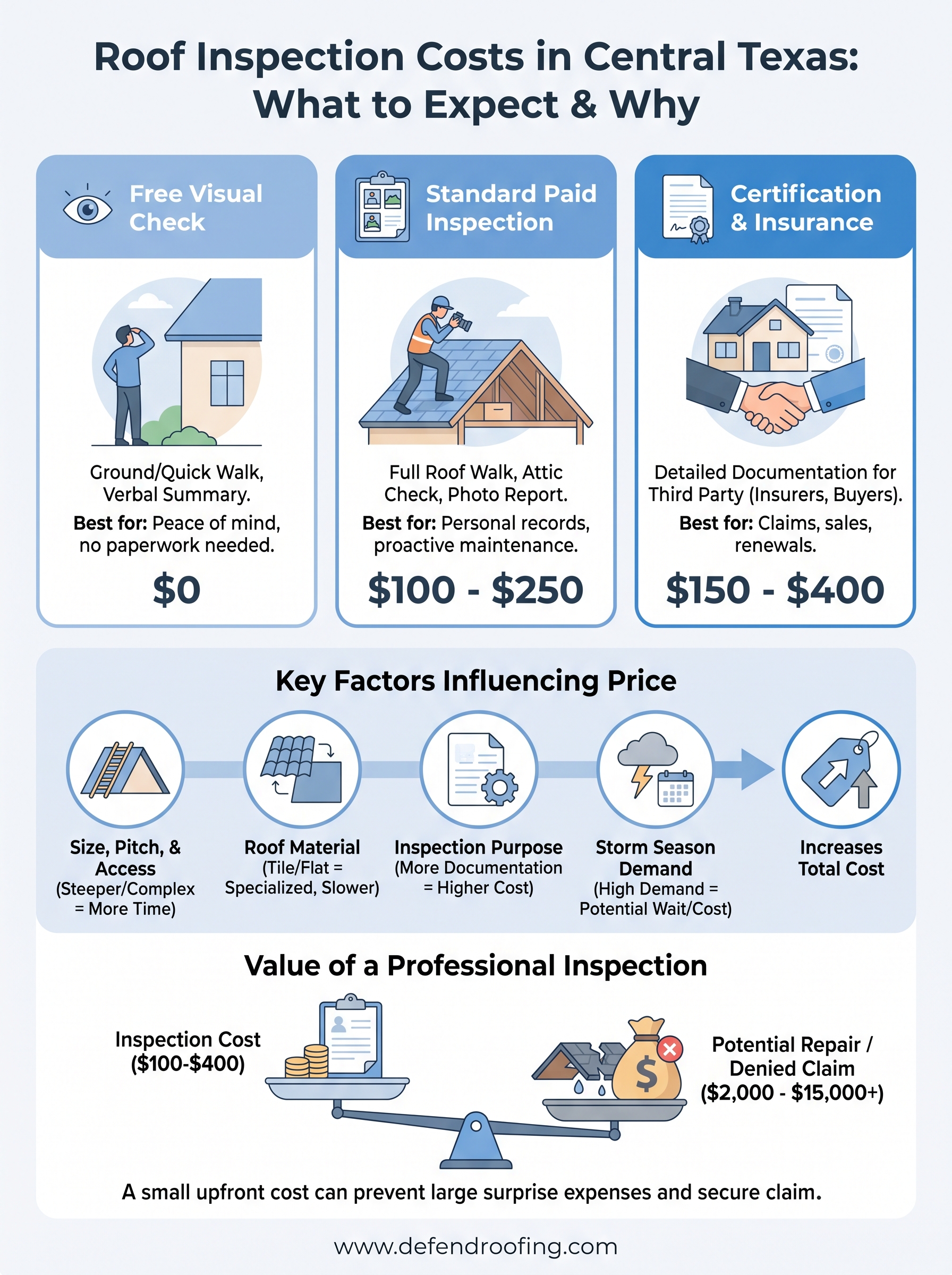
Most Central Texas homeowners land somewhere between free and $250 for a standard inspection, with certification and specialty reports pushing past that when insurance or a home sale is involved. Roof inspection costs make the most sense once you know what you're paying for: a quick visual check, a documented report, or a certification someone else will scrutinize. Skip the guesswork by asking upfront what's included, and match the inspection tier to your actual need instead of grabbing the cheapest number you find.
Your roof rarely fails all at once. It gives you warning signs first, and a documented inspection is how you catch them before they turn into a five-figure repair. If you're ready to find out exactly what your roof needs, without pressure or upselling, call, text, or get an instant quote from Defend Roofing for a real answer about your roof's condition.